⚡ Class 5 Science: Force, Work and Energy

Force ➡️ Work ➡️ Energy. Three big ideas that make everything move!

👆 Tap a button to jump to that section. The blue H · Quiz button opens the chapter quiz.

🎯 Section A: Learning Objectives

🚀 What You Will Learn

Force ➡️ Work ➡️ Energy. Three big ideas that make everything move!

🎯 Learning Objectives

After this chapter, I can:

  1. Explain force as a push or a pull. I can name four types and five effects of force.
  2. Explain work in science. I know that work = force × distance, and its unit is the joule.
  3. Tell the difference between work done and work not done, using daily-life examples.
  4. Describe energy as the ability to do work. I can name its forms and show how one form changes into another.
  5. Separate renewable and non-renewable sources of energy. I can say why the Sun is our main source of energy.

🗺️ Chapter Road Map

⚽ Force ➡️ 🧱 Work ➡️ 🔋 Energy ➡️ ☀️ Sources of Energy

📘 Section B: Concept Notes

🤜 1. What is Force?

A force is a push or a pull. Force can make things move.

  • ⚽ Push: kicking a football, pressing a bell, pushing a swing. A push moves a thing away from you.
  • 🚪 Pull: pulling a door, drawing water from a well, pulling a rope. A pull brings a thing closer to you.

Types of Force

  • 💪 Muscular force: force from our muscles. Example: a bullock pulling a cart, you lifting a school bag.
  • 🍎 Gravity: the pull of the Earth. It pulls everything down. Example: a mango falls from the tree.
  • 🛑 Friction: the force that slows things down when two surfaces rub. Example: a rolling cycle stops after you stop pedalling.
  • 🧲 Magnetic force: the pull or push of a magnet. Example: a magnet picks up pins.

Effects of Force

A force can:

  • ➡️ Make a thing move (kicking a ball at rest).
  • 🛑 Stop a moving thing (a wicketkeeper catching the ball).
  • ⚡ Change speed (pedalling harder, or pressing the brake).
  • ↪️ Change direction (a batsman hitting the ball back).
  • 🫓 Change shape (pressing dough into a roti).

📦 Word Box

  • Force: a push or a pull.
  • Friction: the force that opposes motion between two touching surfaces.
  • Gravity: the force with which the Earth pulls things towards itself.
  • Magnet: an object that pulls iron things.

✅ Remember This: No force, no motion. Force is a push or a pull. It can start, stop, speed up, turn or reshape a thing.

🌟 Fun Fact: Gravity pulls you even now! That is why you stay on the ground and do not float away.

🏠 Try at Home: Take a small ball. (1) Push it gently. (2) Pull a toy car with a string. (3) Squeeze a soft ball or a lump of atta. Write which effect of force you saw each time.

⚠️ Common Mistakes:

  • Thinking force is only a push. A pull is also a force.
  • Thinking friction only stops things. It also helps us walk and grip things.

🧱 2. What is Work?

In daily life, we say “work” for homework or office jobs. In science, work means something special.

Work is done only when a force is applied AND the thing moves in the direction of the force.

Work done ✅ or not done ❌

  • ✅ Lifting a book from the floor: work is done.
  • ✅ Pushing a cycle along the road: work is done.
  • ✅ Pulling a cart: work is done.
  • ❌ Pushing a heavy wall that does not move: no work is done.
  • ❌ Holding a heavy bag and standing still: no work is done.
  • ❌ Sitting and reading a book: no work is done in science.

The Formula

Work = Force × Distance

Force is measured in newton (N). Distance is measured in metre (m). Work is measured in joule (J).

1 joule = 1 newton × 1 metre.

Simple Sums

Situation Force Distance Work
Pushing a box 10 N 3 m 10 × 3 = 30 J
Pulling a cart 20 N 5 m 20 × 5 = 100 J
Lifting a bucket 50 N 2 m 50 × 2 = 100 J
Pushing a wall that does not move 100 N 0 m 100 × 0 = 0 J

📦 Word Box

  • Work: force that moves a thing in the direction of the force.
  • Distance: how far the thing moves.
  • Newton (N): the unit of force.
  • Joule (J): the unit of work and energy.

✅ Remember This: Work needs two things: a force and movement in the direction of that force. If the thing does not move, work done = 0.

🌟 Fun Fact: The joule is named after a scientist, James Prescott Joule. Lifting a small apple up by about 1 metre is roughly 1 joule of work!

🏠 Try at Home: (1) Push a school bag along the floor for 2 steps. Work is done. (2) Now push against a wall for 1 minute. You get tired, but the wall does not move, so no work is done. Write what you feel in each case.

⚠️ Common Mistakes:

  • Saying “I held the bag for an hour, so I did a lot of work.” In science, no movement means no work.
  • Forgetting the units. Always write N, m and J.
  • Mixing up force and distance in the formula. Multiply them. Do not add.

🔋 3. What is Energy?

Energy is the ability to do work. We need energy to run, jump, play, think and even sleep. Just like a car needs petrol, our body needs food for energy. Energy is also measured in joules.

Forms of Energy

  • 🏃 Kinetic energy: energy of a moving thing. Example: a fast cricket ball, a running boy.
  • 🪁 Potential energy: stored energy. Example: a stretched rubber band, a ball held high, a kite string pulled tight.
  • 🔥 Heat energy: makes things warm. Used for cooking, heating water, drying clothes.
  • 💡 Light energy: helps us see. From the Sun, a tube light or a torch.
  • 🔔 Sound energy: made by vibrating things. A drum, a bell, a guitar string.
  • ⚡ Electrical energy: runs fans, lights, TV and the fridge.
  • 🍛 Chemical energy: stored in food, fuel and batteries. Your body uses it to give muscular energy.

Energy Changes Its Form

  • 🔦 Torch: chemical energy (battery) ➡️ electrical ➡️ light + a little heat.
  • 🌀 Ceiling fan: electrical energy ➡️ kinetic energy (moving blades) + a little sound.
  • ☀️ Solar panel: light energy of the Sun ➡️ electrical energy.
  • 🍛 You: chemical energy in food ➡️ muscular (kinetic) energy + heat.
  • 🔔 Doorbell: electrical energy ➡️ sound energy.

Law of Conservation of Energy (in simple words)

Energy cannot be made and it cannot be destroyed. It only changes from one form to another. The total energy always stays the same.

Sources of Energy

  • 🌱 Renewable: never runs out. Sunlight, wind, flowing water.
  • 🛢️ Non-renewable: limited. Takes millions of years to form. Coal, petrol, diesel, natural gas. These are called fossil fuels.

📦 Word Box

  • Energy: the ability to do work.
  • Kinetic energy: energy of motion.
  • Potential energy: stored energy.
  • Conservation: keeping the same. Here it means the total energy does not change.
  • Renewable: can be used again and again, and nature gives it back.
  • Fossil fuel: coal, petrol or gas made from very old plants and animals.

✅ Remember This: Energy = ability to do work. It changes form but is never lost. The Sun is our main source of energy.

🌟 Fun Fact: Sunlight takes about 8 minutes to reach the Earth. The food you eat today got its energy from the Sun through plants!

🏠 Try at Home: Rub your palms together fast for 10 seconds. Your palms feel warm. Your muscular energy changed into heat energy. Then draw one energy change you see at home, like a fan or a TV.

⚠️ Common Mistakes:

  • Saying “energy is used up”. It is changed into other forms. Some becomes heat that we cannot use.
  • Thinking the Sun is non-renewable. For our needs, sunlight is renewable.
  • Mixing up kinetic (moving) and potential (stored) energy.

🔗 4. How Force, Work and Energy Are Connected

🏏 The Story of Rohan’s Cricket Ball

Rohan had his breakfast: a paratha and milk. The food had chemical energy.

In the park, Rohan threw the ball. His muscles used the energy from the food. This gave a force on the ball.

The ball moved 20 metres in the direction of the force. So work was done.

Now the moving ball had kinetic energy. At the top of its path, it had potential energy.

Then Rohan’s friend caught it. His hands stopped the ball, and the energy changed to a little heat and sound. Energy was not lost. It only changed form!

🍛 Energy ➡️ 💪 Force ➡️ 🏏 Work ➡️ 🔄 Energy in a new form
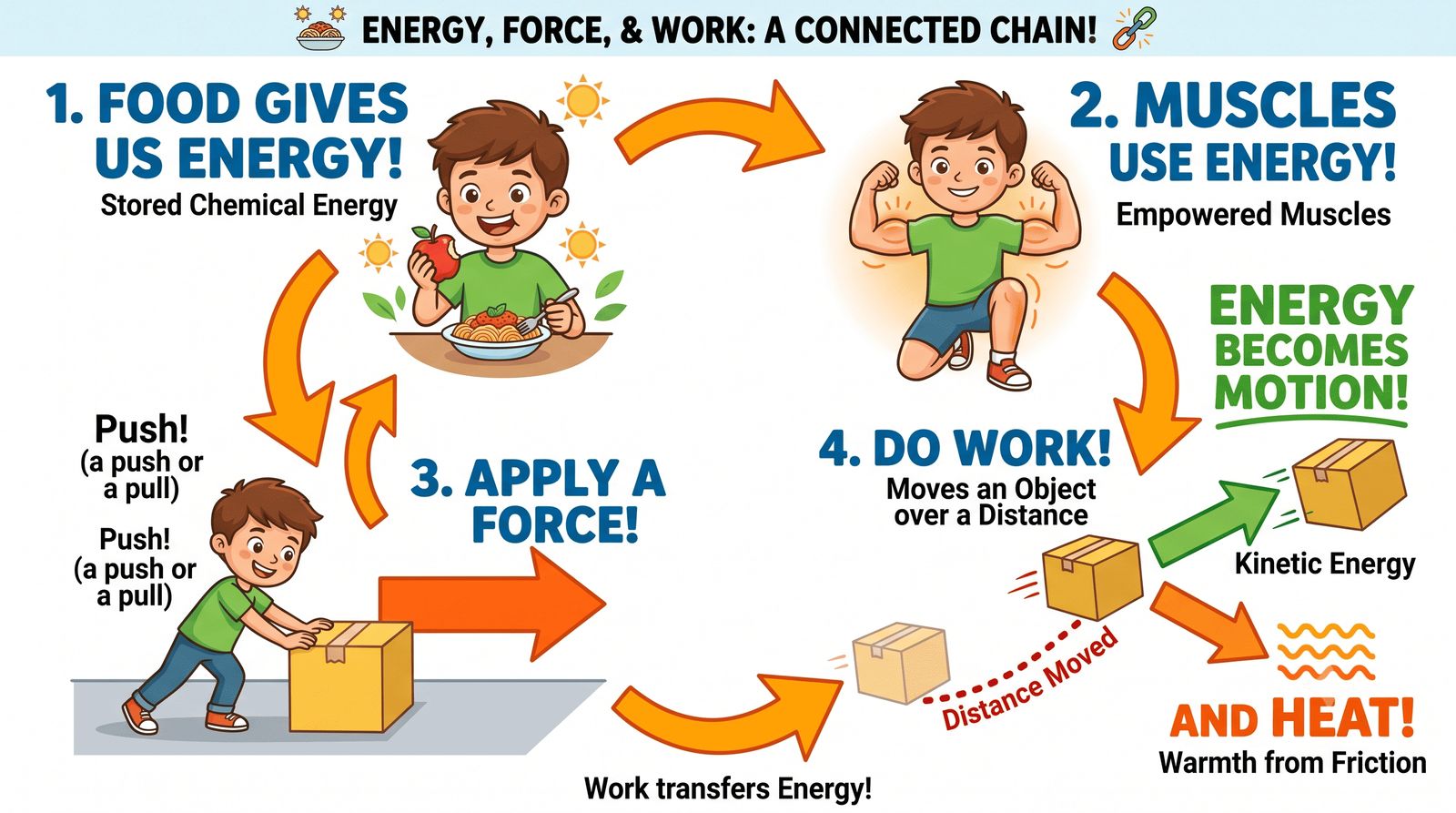
A chain showing food giving energy, muscles using it, a push on a box, and the box moving, which is work, with kinetic energy and heat.

📦 Word Box

  • Transfer: to pass from one place or form to another.
  • Chain: things linked one after another.

✅ Remember This: Energy gives us the ability to apply force. Force that moves a thing does work. Work moves energy from one place or form to another.

🌟 Fun Fact: When you do 100 joules of work, you spend about 100 joules of energy. That is why you feel hungry after playing!

🏠 Try at Home: Pick one daily activity, like riding a cycle or flying a kite. On paper, write the energy chain: where the energy came from, what force was used, whether work was done, and where the energy went.

⚠️ Common Mistakes:

  • Thinking force, work and energy mean the same thing. Force is a push or pull. Work is force moving something. Energy is the ability to do work.
  • Saying a tired person has done work. Tiredness alone does not prove that work was done in science.
🎨 Section C: Picture Cards

🎨 Picture Cards

Look at each picture. Read the note. Then try to explain it in your own words!

🖼️ Card 1: Push vs Pull
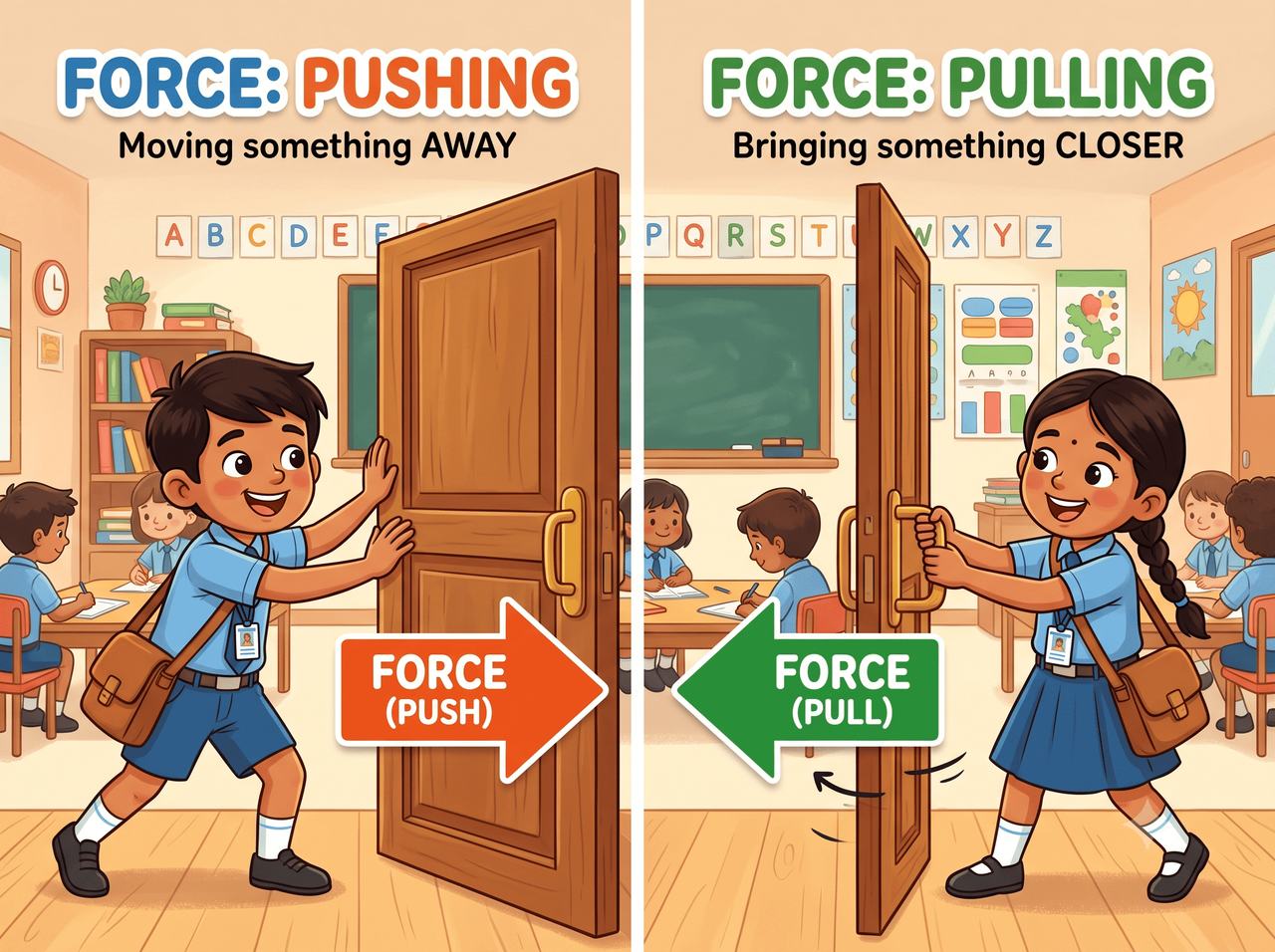
A boy pushing a classroom door away and a girl pulling a classroom door closer, with force arrows.

Note: A push moves a thing away from you. A pull brings it towards you. Kicking a football is a push. Pulling a rope in tug-of-war is a pull.

🖼️ Card 2: Effects of Force
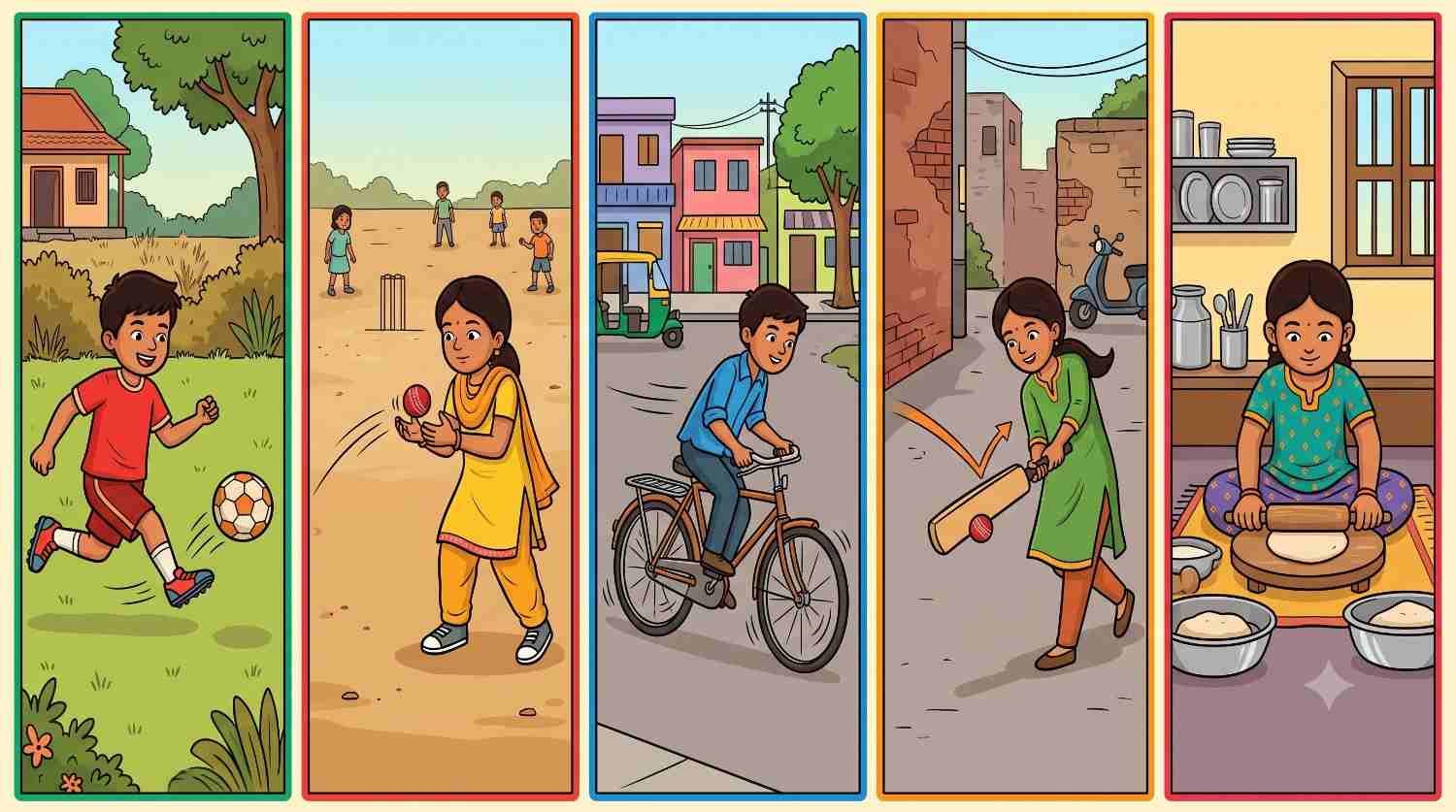
Five pictures showing a force starting, stopping, speeding up, turning and reshaping things.

Note: A force can start, stop, speed up, slow down or turn a thing. It can also change its shape, like pressing atta dough into a flat roti.

🖼️ Card 3: Friction
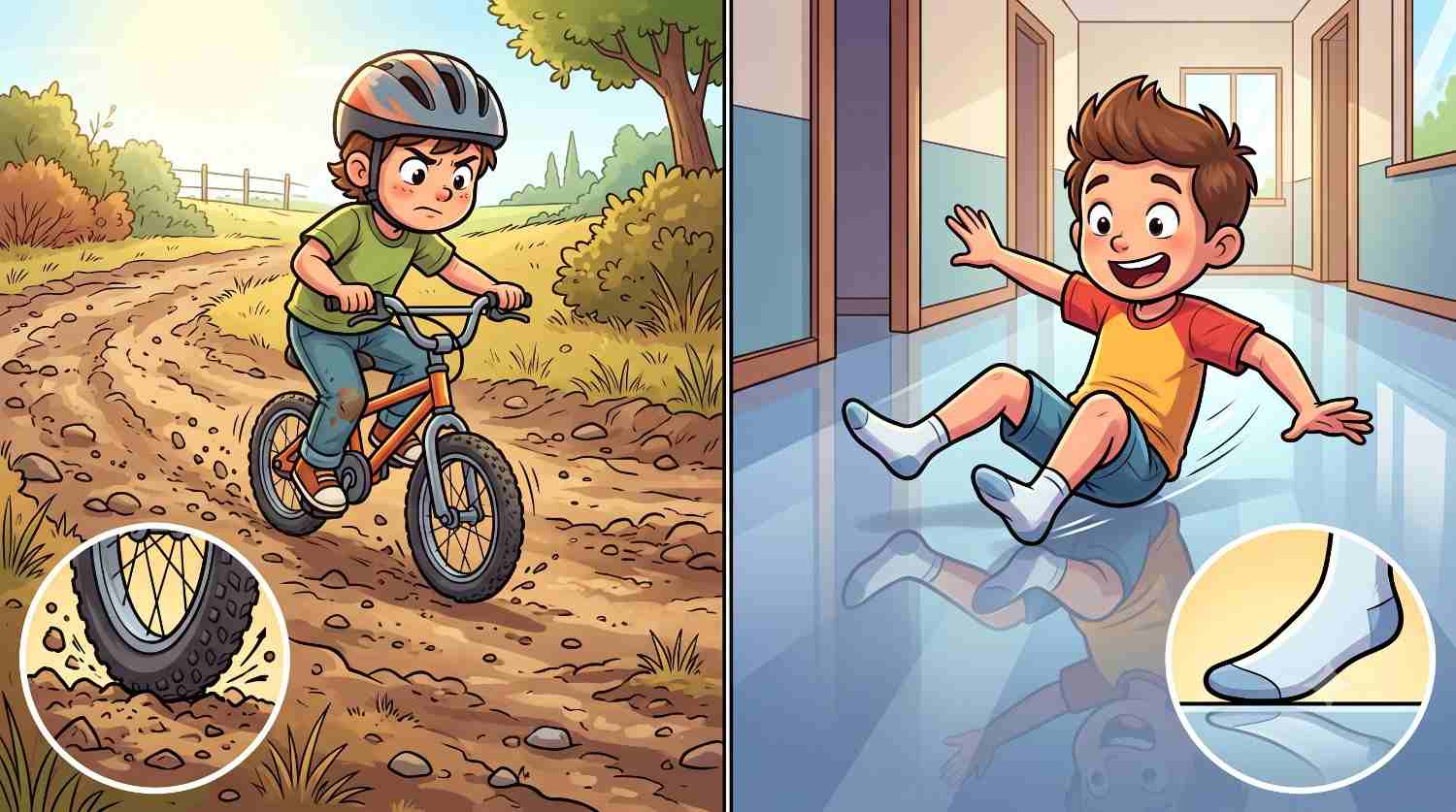
A cycle slowing on a rough road and a child sliding on a smooth floor to show friction.

Note: Friction is the force that opposes motion when two surfaces rub. It slows things down and makes heat. It also helps us walk and grip things.

🖼️ Card 4: Gravity
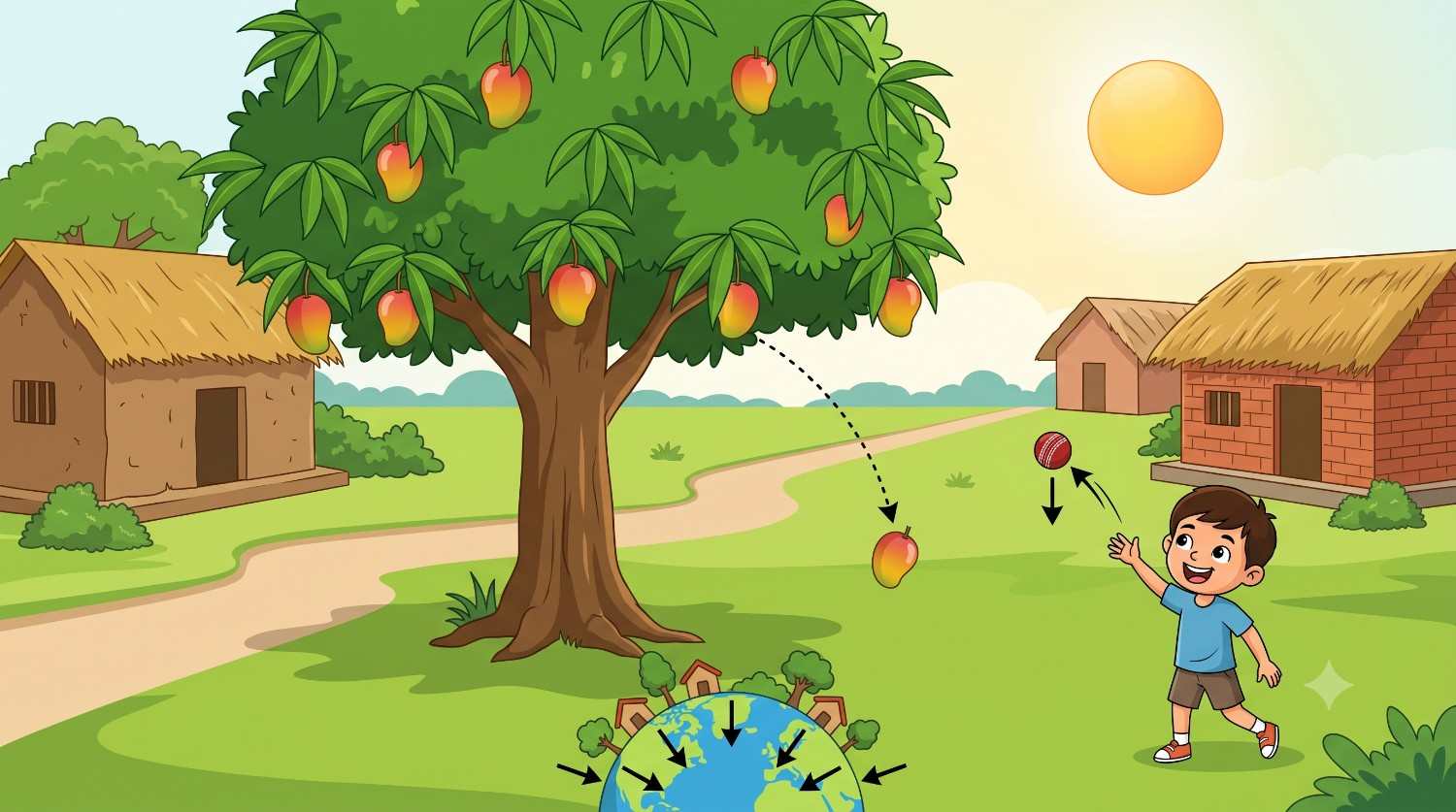
A mango falling from a tree and a ball coming down, showing the Earth's gravity pulling them.

Note: Gravity is the pull of the Earth. It pulls every thing towards the ground. A mango falls from the tree and a ball comes back down because of gravity.

🖼️ Card 5: Work Done vs No Work Done
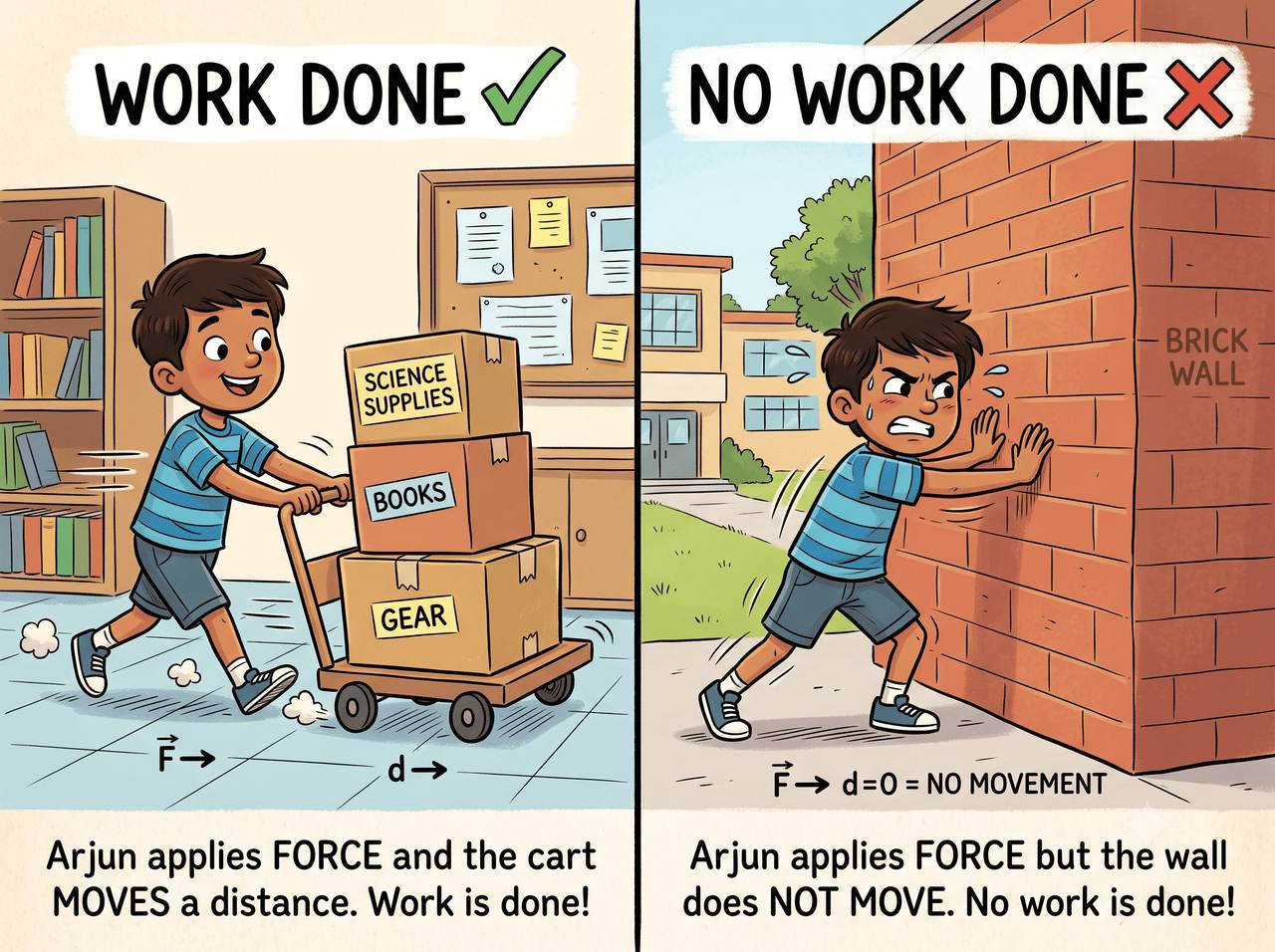
Left: a boy moving a loaded cart, so work is done. Right: the same boy pushing a brick wall that does not move, so no work is done.

Note: Work is done only when a force makes a thing move in the direction of the force. If the thing does not move, the work done is zero, even if you feel tired.

🖼️ Card 6: Kinetic vs Potential Energy
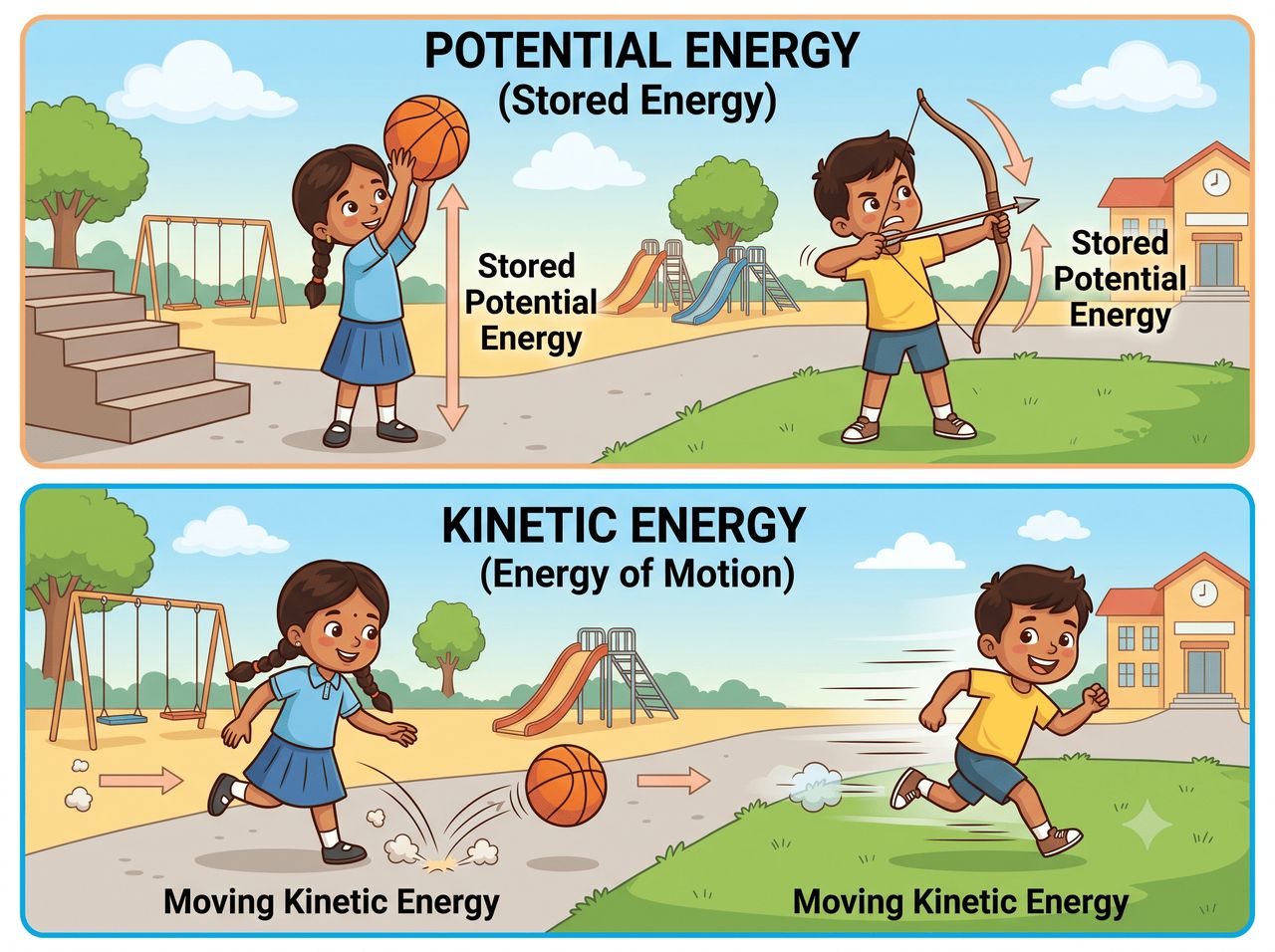
Top: a girl holding a ball high and a boy pulling a bow, showing stored potential energy. Bottom: a girl bouncing a ball and a boy running, showing kinetic energy.

Note: Kinetic energy is the energy of a moving thing. Potential energy is stored energy that waits to be used. A ball held high has potential energy. When you drop it, the energy turns into kinetic energy.

🖼️ Card 7: Energy Conversion
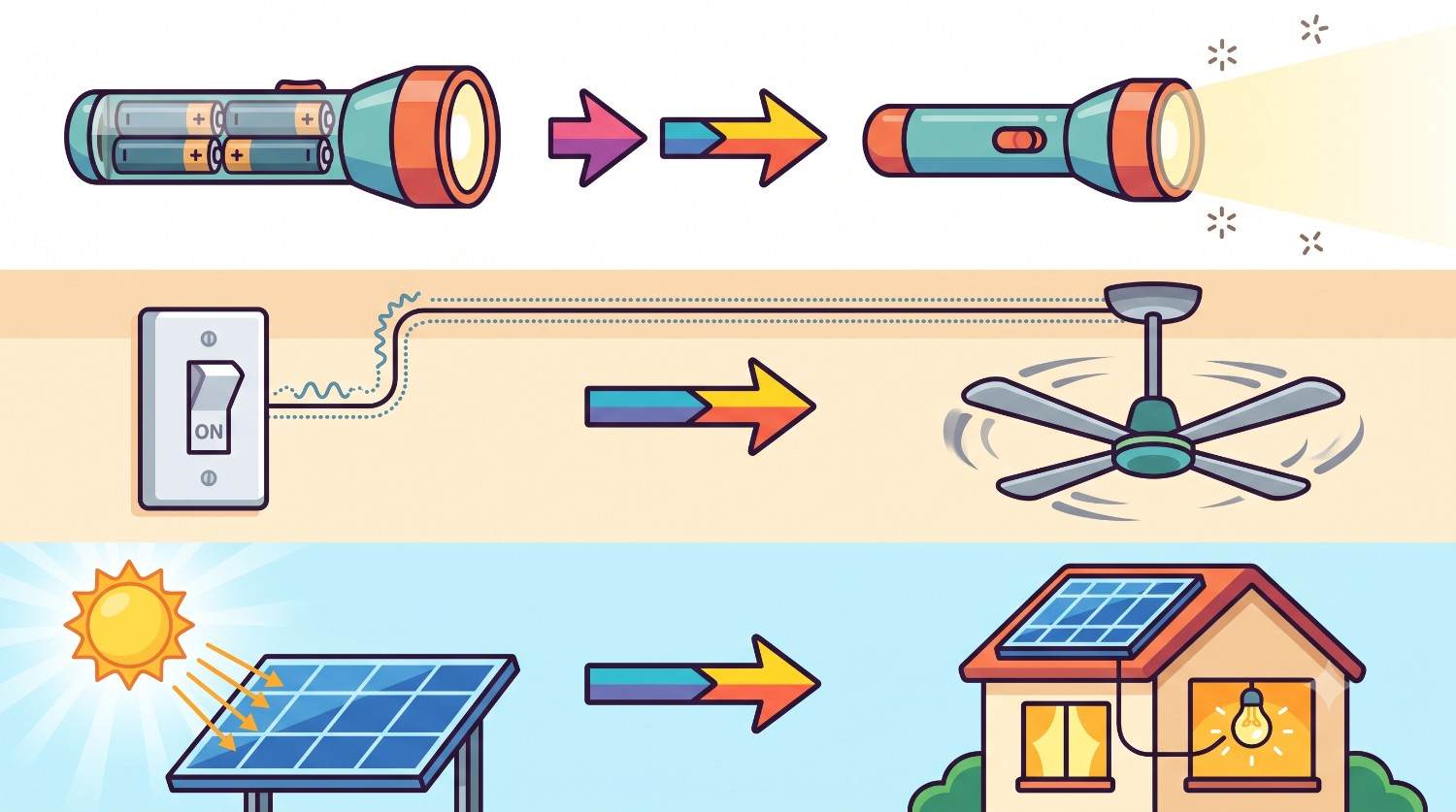
Three examples of energy changing form: torch, ceiling fan and solar panel.

Note: Energy does not disappear. It changes from one form to another. A torch changes battery energy into light. A fan changes electrical energy into movement.

🖼️ Card 8: A Day-in-the-Life Energy Chain
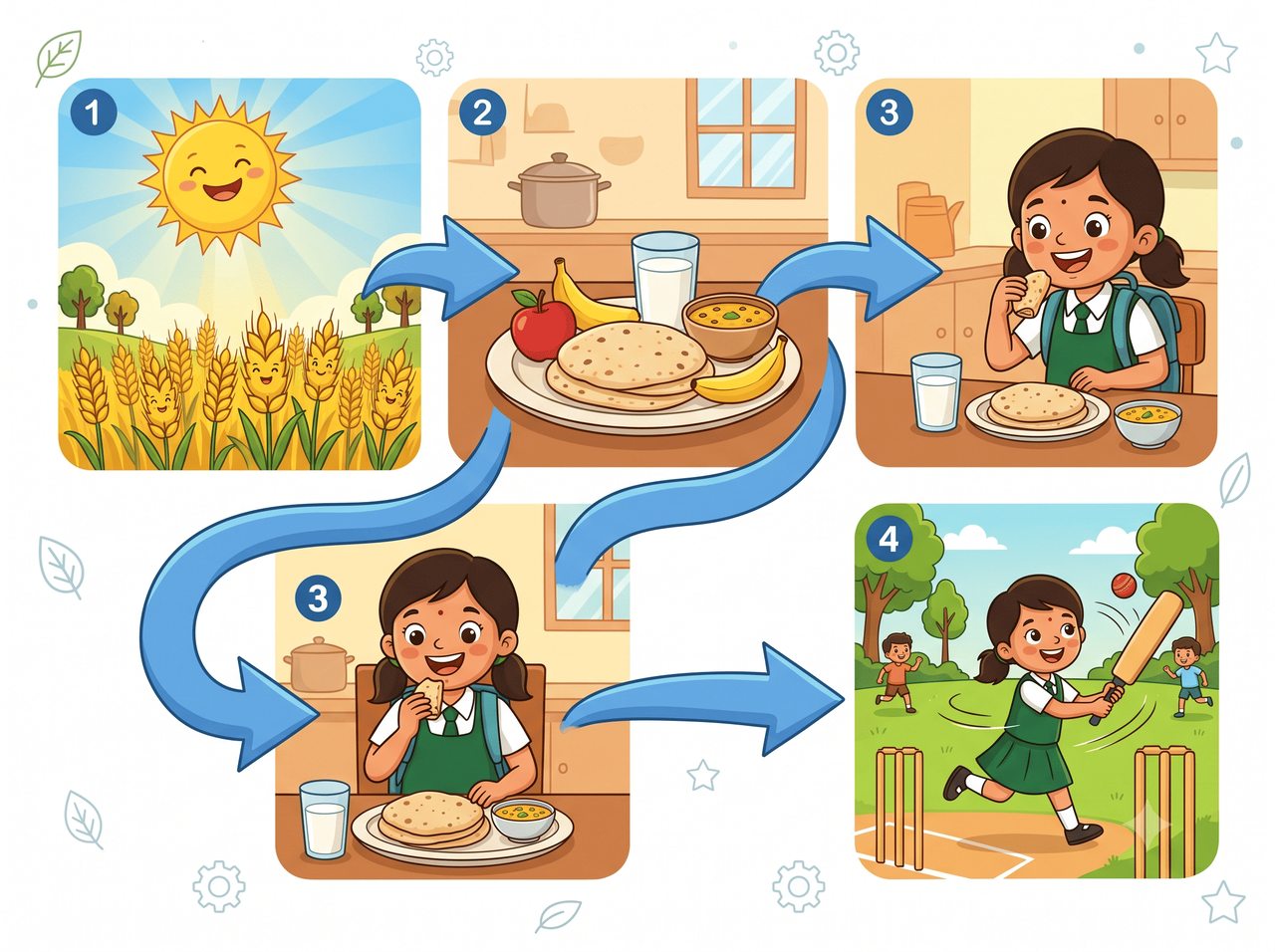
Energy flowing from the Sun to the wheat field, to a roti meal, to a girl eating, to the same girl playing cricket.

Note: The Sun’s light helps plants grow. We eat the food. Our body changes the chemical energy in food into muscular energy to play. Some of it becomes heat, so we feel warm.

🃏 Section D: Flash Cards

🃏 Flash Cards

Read the question. Say your answer. Then tap the card to check!

1. 🤜 What is a force?
Answer: A force is a push or a pull.
2. 🪣 Is drawing water from a well a push or a pull?
Answer: It is a pull. You pull the rope towards you.
3. 💪 Name four types of force.
Answer: Muscular force, gravity, friction and magnetic force.
4. ✅❌ True or False: A force can change the shape of a thing.
Answer: True. Pressing dough with your hands changes its shape.
5. 🚲 Why does a rolling cycle stop after you stop pedalling?
Answer: Friction between the tyres and the road slows it down until it stops.
6. 🍎 What is gravity? Give one example.
Answer: Gravity is the pull of the Earth on everything. Example: a mango falls from the tree.
7. 🎯 Name five effects of force.
Answer: A force can make a thing move, stop it, change its speed, change its direction, or change its shape.
8. 🧱 What is work in science?
Answer: Work is done when a force makes a thing move in the direction of the force.
9. 🔢 Write the formula for work and its unit.
Answer: Work = Force × Distance. The unit is the joule (J).
10. 📦 Sum: You push a box with 10 N for 3 m. How much work is done?
Answer: Work = 10 × 3 = 30 joules.
11. ✅❌ True or False: Holding a heavy bag and standing still is work in science.
Answer: False. The bag does not move, so no work is done.
12. 🧱 Why is no work done when you push a wall that does not move?
Answer: The distance moved is 0. Work = Force × 0 = 0 joules.
13. 🔋 What is energy?
Answer: Energy is the ability to do work. It is measured in joules.
14. 🏃 What is the difference between kinetic and potential energy?
Answer: Kinetic energy is the energy of a moving thing, like a rolling ball. Potential energy is stored energy, like a ball held high.
15. 🔦 Which energy changes happen when you switch on a torch?
Answer: Chemical energy in the battery changes to electrical energy, and then to light energy (and a little heat).
16. 🍛 Where does the energy in our muscles come from?
Answer: From the food we eat. Food gets its energy from the Sun through plants.
17. ♻️ Say the law of conservation of energy in simple words.
Answer: Energy cannot be made or destroyed. It only changes from one form to another.
18. 🌱 Name two renewable and two non-renewable sources of energy.
Answer: Renewable: sunlight and wind. Non-renewable: coal and petrol.
19. ✅❌ True or False: Coal is a renewable source of energy. Why?
Answer: False. Coal takes millions of years to form, so it cannot be replaced easily. It is non-renewable.
20. ☀️ Why is the Sun called our main source of energy?
Answer: The Sun gives light and heat. Plants use sunlight to grow, we eat plants for food energy, and solar panels turn sunlight into electricity.
🧠 Section E: Mind Map

🧠 Mind Map

Everything in this chapter on one page!
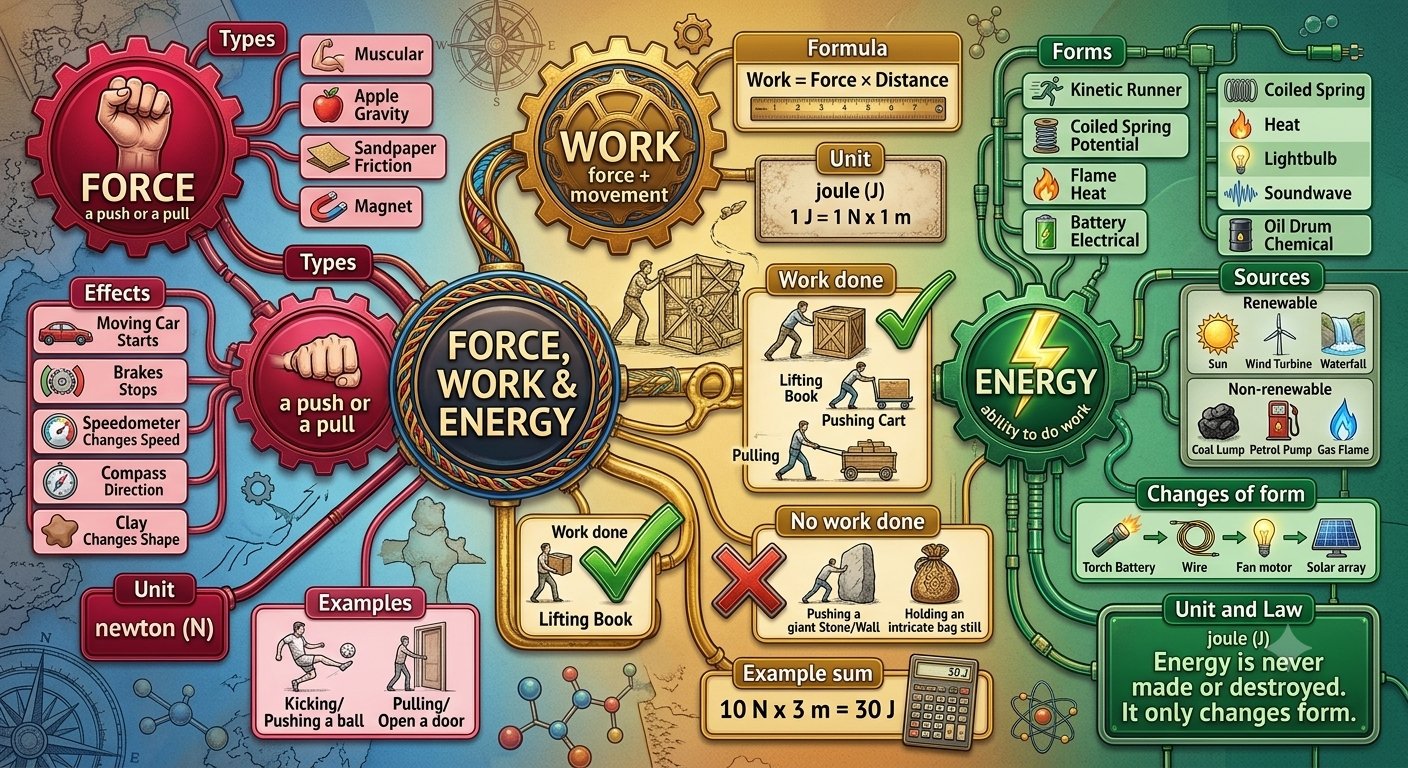
Colourful mind map with Force, Work and Energy in the centre. Force branches to types, effects, unit and examples. Work branches to the formula, unit, work done and no work done. Energy branches to forms, sources, changes of form and the law.

👆 Tip: on a phone, turn the screen sideways or pinch to zoom.

📝 The same mind map in words

⭐ Force, Work & Energy ⭐

⬇️

🤜 FORCE (a push or a pull)

Types
💪 Muscular
🍎 Gravity
🛑 Friction
🧲 Magnetic
Effects
➡️ Starts motion
✋ Stops motion
⚡ Changes speed
↪️ Changes direction
🫓 Changes shape
Unit
newton (N)
Examples
Kicking a football (push)
Pulling a door (pull)

🧱 WORK (force + movement)

Formula
Work = Force × Distance
Unit
joule (J)
1 J = 1 N × 1 m
✅ Work done
Lifting a book
Pushing a cart
Pulling a cart
❌ No work done
Pushing a wall
Holding a bag still
Example sum: 10 N × 3 m = 30 J

🔋 ENERGY (ability to do work)

Forms
🏃 Kinetic
🪁 Potential
🔥 Heat
💡 Light
🔔 Sound
⚡ Electrical
🍛 Chemical
Sources
🌱 Renewable: sunlight, wind, water
🛢️ Non-renewable: coal, petrol, natural gas
Changes of form
🔦 Torch: chemical ➡️ electrical ➡️ light
🌀 Fan: electrical ➡️ kinetic
☀️ Solar panel: light ➡️ electrical
Unit and Law
joule (J)
Energy is never made or destroyed. It only changes form.

📝 Outline Version

  1. Force
    • Meaning: a push or a pull
    • Types: muscular, gravity, friction, magnetic
    • Effects: start, stop, change speed, change direction, change shape
    • Unit: newton (N)
    • Examples: kicking a football, pulling a door
  2. Work
    • Meaning: force makes a thing move in the direction of the force
    • Formula: Work = Force × Distance
    • Unit: joule (J)
    • Work done: lifting a book, pushing a cart
    • No work done: pushing a wall, holding a bag still
  3. Energy
    • Meaning: ability to do work
    • Forms: kinetic, potential, heat, light, sound, electrical, chemical
    • Sources: renewable (sunlight, wind, water); non-renewable (coal, petrol, natural gas)
    • Changes of form: torch, fan, solar panel
    • Law: energy is never made or destroyed, it only changes form
    • Unit: joule (J)
✏️ Section F: Short and Long Answers

Try to write your own answer first. Then tap to see the model answer.

✏️ 10 Short Questions (about 30 to 50 words each)

Short 1. What is a force? Give one example of a push and one of a pull. (tap for the model answer)

A force is a push or a pull. Force can make things move. Kicking a football is a push, and drawing water from a well is a pull.

Short 2. Name four types of force with one example of each. (tap for the model answer)

Muscular force, such as a bullock pulling a cart. Gravity, such as a mango falling from a tree. Friction, such as a rolling cycle stopping. Magnetic force, such as a magnet picking up pins.

Short 3. What is gravity? Why do we not float away from the ground? (tap for the model answer)

Gravity is the pull of the Earth. It pulls everything towards the Earth. That is why a mango falls down from the tree, and why we stay on the ground and do not float away.

Short 4. What is friction? Why does a rolling cycle stop when we stop pedalling? (tap for the model answer)

Friction is the force that slows things down when two surfaces rub against each other. When we stop pedalling, friction between the wheels and the road slows the cycle until it stops.

Short 5. Name five effects of force. (tap for the model answer)

A force can make a thing move, stop a moving thing, change its speed, change its direction and change its shape. For example, pressing dough into a roti changes its shape.

Short 6. What is work in science? When is no work done? (tap for the model answer)

Work is done only when a force is applied and the thing moves in the direction of the force. If a thing does not move, no work is done, even if we push a wall with a big force.

Short 7. Write the formula of work with the units of each quantity. (tap for the model answer)

Work = Force × Distance. Force is measured in newton (N), distance in metre (m) and work in joule (J). One joule is equal to one newton multiplied by one metre.

Short 8. A boy pushes a box with a force of 10 N and moves it 3 m. How much work does he do? (tap for the model answer)

Work = Force × Distance = 10 N × 3 m = 30 J. So the boy does 30 joules of work. We must always write the unit joule after the answer.

Short 9. What is energy? In which unit is it measured? (tap for the model answer)

Energy is the ability to do work. We need it to run, jump, play and think. Like work, energy is measured in joules. A car needs petrol and our body needs food to get energy.

Short 10. What is the Law of Conservation of Energy in simple words? (tap for the model answer)

Energy cannot be made and it cannot be destroyed. It only changes from one form to another, and the total energy always stays the same. For example, in a doorbell, electrical energy changes to sound energy.

📝 10 Long Questions (about 80 to 120 words each)

Long 1. What is a force? Explain with examples the different types of force. (tap for the model answer)

Introduction: A force is a push or a pull. A push moves a thing away from us, and a pull brings it closer.

Main points: Muscular force is the force from our muscles, as when a bullock pulls a cart or we lift a school bag. Gravity is the pull of the Earth, which pulls everything down. Friction is the force that slows things down when two surfaces rub, and it also helps us to walk and grip things. Magnetic force is the pull or push of a magnet. Kicking a football and pressing a bell are pushes, while pulling a door and drawing water from a well are pulls.

Example: A mango falls from the tree because of gravity, and a magnet picks up pins because of magnetic force.

Conclusion: Force is a push or a pull, and it acts on every thing around us.

Long 2. Explain the effects of force with examples. (tap for the model answer)

Introduction: A force cannot be seen, but we can see what it does. Force has five effects.

Main points: A force can make a thing move, such as when we kick a ball at rest. It can stop a moving thing, such as when a wicketkeeper catches the ball. It can change the speed of a thing, such as when we pedal harder or press the brake. It can change the direction of a thing, such as when a batsman hits the ball back. It can also change the shape of a thing, such as when we press dough into a roti.

Example: In a game of cricket, we can see all five effects of force.

Conclusion: Whenever a thing starts moving, stops, speeds up, turns or changes its shape, a force is acting on it.

Long 3. What is friction? Explain its advantages and disadvantages. (tap for the model answer)

Introduction: Friction is the force that opposes motion between two touching surfaces. It acts when two surfaces rub against each other.

Main points: Friction slows things down and can stop them. A rolling cycle stops after we stop pedalling because of friction. People often think friction only stops things, but it also helps us. It lets us walk without slipping and lets us grip things like a pencil or a glass. Without friction, we could not walk or hold anything. Friction also makes surfaces rub away and become warm.

Example: Brakes use friction to stop a cycle, and a rough sole helps a shoe to grip the floor.

Conclusion: Friction is a force that is both a helper and an obstacle in our daily life.

Long 4. What is work in science? Explain with examples when work is done and when it is not done. (tap for the model answer)

Introduction: In daily life we say work for homework or an office job, but in science work means something special.

Main points: Work is done only when a force is applied and the thing moves in the direction of the force. Work = Force × Distance. Force is measured in newton, distance in metre and work in joule. Work is done when we push a box, pull a cart or lift a bucket. Work is not done when we push a wall that does not move, because the distance is 0 m, so the work is 100 × 0 = 0 J.

Example: Pulling a cart with 20 N over 5 m is 20 × 5 = 100 J of work. Holding a bag for an hour is not work in science, because there is no movement.

Conclusion: In science, no movement means no work, and tiredness alone does not prove that work was done.

Long 5. Solve and explain: (a) A force of 50 N lifts a bucket by 2 m. (b) A force of 100 N pushes a wall that does not move. Find the work done in each case. (tap for the model answer)

Introduction: Work is found by multiplying the force by the distance moved in the direction of the force. Work = Force × Distance.

Main points: In (a), the force is 50 N and the distance is 2 m, so the work done is 50 × 2 = 100 J. In (b), the force is 100 N but the wall does not move, so the distance is 0 m. The work done is 100 × 0 = 0 J. In the formula we must multiply force and distance, not add them. We must also write the units N, m and J.

Example: One joule is about the work done in lifting a small apple up by about 1 metre.

Conclusion: Work is done in case (a) but not in case (b), even though a bigger force was used in (b).

Long 6. What is energy? Explain the different forms of energy with examples. (tap for the model answer)

Introduction: Energy is the ability to do work. It is measured in joules, like work.

Main points: Kinetic energy is the energy of a moving thing, like a running boy. Potential energy is stored energy, like a stretched rubber band. Heat energy makes things warm and is used for cooking. Light energy helps us see and comes from the Sun and a torch. Sound energy is made by vibrating things like a bell. Electrical energy runs fans, lights and the TV. Chemical energy is stored in food, fuel and batteries, and our body uses it to give muscular energy.

Example: A fast cricket ball has kinetic energy, and a ball held high has potential energy.

Conclusion: Energy comes in many forms, and every action around us uses some form of energy.

Long 7. Explain with examples how energy changes from one form to another. State the Law of Conservation of Energy. (tap for the model answer)

Introduction: Energy does not stay in one form. It keeps changing into other forms.

Main points: In a torch, chemical energy of the battery changes to electrical energy and then to light with a little heat. In a ceiling fan, electrical energy changes to kinetic energy and a little sound. In a solar panel, light energy of the Sun changes to electrical energy. In our body, the chemical energy of food changes to muscular energy and heat. The Law of Conservation of Energy says that energy cannot be made or destroyed. It only changes form, and the total energy always stays the same.

Example: In a doorbell, electrical energy changes to sound energy.

Conclusion: Energy is never lost. It only changes its form, and some of it becomes heat that we cannot use.

Long 8. What are renewable and non-renewable sources of energy? Give examples. Why should we save non-renewable sources? (tap for the model answer)

Introduction: We get energy from different sources. They are of two kinds, renewable and non-renewable.

Main points: Renewable sources never run out, and nature gives them back. Sunlight, wind and flowing water are renewable. Non-renewable sources are limited and take millions of years to form. Coal, petrol, diesel and natural gas are non-renewable. They are called fossil fuels because they are made from very old plants and animals. Once we use them up, they will not come back in our lifetime. So we should save them and use more sunlight and wind.

Example: A solar panel uses sunlight, and a windmill uses wind, and both are renewable sources.

Conclusion: We should use energy carefully, switch off lights and fans when not in use, and prefer renewable sources.

Long 9. Explain how force, work and energy are connected, with the help of the story of Rohan’s cricket ball. (tap for the model answer)

Introduction: Force, work and energy are different things, but they are connected like links in a chain.

Main points: Rohan had paratha and milk for breakfast, which had chemical energy. His muscles used this energy to give a force on the ball when he threw it. The ball moved 20 metres in the direction of the force, so work was done. The moving ball had kinetic energy, and at the top of its path it had potential energy. When his friend caught the ball, the energy changed to a little heat and sound. Energy was not lost. It only changed form.

Example: When we do 100 joules of work, we spend about 100 joules of energy. That is why we feel hungry after playing.

Conclusion: Energy gives force, force does work, and work changes energy into a new form.

Long 10. Differentiate between force, work and energy. What common mistakes do students make about them? (tap for the model answer)

Introduction: Force, work and energy are related, but they do not mean the same thing.

Main points: Force is a push or a pull, and it is measured in newton. Work is a force moving a thing in the direction of the force, and it is measured in joule. Energy is the ability to do work, and it is also measured in joule. Students often think that force is only a push, but a pull is also a force. They think that energy is used up, but it only changes form. They also think that a tired person has done work, but in science, work needs movement.

Example: Pulling a door is a force. Pulling the door open through 1 m is work. The food we ate gave the energy to do it.

Conclusion: We should learn the three words with their meanings and units, and not mix them up.

🔍 Section G: Case Studies

🔍 Case Studies

Read each story carefully. Answer the 5 questions. Then tap to check your answers!

🐂 Case Study 1: The Bullock Cart

📖 Read the story:

Ramesh lives in a village in Maharashtra. Every morning, his bullock pulls a cart full of wheat sacks to the market. The bullock pulls with a force of 300 N and the cart moves 10 m to the gate. At the gate, a wheel of the cart gets stuck in mud. The bullock now pulls with 400 N, but the cart does not move at all. Ramesh gives the bullock hay and grass to eat.

❓ Answer these 5 questions:

  1. Is the bullock pulling or pushing the cart?
  2. Is work done while the cart moves to the gate? Why?
  3. How much work is done in moving the cart 10 m with a force of 300 N?
  4. The bullock pulls with 400 N, but the cart stays stuck. How much work is done? Explain.
  5. The bullock eats hay and grass. Where did the energy in the hay first come from?
✅ Tap to see the answers
  1. Pulling. The bullock pulls the cart along behind it.
  2. Yes. The bullock applies a force and the cart moves in the direction of the force.
  3. Work = Force × Distance = 300 × 10 = 3000 J.
  4. 0 J. The cart does not move, so distance = 0 and work = 400 × 0 = 0 J. The bullock may feel tired, but no work is done in science.
  5. From the Sun. Plants use sunlight to grow, and the bullock gets chemical energy from the plants. Its body changes this into muscular energy.

☀️ Case Study 2: Solar Panels at Priya’s School

📖 Read the story:

Priya’s school in Mumbai has solar panels on its roof. One afternoon, there is a power cut in the area. The lights and fans in the classrooms keep working because the school uses solar electricity stored in batteries. Earlier, the school used a diesel generator, which was noisy and made black smoke. On a cloudy, rainy day, Priya notices that fewer lights work.

❓ Answer these 5 questions:

  1. Which energy do the solar panels use?
  2. Which energy change takes place in a solar panel?
  3. Is solar energy renewable or non-renewable? Why?
  4. Why do fewer lights work on a cloudy, rainy day?
  5. Give two reasons why solar panels are better than a diesel generator.
✅ Tap to see the answers
  1. Solar energy, which is the light energy of the Sun.
  2. Light energy changes into electrical energy.
  3. Renewable. Sunlight is given by nature again and again and never runs out.
  4. Less sunlight reaches the panels, so less electrical energy is made.
  5. Any two: no smoke, no noise, never runs out, cleaner for the environment. Diesel is a non-renewable fossil fuel and it will run out.

🏏 Case Study 3: Arjun Hits a Six

📖 Read the story:

Arjun is playing cricket in the park near his building. The bowler throws the ball and it comes fast towards him. Arjun hits it with his bat and the ball flies high for a six. At the highest point, the ball stops rising for a moment and then falls down. It lands on the grass, rolls slowly and stops. Before the game, Arjun ate dal, rice and roti for lunch.

❓ Answer these 5 questions:

  1. When Arjun hits the ball with the bat, is it a push or a pull? Which effects of force can you see?
  2. Which kind of energy does the ball have at its highest point?
  3. Which force brings the ball back down to the ground?
  4. The ball rolls on the grass and stops. Which force stops it? What happens to its energy?
  5. Where did Arjun get the energy to hit the ball?
✅ Tap to see the answers
  1. A push. The force changes the speed and the direction of the ball.
  2. Potential energy, because it is stored energy of the ball high above the ground.
  3. Gravity, the pull of the Earth.
  4. Friction between the ball and the grass stops it. The energy is not destroyed. It changes into heat (and a little sound).
  5. From the food he ate. The chemical energy in dal, rice and roti changed into muscular energy.

📦 Case Study 4: Shifting Day

📖 Read the story:

Meena’s family is shifting to a new flat. Her father tries to push a heavy almirah alone, but it does not move. Then her two uncles come to help. Together they push with a combined force of 150 N and the almirah slides 2 m across the floor. Meena stands near the door holding a heavy bag while she waits for them. Everyone feels tired by the evening.

❓ Answer these 5 questions:

  1. Why did the almirah not move when Meena’s father pushed it alone?
  2. Why did the almirah move when the uncles joined in?
  3. How much work is done when a force of 150 N moves the almirah 2 m?
  4. Meena is holding a heavy bag and standing still. Is she doing work in science? Why?
  5. Which force makes it hard to slide the almirah? Suggest one way to make it easier.
✅ Tap to see the answers
  1. His force was too small to overcome the weight of the almirah and the friction with the floor.
  2. The forces of all three added together. The combined force was strong enough to move it.
  3. Work = Force × Distance = 150 × 2 = 300 J.
  4. No. The bag does not move, so no work is done, even though she feels tired.
  5. Friction. Put the almirah on a thick cloth or on a trolley with wheels. This reduces friction.

🌬️ Case Study 5: A Visit to the Wind Farm

📖 Read the story:

Ravi’s class goes on a school trip to a wind farm on a windy hill in Maharashtra. Many tall windmills stand in a row and their huge blades spin slowly. The guide says that the spinning blades help to make electricity, which goes to homes and buildings. Ravi asks why there are no windmills near his city school. The guide says that the wind in the city is weak and not steady.

❓ Answer these 5 questions:

  1. Which energy turns the blades of the windmill?
  2. Write the energy change that happens in a windmill.
  3. Why are wind farms built on hills or in open fields?
  4. Is wind energy renewable or non-renewable? Why?
  5. Why can we not use wind energy everywhere?
✅ Tap to see the answers
  1. Wind energy, the energy of moving air.
  2. Wind energy changes into the movement (kinetic energy) of the blades, and then into electrical energy.
  3. There the wind is strong and blows steadily, so the blades spin well.
  4. Renewable. Wind is made by nature again and again and never runs out.
  5. In many places the wind is weak or does not blow all the time, so not enough electricity can be made.

✅ Section H: Quiz

The quiz for this chapter is a separate step, right after this lesson. You get your score straight away, with the correct answer and the reason for each question.

Start the quiz ➜