👆 Tap a button to jump to that section, then tap the heading to open it. The blue H · Quiz button opens the chapter quiz.
🎯 A · Learning Objectives

🎯 What you will learn
- Identify and group everyday sounds from nature, people, animals and machines.
- Explain how pleasant and unpleasant sounds and music affect our mood.
- Classify musical instruments as blowing, beating or vibrating strings.
- Describe how vibrations make sound and carry it to our ears and brain.
- Explain why warning sounds matter, how loud noise harms us and suggest ways to reduce noise pollution.
Think about your alarm clock, birds singing, a school bell, footsteps and traffic. Which sounds are loud? Which are soft? Which make you feel happy or uncomfortable? Now close your eyes for one minute and count the sounds you can hear.
🗺️ Road map
| Section | What you will do |
| B · Concept Notes | Read the story and the four topics |
| C · Picture Cards | Look at 8 picture cards |
| D · Mind Map | See the whole chapter on one page |
| E · Flash Cards | Flip 20 cards to revise |
| F · Answers | Practise 10 short and 5 long answers |
| G · Case Studies | Solve 5 real-life stories |
| H · Quiz | Take the 25-question quiz |
📘 B · Concept Notes
Aarav lives in a flat in Dadar, Mumbai. On Sunday morning he woke up before his alarm. Outside, a milkman rang his cycle bell. In the kitchen, the pressure cooker whistled and the mixer grinder roared. A crow cawed on the balcony, and far away a local train rumbled past. Then the temple bell rang, ting, ting, ting. Aarav smiled. “I have not even left my bed, and I have heard ten different sounds!” he said.

Think: Which sounds in the story came from living things? Which came from machines or objects?
Topic 1: Everyday Sounds and Foley Sounds
🌍 Sounds All Around Us
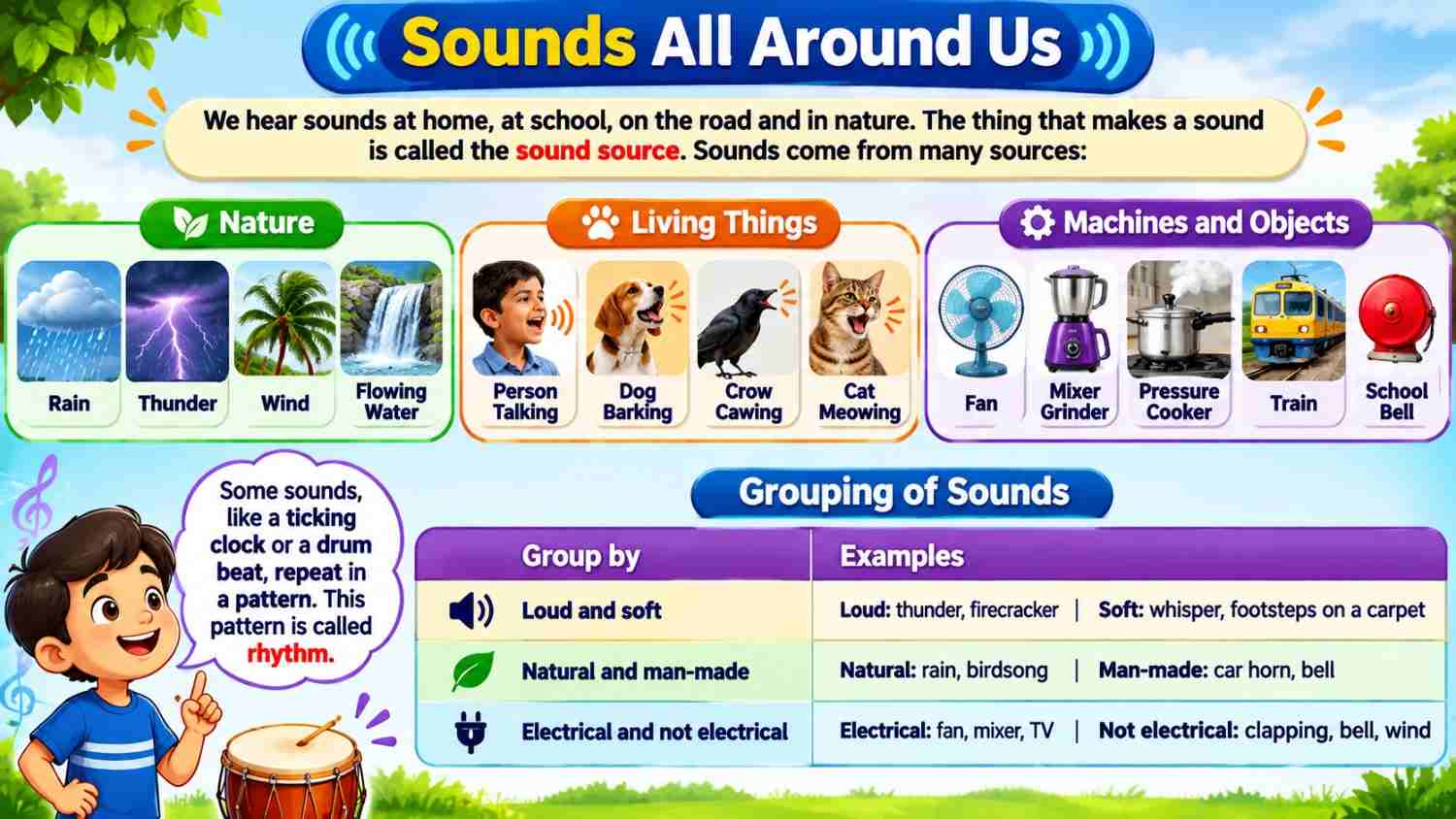
We hear sounds at home, at school, on the road and in nature. The thing that makes a sound is called the sound source. Sounds come from many sources:
- Nature: rain, thunder, wind, flowing water and the rustling of leaves.
- Living things: a person talking, a dog barking, a crow cawing, a cat meowing.
- Machines and objects: a fan, a mixer grinder, a pressure cooker, a train, a school bell.
We can group sounds in many ways. For example: loud and soft, high and low, pleasant and unpleasant, natural and man-made, or sounds made by electrical things and sounds made without electricity. Some sounds, like a ticking clock or a drum beat, repeat in a pattern. This pattern is called rhythm.
| Group by | Examples |
| Loud and soft | Loud: thunder, firecracker. Soft: whisper, footsteps on a carpet |
| Natural and man-made | Natural: rain, birdsong. Man-made: car horn, bell |
| Electrical and not electrical | Electrical: fan, mixer, TV. Not electrical: clapping, bell, wind |
🐺 Animals Use Sound
Animals use sounds to talk to each other. Birds sing to call their friends and warn of danger. A wolf howls to tell the pack where it is, and the other wolves howl back, even from far away. Whales and elephants also use sounds that travel a long distance to stay in touch.
🎬 Movie Sounds Made by Foley
In films, small sounds like footsteps often get lost, or the action is so loud that they cannot be heard. A Foley artist fixes this. Foley artists work in a quiet studio and use everyday objects to make sounds that match what is on the screen:
- Breaking bones: snapping celery or carrot sticks.
- Rustling clothes: rubbing pieces of cloth together.
- Footsteps: walking in shoes on a tray of sand, leaves or gravel.
A film character walks across a wooden floor. A Foley artist records the footsteps separately in the studio and adds them to the film.
Without Foley sounds, a car chase with no screeching tyres or a fight with no punches would feel empty and boring.
Sound source: the thing that makes a sound
Rhythm: a pattern of sounds that repeats
Foley artist: a person who makes film sound effects with everyday objects
Sound effect: a special sound added to a film or show
Sounds come from nature, living things and machines. We can group them in many ways. Foley artists make film sounds with everyday objects.
Plants can make sounds too! Scientists have recorded very faint clicking sounds from plants that were short of water. These clicks are too soft and too high for our ears to hear. Rustling leaves, on the other hand, are made by the wind, not by the plant.
Sit quietly for two minutes with your eyes closed. Write down every sound you hear. Then group them in two different ways. Next, with a parent, record a ‘movie sound’ on a phone using things from the kitchen and ask your family to guess what made it.
Many children think only living things make sound. Wind, rain, bells and machines make sound too. Also, a quiet place is not a place with no sound. It just has soft sounds.
Topic 2: Pleasant Sounds, Unpleasant Sounds and Music
😊 Pleasant and Unpleasant Sounds
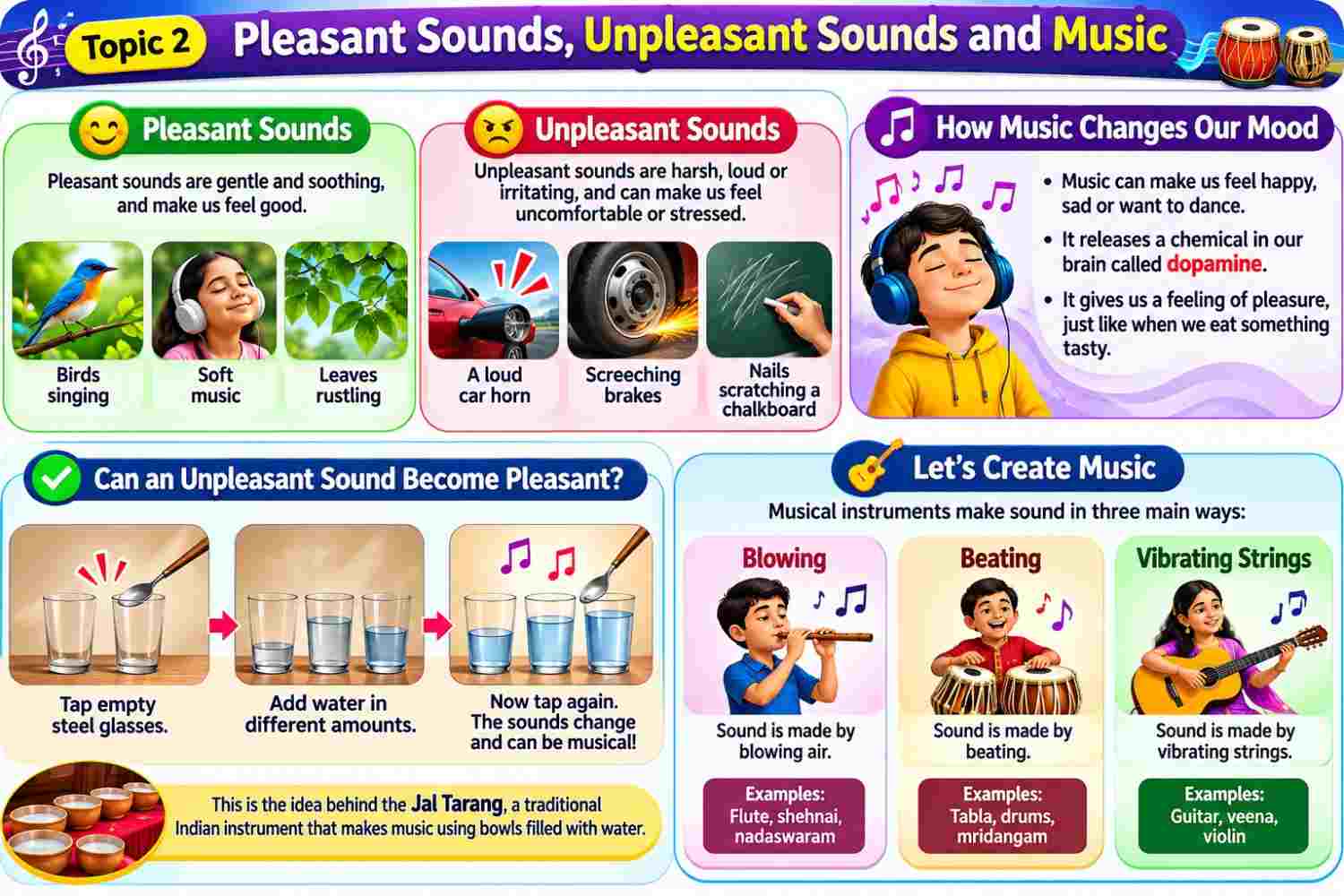
Pleasant sounds are gentle and soothing, and they make us feel good. They often have a nice rhythm or melody, like birds singing, soft music or leaves rustling in the wind.
Unpleasant sounds are harsh, loud or irritating. They can make us feel uncomfortable or stressed, like screeching brakes, a loud horn or nails scratching a chalkboard.
| Pleasant sounds | Unpleasant sounds |
| Birds singing | Screeching brakes |
| Soft music | A loud car horn |
| Leaves rustling in the wind | Nails scratching a chalkboard |
The same sound can feel pleasant to one person and unpleasant to another. A loud dhol at a festival may make you want to dance, but it can disturb a sleeping baby. Even an unpleasant sound can be useful. The sharp ring of an alarm clock wakes us up on time.
🎶 How Music Changes Our Mood
Music can make us feel happy, sad or want to dance. When we listen to music we like, our brain releases a chemical called dopamine. It gives us a feeling of pleasure, just like when we eat something tasty. We can enjoy music even if we do not understand the words, because the beat, the tune and the rhythm speak to us. Film makers use fast music for action scenes and slow music for sad scenes to change how the audience feels.
🥣 Can an Unpleasant Sound Become Pleasant?
Tap empty steel glasses gently with a spoon. The sound is harsh. Now add some water to the glasses in different amounts and tap again. The sounds change and now you can make a tune! This is the idea behind the Jal Tarang, a traditional Indian instrument made of bowls filled with water and struck gently with sticks.
🎺 Let’s Create Music
Musical instruments make sound in three main ways:
| How sound is made | Examples |
| Blowing | Flute, shehnai, nadaswaram |
| Beating | Tabla, drums, mridangam |
| Vibrating strings | Guitar, veena, violin |
Each instrument has its own special sound. You can change the sound by changing something, like tightening a string or changing how much water is in a bowl.
Pleasant sound: a gentle sound that makes us feel good
Unpleasant sound: a harsh sound that irritates us
Dopamine: a chemical in the brain that gives a feeling of pleasure
Jal Tarang: an Indian instrument made of bowls with water
Pleasant or unpleasant depends on the sound, the person and the situation. Music can change our mood. Instruments make sound by blowing, beating or vibrating strings.
The Jal Tarang is one of the oldest instruments of India. The musician arranges the bowls in a half circle and plays tunes by tapping them with two light sticks.
With an adult nearby, take 5 or 6 steel glasses and a steel spoon. Tap the empty glasses gently. Then add different amounts of water and tap again. Which sounds are more pleasant now? Do not tap hard.
Loud does not always mean unpleasant, and soft does not always mean pleasant. A loud drum at a festival can be joyful, while soft scratching on a board can be very irritating. Also, not everyone finds the same sound pleasant, because our experiences and likes are different.
Topic 3: How Sound Travels
〰️ Sound Is Made by Vibrations
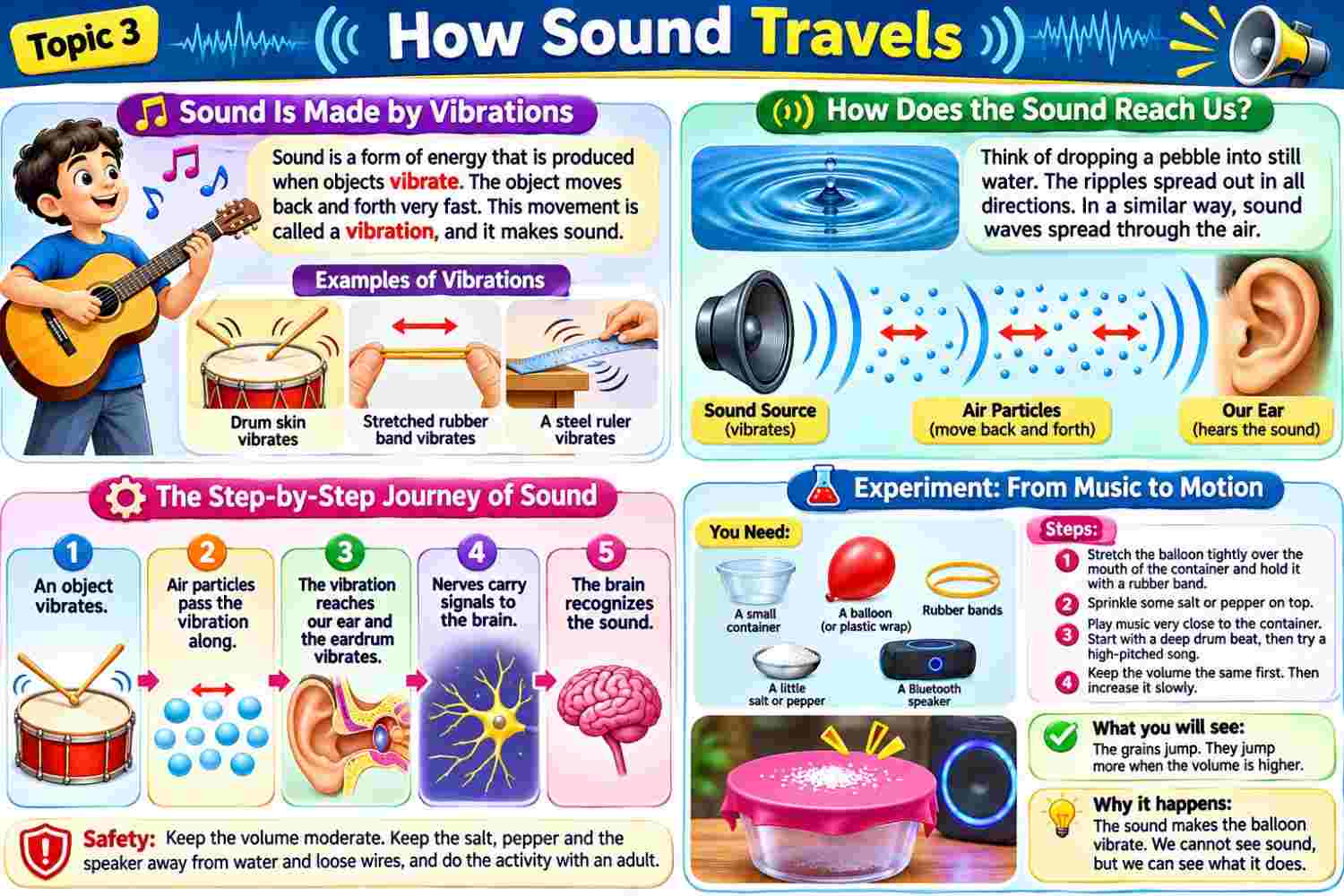
Sound is a form of energy that is produced when objects vibrate. When we talk, clap, pluck a rubber band or strike a steel ruler, the object moves back and forth very fast. This movement is called a vibration, and it makes sound.
🌊 How Does the Sound Reach Us?
Think of dropping a pebble into still water. The ripples spread out in all directions. Sound waves spread in the same way from the source through the air. Air is full of tiny, invisible particles. When something vibrates, it makes the nearby air particles move back and forth. They bump into their neighbours and pass the energy along, like a row of falling dominoes. In this way the energy of the sound travels from the source to our ears.
| Step | What happens |
| 1 | An object vibrates |
| 2 | Air particles pass the vibration along |
| 3 | The vibration reaches our ear and the eardrum vibrates |
| 4 | Nerves carry signals to the brain |
| 5 | The brain recognises the sound |
🔬 Experiment: From Music to Motion
You need: a small container, a balloon or plastic wrap, rubber bands, a little salt or pepper and a Bluetooth speaker.
- Stretch the balloon tightly over the mouth of the container and hold it with a rubber band.
- Sprinkle some salt or pepper on top.
- Play music very close to the container. Start with a deep drum beat. Then try a high-pitched song.
- Keep the volume the same first. Then increase it slowly.
Safety: Keep the volume moderate. Keep the salt, pepper and the speaker away from water and loose wires, and do the activity with an adult.
What you will see: The grains jump. They jump more when the volume is higher. If you touch the side of the container gently, you can feel a tiny movement. This is because the sound makes the balloon vibrate. We cannot see sound, but we can see what it does.
Vibration: fast back-and-forth movement
Medium: the material, like air, that carries sound
Eardrum: a thin skin inside the ear that vibrates when sound reaches it
Energy: the ability to do work or make things move
No vibration, no sound. Sound travels as vibrations through a medium like air, makes the eardrum vibrate, and the brain understands it.
There is no air in space, so there is no sound there. Astronauts cannot hear each other directly in space. They speak to each other using radio.
Place your fingers gently on your throat and hum. Can you feel a tickle? That is your voice box vibrating. Then do the balloon experiment with a parent. Keep the volume low and keep the speaker away from water.
Some children think the air itself travels from the speaker to our ear. It does not. Only the vibration (the energy) travels. The air particles just move back and forth a little.
Topic 4: Warning Sounds, Loud Noise and Noise Pollution
🚨 Sounds of Safety
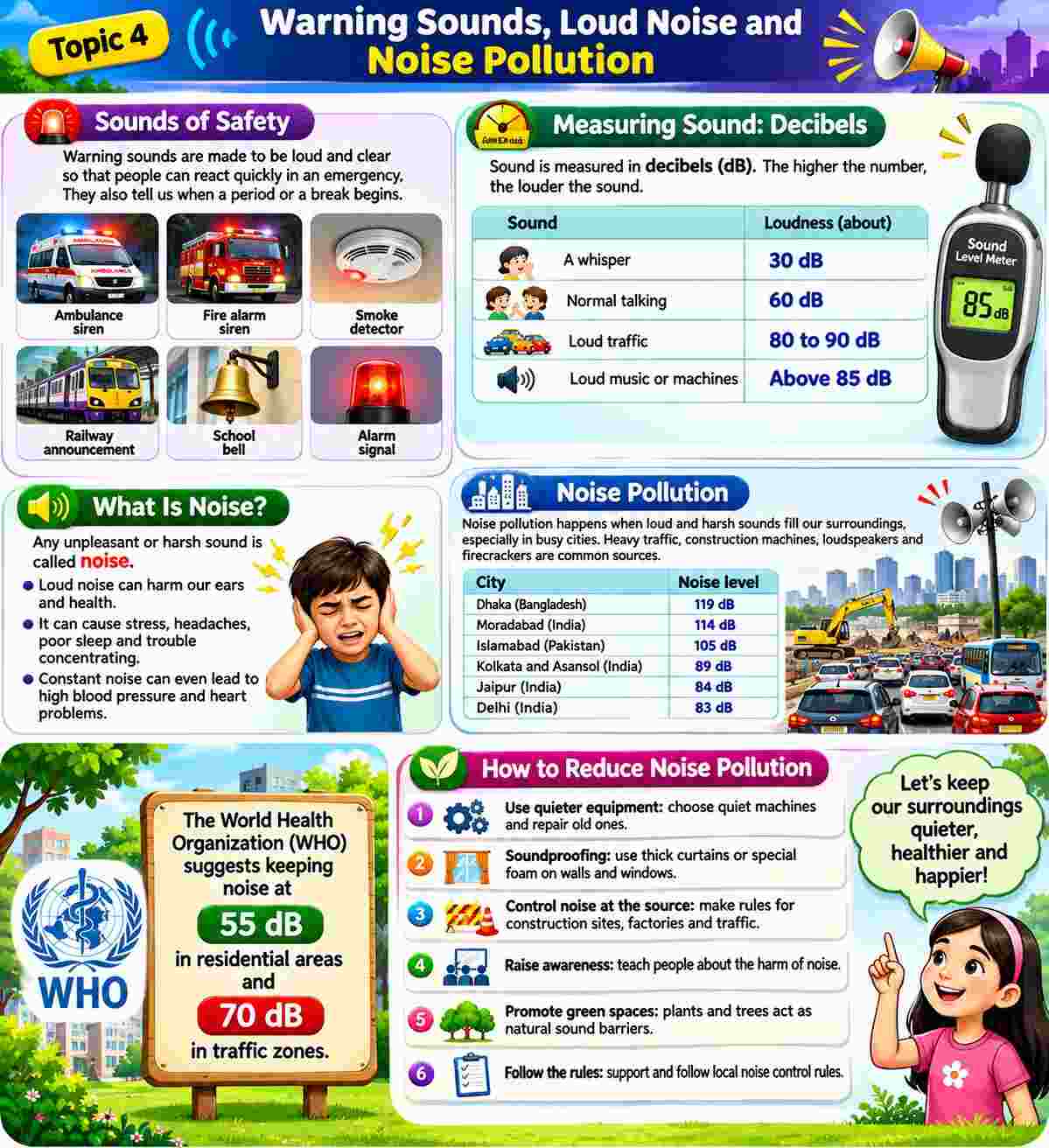
Warning sounds are made to be loud and clear so that people can react quickly in an emergency. Examples are an ambulance siren, a fire alarm, a smoke detector and the loud beep before an announcement at a railway station. A school bell is also a signal. It tells us when a period or a break begins. A siren may sound loud and unpleasant, but it is helpful because it warns people of an emergency. When we hear a siren, we move aside for the ambulance. When we hear a fire alarm, we leave the building calmly. Hospitals and libraries use softer sounds or flashing lights so they do not disturb people.
📏 Measuring Sound: Decibels
Sound is measured in decibels (dB). The higher the number, the louder the sound.
| Sound | Loudness (about) |
| A whisper | 30 dB |
| Normal talking | 60 dB |
| Loud traffic | 80 to 90 dB |
| Loud music or machines | Above 85 dB can harm the ears if heard for a long time |
📢 What Is Noise?
Any unpleasant or harsh sound is called noise. Loud noise can harm our ears and our health. Hearing very loud sounds for a long time can damage the ears and lead to hearing loss. It can also cause stress, headaches, poor sleep and trouble concentrating. Constant noise from traffic or construction can even lead to high blood pressure and heart problems. Animals suffer too, because their hearing is often more sensitive than ours.
🏙️ Noise Pollution
Noise pollution happens when loud and harsh sounds fill our surroundings, especially in busy cities. Heavy traffic, construction machines, loudspeakers and firecrackers are common sources. A 2022 report by the United Nations Environment Programme (UNEP) found very high noise levels in several South Asian cities. Your textbook gives these figures:
| City | Noise level |
| Dhaka (Bangladesh) | 119 dB |
| Moradabad (India) | 114 dB |
| Islamabad (Pakistan) | 105 dB |
| Kolkata and Asansol (India) | 89 dB |
| Jaipur (India) | 84 dB |
| Delhi (India) | 83 dB |
Your textbook also says that the World Health Organization (WHO) suggests keeping noise at 55 dB in residential areas and 70 dB in traffic zones.
🔇 How to Reduce Noise Pollution
- Use quieter equipment: choose quiet machines and repair old ones.
- Soundproofing: use thick curtains or special foam on walls and windows.
- Control noise at the source: make rules for construction sites, factories and traffic.
- Raise awareness: teach people about the harm of noise.
- Promote green spaces: plants and trees act as natural sound barriers.
- Follow the rules: support and follow local noise control rules.
Decibel (dB): the unit for measuring how loud a sound is
Noise: an unpleasant or harsh sound
Noise pollution: too much loud, harsh sound in our surroundings
Soundproofing: ways to block sound from getting in or out
Warning sounds are loud on purpose. Sounds above 85 dB can harm our ears. We can reduce noise with quiet machines, soundproofing, trees, awareness and rules.
Sound engineers can find faults in railway tracks just by listening! Special microphones and sensors pick up odd sounds from damaged wheels or loose rails, so that repairs can be done before they cause bigger problems.
Walk around your home or school with an adult and list the sources of noise. Choose one and write how you could make it quieter. Then make a poster on chart paper to teach people how to reduce noise pollution. Practise what to do when a fire alarm rings: stay calm, walk, do not run or push.
Some children think a sound is harmless if they enjoy it. But very loud music, even our favourite song, can damage our ears if we listen for too long. Keep the volume low, especially with earphones.
Sounds are made by vibrations and travel through a medium like air to our ears. Music and other sounds change our mood. Some sounds warn us of danger. Too much loud noise can harm people and animals, so we must protect our hearing and help to make our surroundings quieter.
🖼️ C · Picture Cards
Each card has a picture and a two-line note. The second line is the key idea.
Picture Card 1: Sounds of a Morning

We hear many different sounds at home, from living things and from machines.
Key idea: Sounds come from people, animals, machines and nature.
Picture Card 2: The Foley Artist
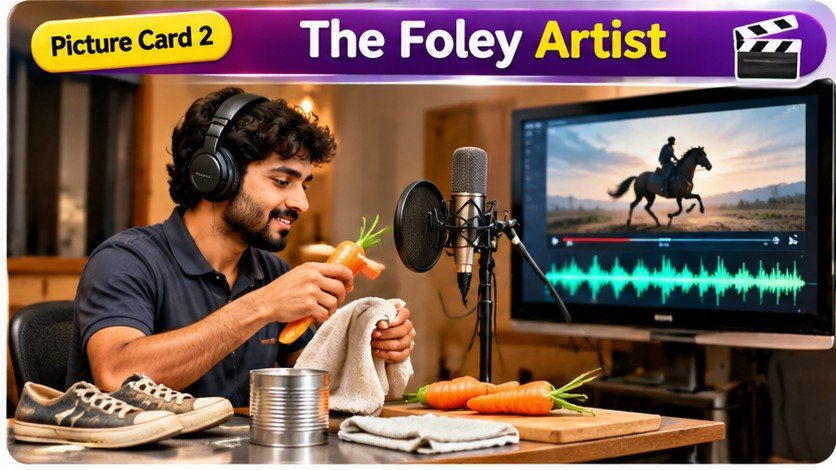
A Foley artist makes film sounds with everyday objects like carrots, shoes and cloth.
Key idea: Foley sounds make films feel real.
Picture Card 3: Music Lifts the Mood

Music can make us feel happy, sad or want to dance.
Key idea: Music makes our brain release dopamine, which gives us pleasure.
Picture Card 4: The Jal Tarang

Each bowl with a different amount of water gives a different sound.
Key idea: Changing something in an instrument changes its sound.
Picture Card 5: Three Ways to Make Music
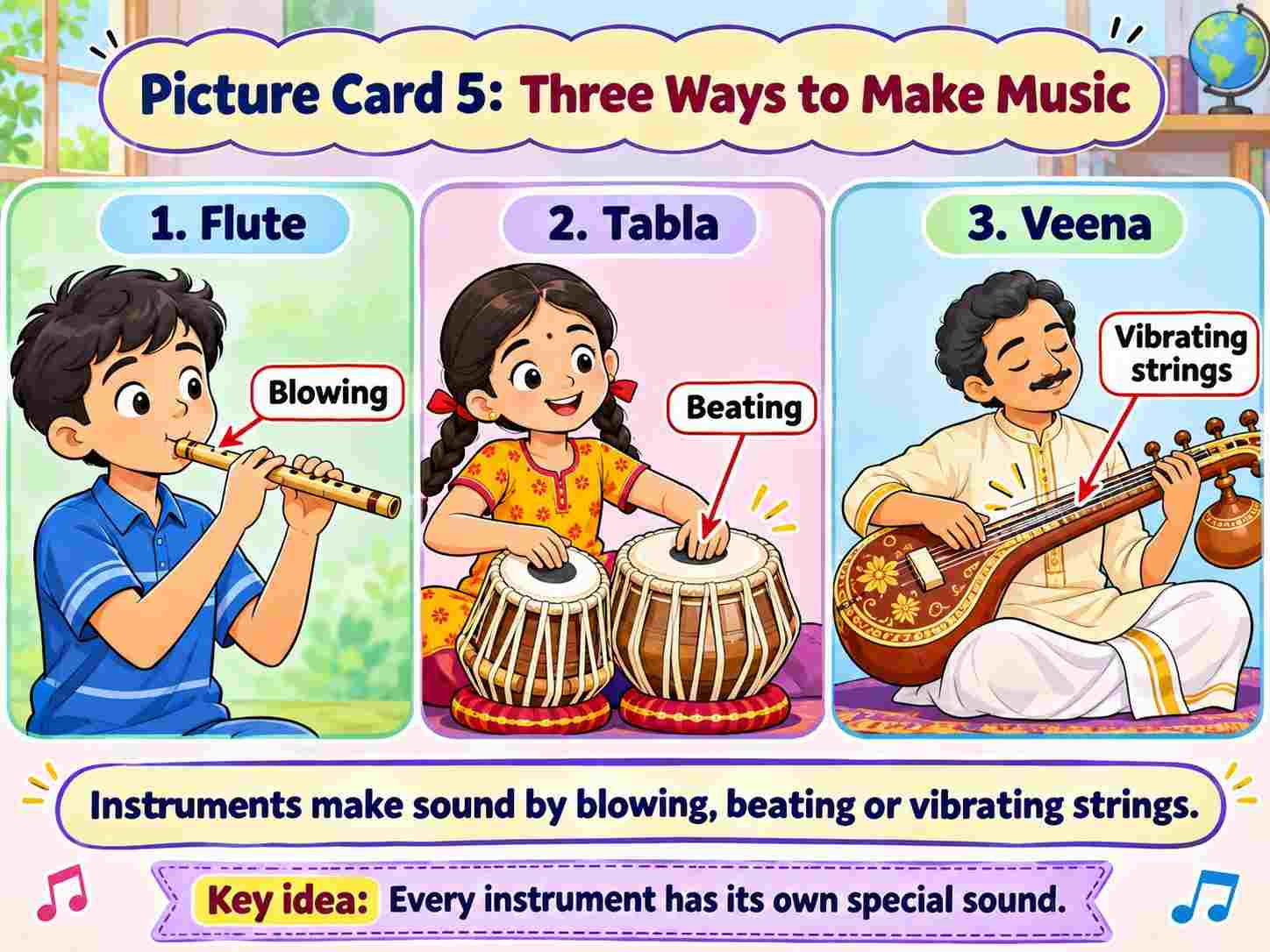
Instruments make sound by blowing, beating or vibrating strings.
Key idea: Every instrument has its own special sound.
Picture Card 6: From Music to Motion

Sound makes the stretched balloon vibrate and the grains jump.
Key idea: Where there is sound, there is vibration.
Picture Card 7: The Ambulance Siren
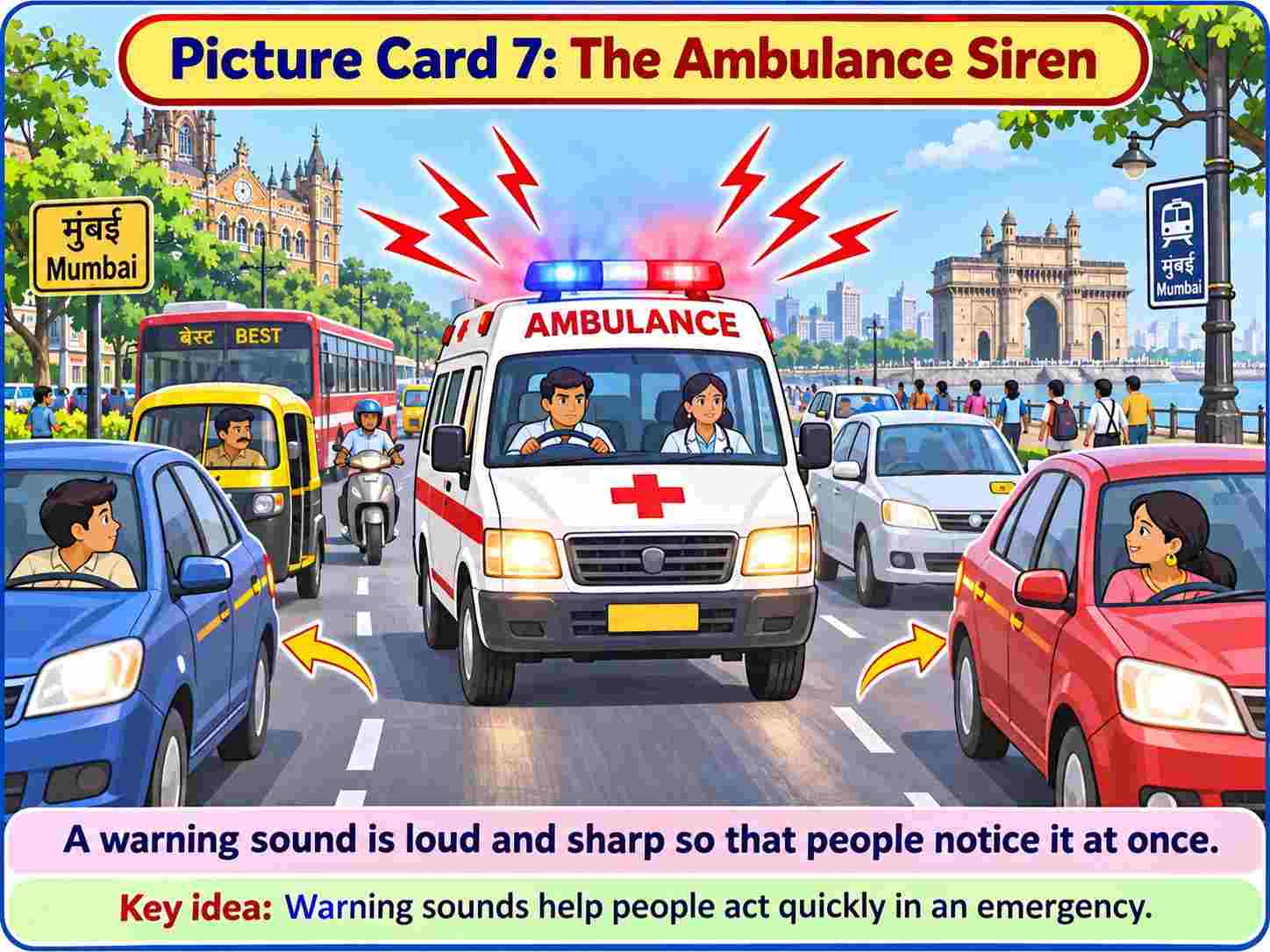
A warning sound is loud and sharp so that people notice it at once.
Key idea: Warning sounds help people act quickly in an emergency.
Picture Card 8: A Noisy City and a Quiet Park

Loud traffic is noise pollution. Trees and parks help to cut down noise.
Key idea: We can reduce noise with quiet machines, soundproofing, trees and rules.
🧠 D · Mind Map
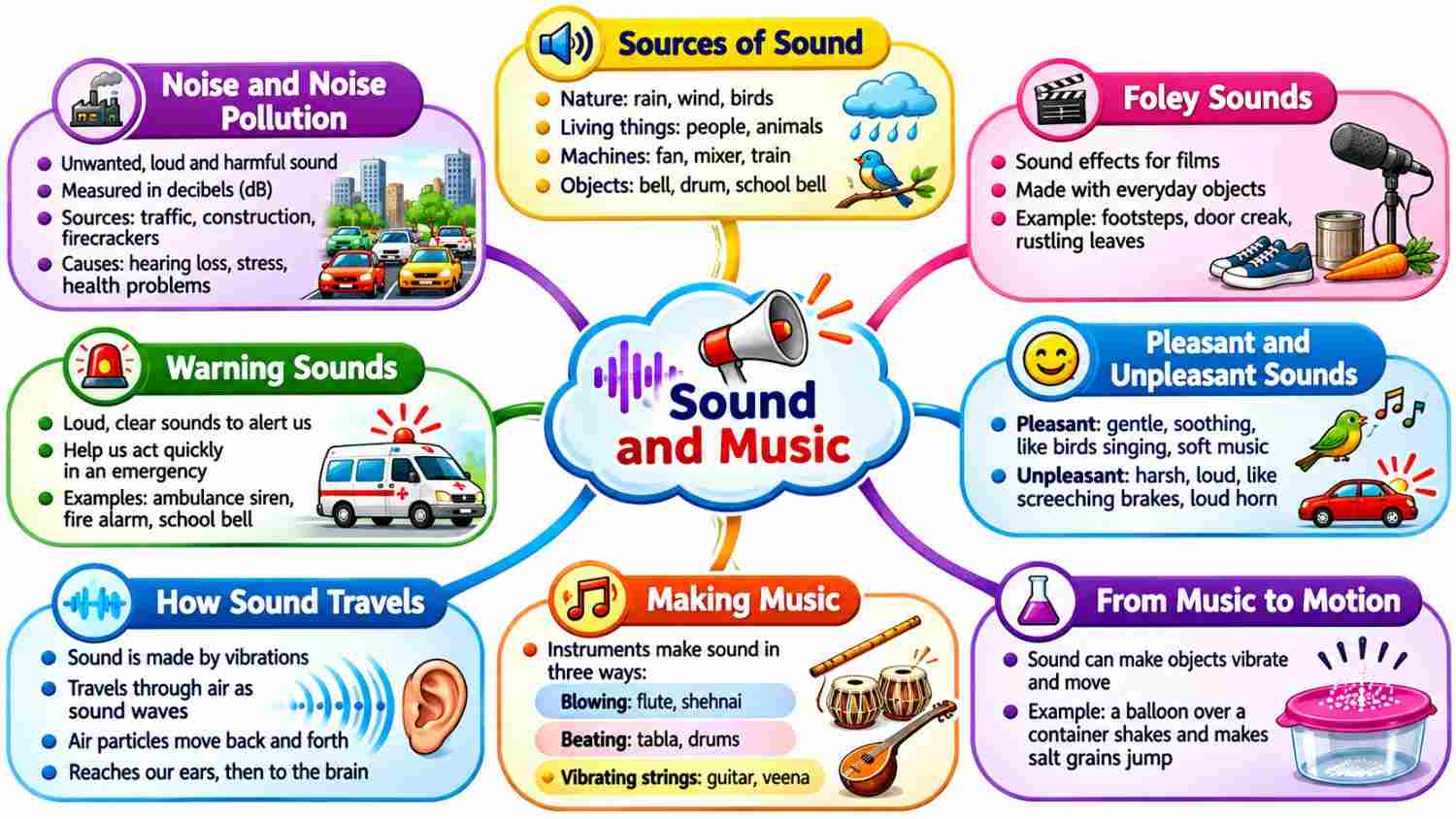
The same mind map in words
Sounds around us, how they are made and how we protect our ears
• Nature: rain, wind, birds
• Living things: people, animals
• Machines: fan, mixer, train
• We can group sounds in many ways
• Sound effects for films
• Made with everyday objects
• Celery or carrot = breaking bones
• Rubbing cloth = rustling clothes
• Pleasant: gentle, soothing, with a rhythm
• Unpleasant: harsh, loud, irritating
• It can depend on the person
• Music releases dopamine
• Blowing: flute, shehnai, nadaswaram
• Beating: tabla, drums, mridangam
• Vibrating strings: guitar, veena, violin
• Jal Tarang: bowls with water
• Vibration ➜ Medium (air) ➜ Ear ➜ Brain
• Air particles pass the energy on
• Eardrum vibrates, nerves carry signals
• No sound in a vacuum
• Siren, fire alarm, smoke detector
• Loud and sharp on purpose
• Help people act quickly
• Hospitals use softer signals
• Measured in decibels (dB)
• Above 85 dB can damage hearing
• Stress, headaches, poor sleep, heart problems
• Reduce: quiet machines, soundproofing, trees, rules
Outline
- Sources of Sound
- Nature: rain, wind, birds
- Living things: people, animals
- Machines: fan, mixer, train
- We can group sounds in many ways
- Foley Sounds
- Sound effects for films
- Made with everyday objects
- Celery or carrot = breaking bones
- Rubbing cloth = rustling clothes
- Pleasant and Unpleasant
- Pleasant: gentle, soothing, with a rhythm
- Unpleasant: harsh, loud, irritating
- It can depend on the person
- Music releases dopamine
- Making Music
- Blowing: flute, shehnai, nadaswaram
- Beating: tabla, drums, mridangam
- Vibrating strings: guitar, veena, violin
- Jal Tarang: bowls with water
- How Sound Travels
- Vibration ➜ Medium (air) ➜ Ear ➜ Brain
- Air particles pass the energy on
- Eardrum vibrates, nerves carry signals
- No sound in a vacuum
- Warning Sounds
- Siren, fire alarm, smoke detector
- Loud and sharp on purpose
- Help people act quickly
- Hospitals use softer signals
- Noise and Noise Pollution
- Measured in decibels (dB)
- Above 85 dB can damage hearing
- Stress, headaches, poor sleep, heart problems
- Reduce: quiet machines, soundproofing, trees, rules
🃏 E · Flash Cards
Tap a card to flip it and see the answer. Try to say the answer first!
🃏 Card 1: What produces sound?
🃏 Card 2: What is a sound source?
🃏 Card 3: What is rhythm?
🃏 Card 4: Who is a Foley artist?
🃏 Card 5: What can make the sound of breaking bones in a film?
🃏 Card 6: Name two ways to group sounds.
🃏 Card 7: What is a pleasant sound?
🃏 Card 8: What is an unpleasant sound?
🃏 Card 9: Which chemical does music release in our brain?
🃏 Card 10: Name three instruments played by blowing.
🃏 Card 11: Name three instruments played by beating.
🃏 Card 12: Name three instruments with vibrating strings.
🃏 Card 13: What is a Jal Tarang?
🃏 Card 14: What is a vibration?
🃏 Card 15: How does sound reach our brain?
🃏 Card 16: Can sound travel through empty space?
🃏 Card 17: Why are warning sounds loud and sharp?
🃏 Card 18: What is a decibel?
🃏 Card 19: At what level can loud sound harm our ears?
🃏 Card 20: What is noise pollution?
✍️ F · Q&A
Part 1: Ten Short Answer Questions
Write each answer in 30 to 50 words. Try first, then tap to check.
👉 Tap to see the model answer
👉 Tap to see the model answer
👉 Tap to see the model answer
👉 Tap to see the model answer
👉 Tap to see the model answer
👉 Tap to see the model answer
👉 Tap to see the model answer
👉 Tap to see the model answer
👉 Tap to see the model answer
👉 Tap to see the model answer
Part 2: Five Long Answer Questions
Write each answer in 80 to 120 words: Introduction, Main points, Example and Conclusion.
👉 Tap to see the model answer
👉 Tap to see the model answer
👉 Tap to see the model answer
👉 Tap to see the model answer
👉 Tap to see the model answer
🔍 G · Case Studies
Read each story. Then answer the five questions. Tap to see the answers.
Case Study 1: The Missing Footsteps
The film club of a school in Andheri made a short film. In one scene, a hero walked through a forest full of dry leaves. When the students watched the film, the video looked good, but the footsteps were hardly heard because the wind was loud during filming. Their teacher said, “Do not worry. We can use Foley sounds.” In a quiet room, Neha walked on a tray of dry leaves while the others watched the screen. She recorded the crunch in time with the hero’s steps. The scene suddenly felt real.
- What did the students have to add to the film?
- Who creates sounds like these in real film studios?
- Which object made the sound of walking on leaves?
- Why was the sound of the footsteps missing?
- What could you use to make the sound of breaking bones?
👉 Tap to see the answers
- They had to add the sound of the footsteps.
- A Foley artist creates such sounds in a studio.
- A tray of dry leaves made the crunching sound.
- The wind was loud during filming, so the small sound of footsteps was lost.
- We could snap celery or carrot sticks.
Case Study 2: The Tumbler Orchestra
Riya visited her grandmother in Nashik. After dinner, she lined up five steel tumblers and tapped them with a spoon. The empty tumblers made a harsh, clanging sound, and her grandmother covered her ears. Then Riya poured a different amount of water into each tumbler and tapped them again. This time each tumbler gave a different sound, and Riya could play a simple tune. Her grandmother clapped and said, “This is just like a Jal Tarang!” Riya had turned an unpleasant sound into a pleasant one.
- Why did the empty tumblers sound unpleasant?
- What change made the sounds more musical?
- Which Indian instrument is like Riya’s tumblers?
- Why do the tumblers give different sounds?
- Why should we tap the tumblers gently?
👉 Tap to see the answers
- The empty tumblers gave a harsh and clanging sound.
- Adding different amounts of water changed the sounds.
- The Jal Tarang is like Riya’s tumblers.
- The different amounts of water change how the tumblers vibrate, so each one gives a different sound.
- Tapping gently is safe and does not hurt the ears or break the tumblers.
Case Study 3: The Dancing Salt
Kabir and his friends in Pune did an experiment in science class. They stretched a balloon tightly over a small box and sprinkled salt on it. Then they placed a speaker close to the box and played a deep drum beat. The salt grains jumped up and down. When Kabir turned up the volume, the grains jumped higher. Then they played a high-pitched song, and the grains moved differently. Kabir gently touched the side of the box and felt a small tickle. “Sound is moving the balloon!” he said.
- Why did the salt grains jump?
- What happened when the volume was increased?
- What did Kabir feel on the box, and why?
- Why was the balloon stretched tightly?
- What does this experiment show about sound?
👉 Tap to see the answers
- The sound made the balloon vibrate, and the vibrating balloon made the grains jump.
- The grains jumped higher.
- He felt a small tickle, because the box was vibrating.
- A tight balloon vibrates easily when the sound reaches it.
- It shows that sound is made of vibrations and that sound can make things move.
Case Study 4: The Ambulance on the Highway
Siddharth was going home in a car on the Eastern Express Highway in Mumbai. The traffic was heavy, and many horns were blaring. Suddenly a loud, sharp siren cut through all the noise. An ambulance with flashing lights was coming up behind them. One by one, the cars moved aside and made a path. The ambulance sped to a hospital nearby. At the gate, a board said “Silence Zone”, and the ambulance switched off its siren. Siddharth understood why the siren was loud on the road but not at the hospital.
- Why was the siren loud and sharp?
- What did the other drivers do when they heard it?
- Why did the ambulance switch off its siren near the hospital?
- Name two other warning sounds.
- Was the honking of the cars useful or unpleasant?
👉 Tap to see the answers
- It had to be heard over the noisy traffic so that people would make way.
- They moved their cars aside and made a path.
- A hospital needs quiet so that patients can rest.
- A fire alarm and a smoke detector are two other warning sounds.
- The honking was unpleasant noise, and it added to the noise pollution.
Case Study 5: Diwali Night
On Diwali night in Thane, loud crackers burst all around Maya’s building. Her pet dog, Bruno, started to shiver and hid under the sofa. He barked and would not come out. Maya’s grandfather covered his ears and said that his head was hurting. The next day, the residents met and talked about noise. They decided to light diyas and rangoli, hold a music evening and use only a few, quiet crackers during the day. This Diwali was bright, happy and peaceful, and Bruno slept well.
- Why was Bruno so scared of the crackers?
- What effects of loud noise did Maya’s grandfather feel?
- What can very loud noise do to our ears?
- Suggest two ways to celebrate without loud noise.
- Which kind of pollution was Maya’s building facing?
👉 Tap to see the answers
- Dogs have more sensitive hearing, so loud sounds scare them.
- He had a headache, which is a common effect of loud noise.
- Very loud noise, above 85 dB, can damage our ears and cause hearing loss.
- We can light diyas and make rangoli, or hold a music evening.
- It was facing noise pollution.
Test yourself with 25 multiple-choice questions. You will see the correct answer after each question.
Start the quiz ➜You now know how sounds are made, how they travel and how to protect your ears. Listen carefully around you today!