👆 Tap a button to jump to that section, then tap the heading to open it. The blue H · Quiz button opens the chapter quiz.
🎯 Section A: Learning Objectives
- Why we bleed when the skin is cut
- What blood carries, and how food and medicines reach it
- How the heart pumps blood to the lungs and the body
- Why heartbeat and breathing become faster when we exercise
- How to keep our heart healthy
🎯 Learning Objectives
After this chapter you will be able to:
- Explain why blood is called the transport system of the body.
- Name the four chambers of the heart and say what each one does.
- Compare arteries, veins and capillaries.
- Trace the journey of blood through the heart, lungs and body.
- Describe why exercise makes the heart and breathing faster, and list ways to care for the heart.
Place your hand on your chest and feel your heart beating. Now place two fingers on your wrist and feel your pulse. Something inside you is moving all the time. What do you think it is carrying, and where is it going?
🗺️ Chapter Road Map
| Step | What you do | Section |
| 1 | Read the concept notes | B · Notes |
| 2 | Look at the picture cards | C · Pictures |
| 3 | Revise with the mind map | D · Mind map |
| 4 | Flip the flash cards | E · Flash cards |
| 5 | Practise short and long answers | F · Answers |
| 6 | Solve real-life case studies | G · Case studies |
| 7 | Take the 25-question quiz | H · Quiz |
📘 Section B: Concept Notes
1. Blood and Blood Vessels

Rizu fell while playing and got a few cuts. Some cuts bled and some did not. Her friends rushed to help. Rizu asked, ‘Why does my skin bleed when it is cut, but nothing happens when I cut my hair or nails?’ Khoji thought there was no blood in hair and nails. Simba wondered if blood fills every part of the body, just as air fills a balloon.
Safety first: If you get a cut, tell an adult and wash it gently with clean water.
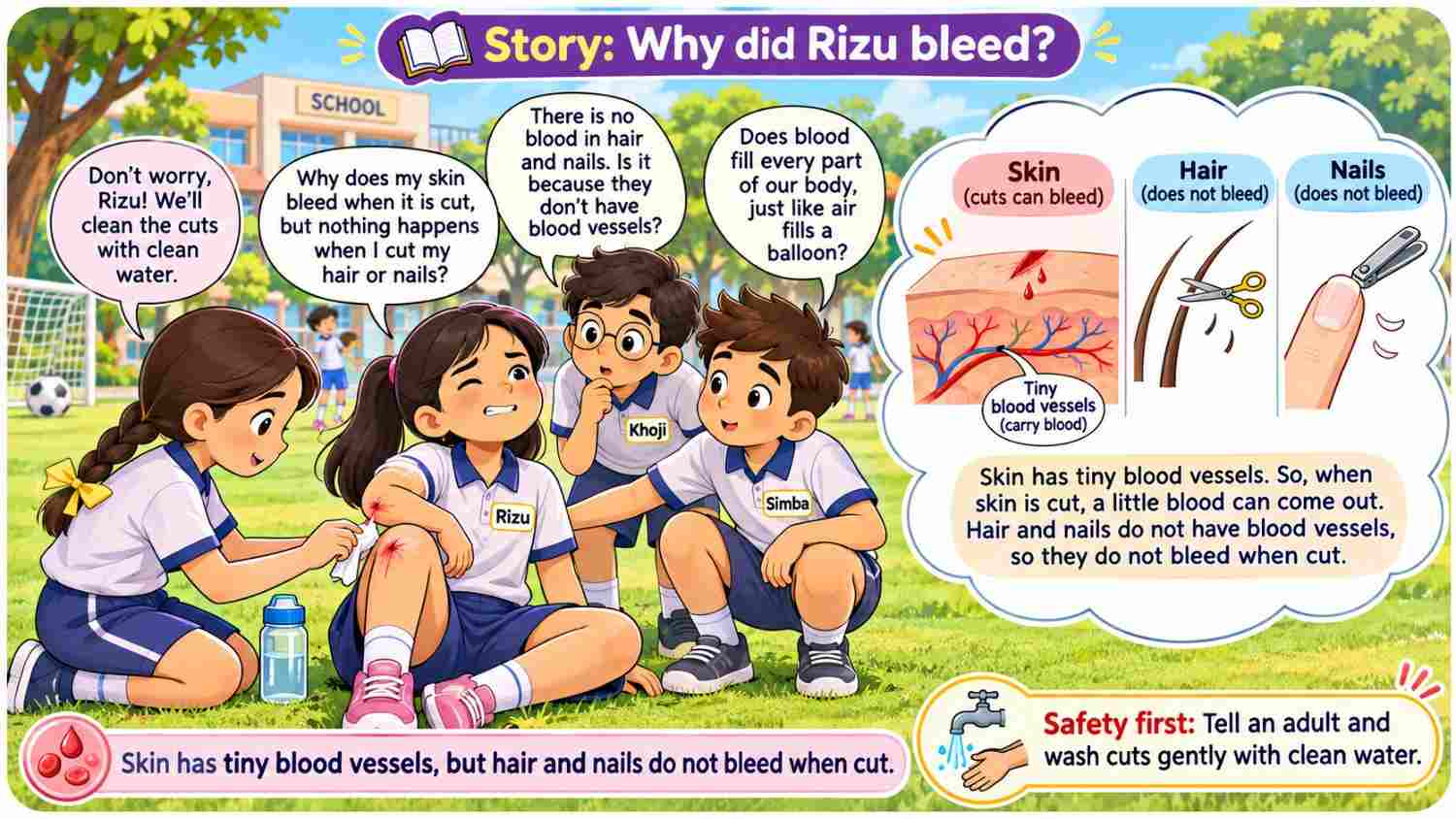
Blood is a very important fluid that keeps us alive and healthy. It flows through all parts of the body inside special tubes called blood vessels. On the back of your hand you can see some of them as faint lines under the skin.
What does blood carry?
- Oxygen from the lungs to every cell.
- Nutrients from food: glucose, fats, proteins, vitamins, minerals and water.
- Carbon dioxide and other wastes away from the cells.
- Medicines to the part of the body that needs them.
What is blood made of?
- Red blood cells contain haemoglobin, which carries oxygen.
- White blood cells help the body fight germs.
- Platelets help blood to clot and stop bleeding.
Why can blood reach every cell?
Our body is made of tiny cells, so small that you need a microscope to see them. Big arteries and veins cannot reach every cell. They branch into thinner and thinner tubes called capillaries, and capillaries reach all the cells. This is why a small cut anywhere on the skin can bleed. The hair we cut and the free edge of a nail do not contain blood vessels, so they do not bleed.
Reading a blood report
When someone is ill, a doctor may ask for a blood test. The report lists parts of the blood and a standard range for each. This is Rizu’s report:
| Component | Standard range | Rizu’s value |
| Red blood cells (RBC) | 3.50 to 5.20 | 4.62 |
| White blood cells (WBC) | 4,500 to 11,000 | 6,030 |
| Haemoglobin | 12 to 15 g/dl | 12.7 |
| Glucose | 70 to 110 | 93.3 |
| Platelet count | 150 to 420 k/ul | 192 |
All of Rizu’s values are inside the range. If a value is outside the range, the doctor looks for the reason and may suggest food, medicine or another test.
📖 Word Box
| Word | Meaning |
| Blood vessels | Tubes that carry blood through the body |
| Capillaries | Very tiny blood vessels that reach every cell |
| Cell | The tiny building block of the body |
| Haemoglobin | A protein in red blood cells that carries oxygen |
| Platelets | Blood parts that help blood clot |
| Glucose | A simple sugar that gives energy |
- Blood is not in hair and nails. The part we cut has no blood vessels.
- Blood does not fill the body like air in a balloon. It flows inside tubes.
2. How Food and Medicines Reach the Blood
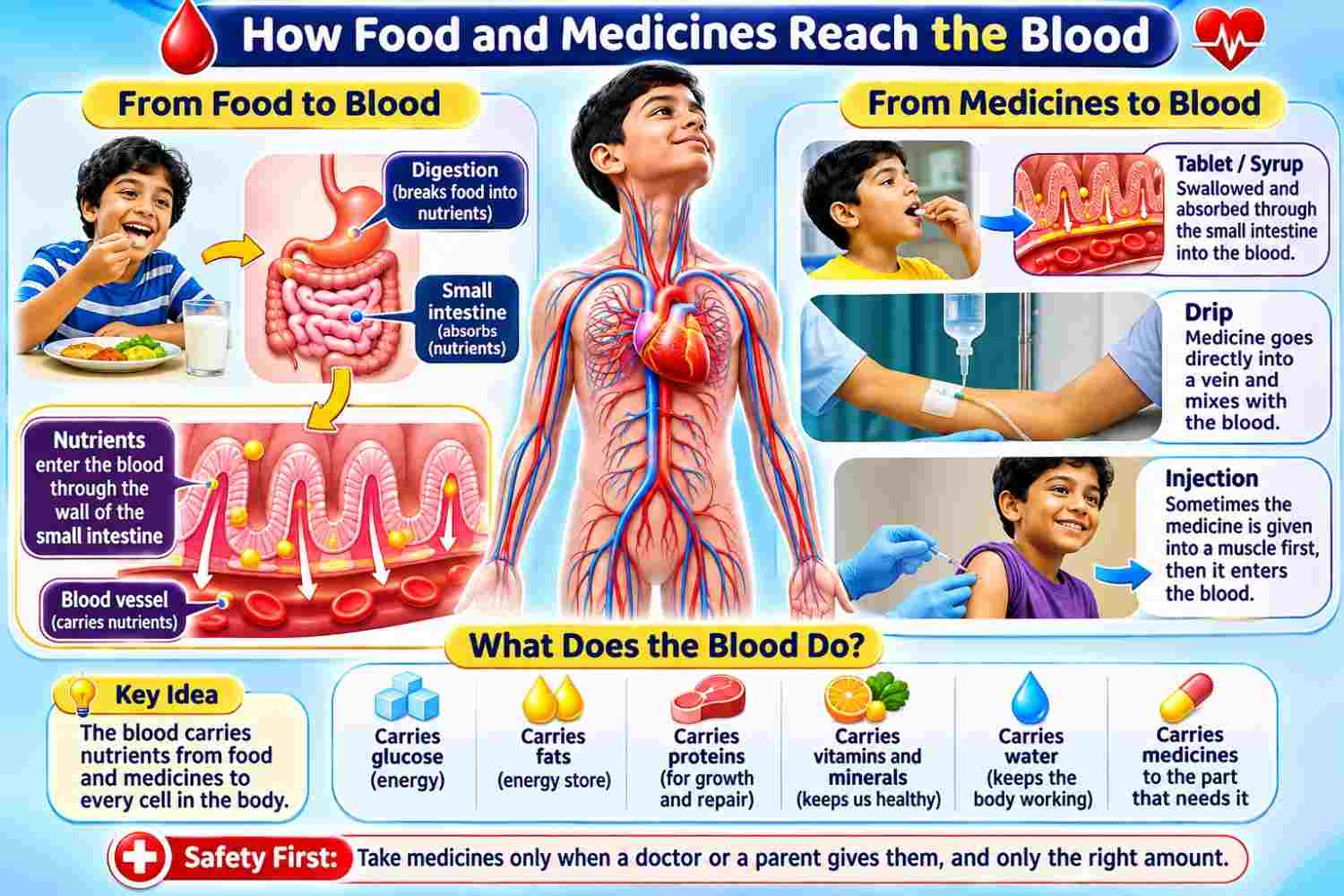
Food is broken down by the digestive system. The nutrients from the food are absorbed into the blood mainly through the walls of the small intestine. The blood then carries glucose, fats, proteins, vitamins, minerals and water to every cell. Cells use glucose and oxygen to make energy. That is why we feel hungry after running or swimming: the body has used up a lot of energy.
What about medicines?
Khoji wondered how a medicine given in his hand could help his stomach. Simba wondered how a syrup could help his injured leg. The answer is the same for both: the blood carries medicine around the body.
- Syrup or tablet: it is swallowed, absorbed through the small intestine and enters the blood.
- Drip: a needle in the hand puts the medicine straight into a vein.
- Some injections go into a muscle first, and then the medicine enters the blood.
- Then the blood carries the medicine to the part of the body that needs it.
📖 Word Box
| Word | Meaning |
| Digestion | Breaking food into very small parts |
| Nutrients | Useful parts of food, like proteins and vitamins |
| Small intestine | The part of the digestive system where nutrients pass into the blood |
| Absorb | To take in |
| Bloodstream | The blood flowing through the body |
| Drip | Medicine given slowly into a vein through a thin tube |
- Syrup does not go straight to the injured leg. It travels in the blood first.
- Injections and syrups do not go to different places. Both are carried by the blood.
3. The Heart and the Journey of Blood
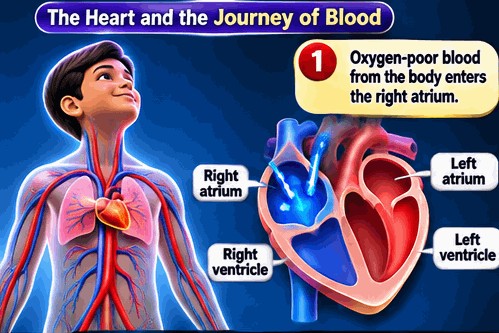
The heart is a strong muscle that pumps blood. It is about the size of your fist and lies slightly to the left of the middle of your chest. It is divided into four chambers.
| Chamber | Main job |
| Right atrium (upper) | Receives oxygen-poor blood from the body |
| Right ventricle (lower) | Pumps oxygen-poor blood to the lungs through the pulmonary artery |
| Left atrium (upper) | Receives oxygen-rich blood from the lungs through the pulmonary veins |
| Left ventricle (lower) | Pumps oxygen-rich blood to the whole body through the aorta |
Your textbook calls the upper chambers auricles. Scientists usually call them atria. Valves in the heart keep the blood moving in one direction only, from the atria to the ventricles. Blood cannot flow backwards. The right side of the heart handles oxygen-poor blood, and the left side handles oxygen-rich blood.
Body ➜ Right atrium ➜ Right ventricle ➜ Lungs ➜ Left atrium ➜ Left ventricle ➜ Body
In the lungs, oxygen passes into the blood and joins haemoglobin, and carbon dioxide leaves the blood. That is why blood must go to the lungs before it returns to the body.
Arteries, veins and capillaries
| Blood vessel | Job |
| Arteries | Carry blood away from the heart. Most carry oxygen-rich blood. |
| Veins | Carry blood back towards the heart. Most carry oxygen-poor blood. |
| Capillaries | Tiny vessels where oxygen and nutrients pass to the cells |
There is one special pair. The pulmonary artery carries oxygen-poor blood from the heart to the lungs, and the pulmonary veins carry oxygen-rich blood from the lungs to the heart. The whole network of the heart, blood and blood vessels is the circulatory system.
📖 Word Box
| Word | Meaning |
| Atrium (atria) | An upper chamber of the heart; it receives blood |
| Ventricle | A lower chamber of the heart; it pumps blood out |
| Valve | A flap that keeps blood flowing one way |
| Oxygenated blood | Blood that is rich in oxygen |
| Deoxygenated blood | Blood that has little oxygen |
| Aorta | The biggest artery; it takes blood from the heart to the body |
| Circulatory system | The heart, blood and blood vessels working together |
- The heart does not make oxygen. Oxygen enters the blood in the lungs.
- Not every artery carries oxygen-rich blood. The pulmonary artery carries oxygen-poor blood.
- Blood does not go straight from the body to the lungs. It passes through the heart first.
- Blood is never blue. Diagrams use blue only to show blood with little oxygen.
4. Heartbeat, Breathing and a Healthy Heart
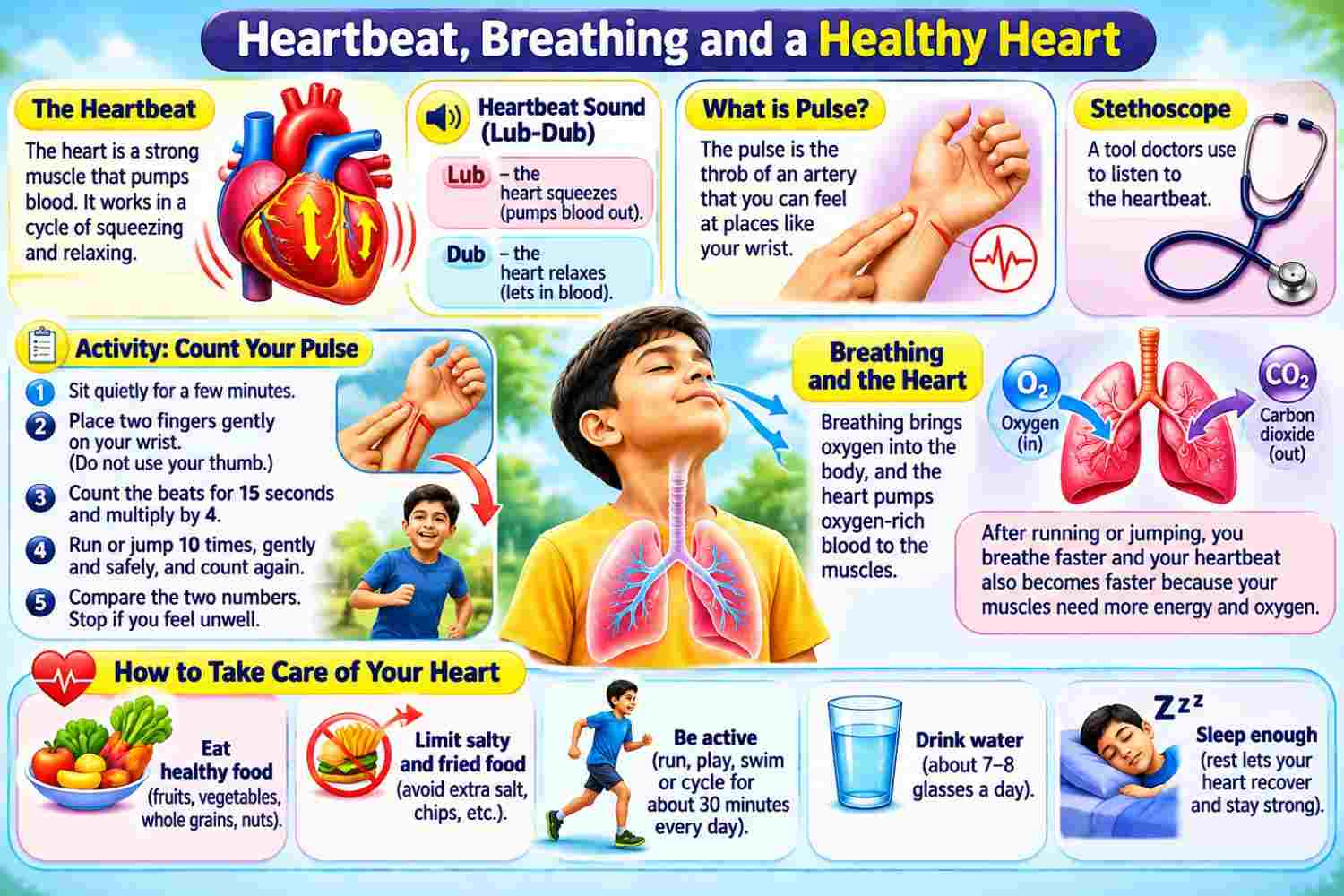
A heartbeat is one cycle of the heart squeezing and relaxing. When you listen to the heart, you hear a lub-dub sound. A doctor uses a stethoscope to hear it. The pulse is the throb of an artery that is pushed open by each heartbeat. You can feel it at your wrist, where an artery is close to the skin.
- Sit quietly for a few minutes.
- Place two fingers gently on your wrist. Do not use your thumb.
- Count the beats for 15 seconds and multiply by 4.
- Run or jump 10 times, gently and safely, and count again.
- Compare the two numbers. Stop if you feel unwell.
After running or jumping, your heartbeat and breathing become faster. Your muscles need more energy, and so they need more oxygen. Breathing brings oxygen into the body, and the heart pumps oxygen-rich blood to the muscles. So the heart beats faster to supply more oxygen where it is needed most.
How to take care of your heart
- Eat healthy food: fruits, vegetables, whole grains and nuts. Dates, figs, spinach and raisins have iron, which helps make haemoglobin.
- Limit salty and fried food: do not add extra salt, and eat fried or packet foods like chips only now and then. Baked or grilled food is better for the heart.
- Be active: try for 30 minutes of running, playing, swimming or cycling every day, in a way that suits your age.
- Drink water: about seven to eight glasses a day, especially when you are active.
- Sleep enough: rest lets your heart recover and stay strong.
📖 Word Box
| Word | Meaning |
| Heartbeat | One beat of the heart; the lub-dub sound |
| Pulse | The throb of an artery with each heartbeat |
| Stethoscope | A tool doctors use to listen to the heart |
| Exercise | Activity like running, jumping or cycling |
| Hydrated | Having enough water in the body |
- Do not count the pulse with your thumb. The thumb has its own pulse.
- A faster heartbeat after running is normal. It does not mean the heart is weak.
🖼️ Section C: Picture Cards
Each card has a picture and a two-line note. The second line is the key idea.
Picture Card 1: Blood Vessels in the Hand
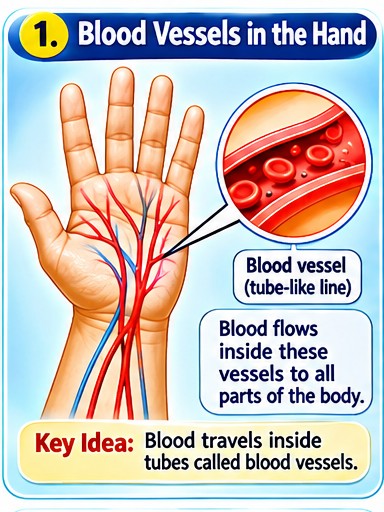
Tube-like lines under your skin are blood vessels. Blood flows inside them.
Key idea: Blood travels inside tubes called blood vessels.
Picture Card 2: The Farm Pipe Idea
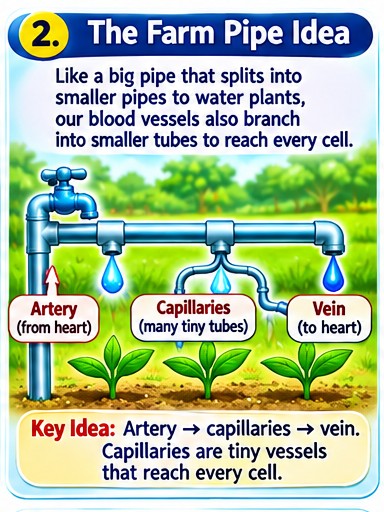
One big pipe splits into small pipes so that every sapling gets water.
Key idea: Artery ➜ capillaries ➜ vein. Capillaries are tiny vessels that reach every cell.
Picture Card 3: Food Enters the Blood
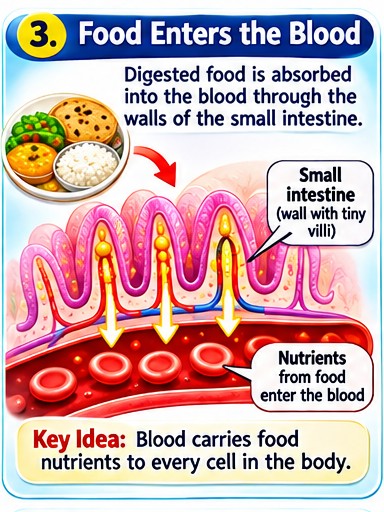
Digested food passes into the blood through the small intestine.
Key idea: Blood carries food nutrients to every cell.
Picture Card 4: Medicine on the Move
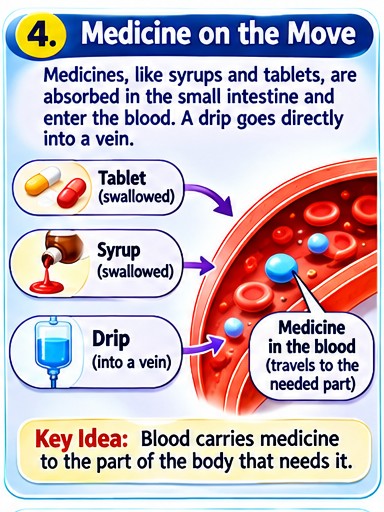
Syrup and tablets are absorbed in the small intestine, and a drip goes into a vein.
Key idea: Blood carries medicine to the part that needs it.
Picture Card 5: The Four-Chambered Heart
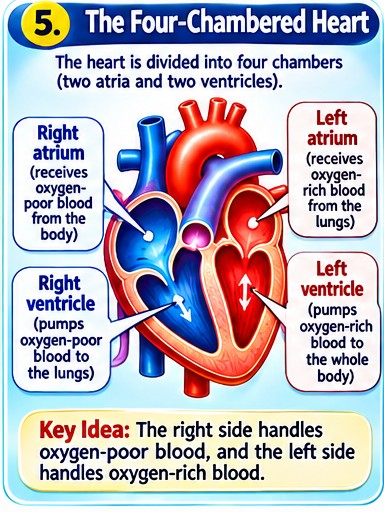
The heart has two atria on top and two ventricles below.
Key idea: The right side holds oxygen-poor blood and the left side holds oxygen-rich blood.
Picture Card 6: The Journey of Blood
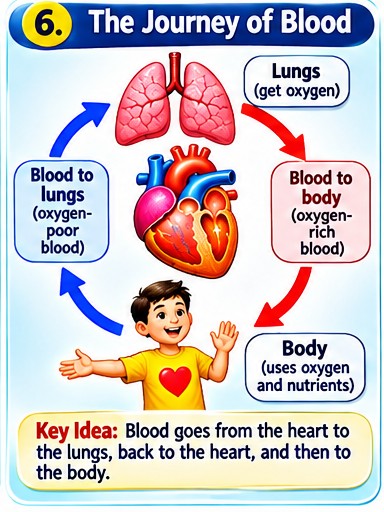
Blood goes from the heart to the lungs, back to the heart and then to the body.
Key idea: Blood always passes through the heart between the lungs and the body.
Picture Card 7: Pulse and Stethoscope
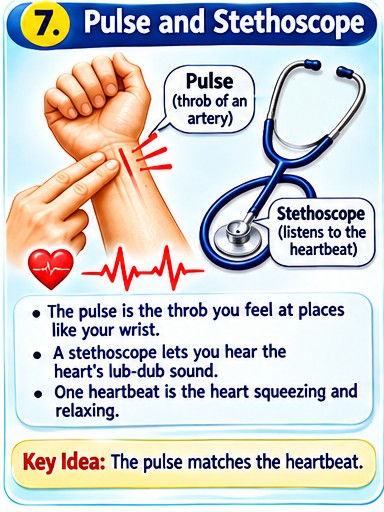
Two fingers on the wrist feel the pulse. A stethoscope lets us hear lub-dub.
Key idea: The pulse matches the heartbeat.
Picture Card 8: Exercise and the Heart
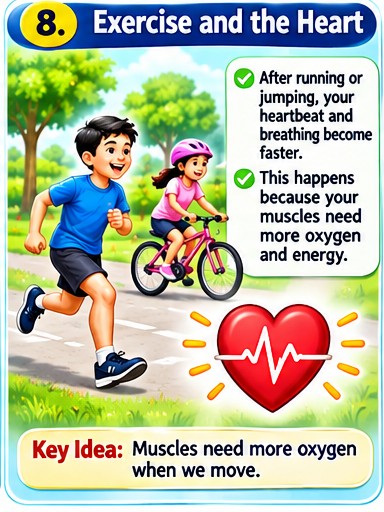
Running and cycling make the heart beat faster and make us breathe faster.
Key idea: Muscles need more oxygen when we move.
🧠 Section D: Mind Map
🧠 ❤️
CIRCULATORY SYSTEM
Heart + Blood + Blood vessels
Image prompt: A colourful mind map with a heart in the centre and seven branches: blood, blood vessels, heart, journey of blood, food and medicine, heartbeat and exercise, heart care.
The same mind map in words
🩸 Blood
Red blood cells carry oxygen with haemoglobin. White blood cells fight germs. Platelets stop bleeding.
🔀 Blood vessels
Arteries go away from the heart. Veins go towards the heart. Capillaries reach every cell.
❤️ Heart
Four chambers, valves, a muscle pump. Right side: oxygen-poor. Left side: oxygen-rich.
🔄 Journey of blood
Body, right atrium, right ventricle, lungs, left atrium, left ventricle, body.
🍛 Food and medicine
Absorbed through the small intestine, then carried by the blood.
🏃 Heartbeat and exercise
More activity needs more oxygen, so the heartbeat and breathing become faster.
🥗 Heart care
Healthy food, less salt and fried food, 30 minutes of activity, water and sleep.
Outline
- Blood
- Carries oxygen, nutrients, wastes and medicines
- Red cells, white cells, platelets
- Blood vessels
- Arteries: away from the heart
- Veins: towards the heart
- Capillaries: reach every cell
- Heart
- Two atria, two ventricles
- Valves keep blood moving one way
- Journey of blood
- Body, heart, lungs, heart, body
- Food and medicine
- Absorbed in the small intestine, carried by blood
- Heartbeat and exercise
- More oxygen needed, so faster heartbeat and breathing
- Heart care
- Healthy food, activity, water, sleep
🃏 Section E: Flash Cards
Tap each card to see the answer. Try to say the answer aloud first.
1. What is the main job of the heart?
The heart is a strong muscle that pumps blood to all parts of the body.
2. What are blood vessels?
They are special tubes that run through the whole body. Blood flows inside them.
3. What is haemoglobin?
A protein in red blood cells that joins with oxygen and helps carry it around the body.
4. What do white blood cells do?
They help the body fight germs and infections.
5. What do platelets do?
Platelets help blood to clot, which helps stop bleeding after a cut.
6. Where do nutrients from food enter the blood?
Mainly through the walls of the small intestine.
7. What is an artery?
A blood vessel that carries blood away from the heart. Most arteries carry oxygen-rich blood.
8. What is a vein?
A blood vessel that carries blood back towards the heart. Most veins carry oxygen-poor blood.
9. What is a capillary?
A very tiny blood vessel that reaches the cells. Oxygen and nutrients pass from it into the cells.
10. How many chambers does the heart have?
Four: two upper chambers and two lower chambers.
11. Name the two upper chambers.
The right atrium and the left atrium. Your textbook also calls them auricles.
12. Name the two lower chambers.
The right ventricle and the left ventricle.
13. What does the right ventricle do?
It pumps oxygen-poor blood to the lungs through the pulmonary artery.
14. What does the left ventricle do?
It pumps oxygen-rich blood to the whole body through the aorta, the biggest artery.
15. Where does blood take up oxygen?
In the lungs. The heart does not make oxygen.
16. What is the pulse?
The throbbing you feel in an artery, for example at the wrist, each time the heart beats.
17. What happens to the heartbeat during exercise?
It becomes faster, so more oxygen-rich blood reaches the working muscles.
18. What do the valves in the heart do?
They keep blood flowing in one direction and stop it from flowing backwards.
19. What is the circulatory system?
The network of the heart, blood and blood vessels that carries oxygen and nutrients and removes wastes.
20. Name two habits that keep the heart healthy.
Daily exercise for 30 minutes and eating fruits and vegetables. Enough water and sleep also help.
❓ Section F: Q&A
Tap a question to see the model answer. Try to write your own answer first.
✏️ 10 Short Answers
1. Why do we bleed when the skin is cut?
Our skin has tiny blood vessels called capillaries almost everywhere. A cut breaks some of them, so blood comes out. Hair and the tip of a nail are made of dead material with no blood vessels, so cutting them does not cause bleeding.
2. Why is the circulatory system important?
The circulatory system is the body’s transport system. It delivers oxygen and nutrients to every cell and carries away carbon dioxide and other wastes. Without it, cells would not get what they need to work, and harmful wastes would not be removed.
3. What does blood carry?
Blood carries oxygen from the lungs to the cells. It carries nutrients from digested food, such as glucose, fats, proteins, vitamins, minerals and water. It also carries carbon dioxide and wastes away from the cells, and it carries medicines to the parts that need them.
4. How does food get into the blood?
The digestive system breaks food into very small nutrients. These nutrients are absorbed into the blood through the walls of the small intestine. The blood then carries them to every cell of the body, where they give energy and help us grow.
5. How does medicine reach different parts of the body?
A tablet or syrup is swallowed and absorbed from the small intestine into the blood. A drip puts medicine straight into a vein. In both cases the blood carries the medicine around the body, so it reaches the part that needs it, like an injured leg.
6. What is haemoglobin?
Haemoglobin is a protein found in red blood cells. In the lungs, oxygen joins with haemoglobin, and the blood carries it to all parts of the body. Iron-rich foods like dates, figs, spinach and raisins help the body make healthy haemoglobin.
7. Name the four chambers of the heart.
The heart has four chambers. The two upper chambers are the right and left atria, which receive blood. The two lower chambers are the right and left ventricles, which pump blood out. Valves keep the blood flowing in only one direction.
8. What is the difference between an artery and a vein?
An artery carries blood away from the heart. A vein carries blood towards the heart. Most arteries carry oxygen-rich blood and most veins carry oxygen-poor blood. The pulmonary artery and the pulmonary veins are the two important exceptions to this rule.
9. What is a pulse and how do we count it?
A pulse is the throbbing you feel in an artery each time the heart beats. Place two fingers gently on your wrist. Count the beats for 15 seconds and multiply by four to get the beats in one minute. Do not use your thumb.
10. Why does the heartbeat increase during exercise?
When we run or jump, our muscles need more energy, so they need more oxygen. The heart beats faster to send more oxygen-rich blood to them. We also breathe faster to take in more oxygen. When we rest, both slow down again.
📝 5 Long Answers
1. Explain the journey of blood through the body.
Introduction: Blood travels in a loop through the heart, lungs and body, and it never stops.
Main points: Oxygen-poor blood from the body enters the right atrium, then the right ventricle. It is pumped to the lungs, where it gives out carbon dioxide and takes in oxygen. Oxygen-rich blood returns to the left atrium, then the left ventricle, which pumps it to the whole body.
Example: It is like a bus on a circular route: it picks up oxygen at one stop, drops it at many stops and returns for more.
Conclusion: This journey keeps every cell supplied with oxygen.
2. Differentiate between arteries, veins and capillaries.
Introduction: Blood flows through three kinds of blood vessels, and each has its own job.
Main points: Arteries carry blood away from the heart. Most carry oxygen-rich blood, but the pulmonary artery carries oxygen-poor blood to the lungs. Veins carry blood back to the heart. Most carry oxygen-poor blood, but the pulmonary veins bring oxygen-rich blood from the lungs. Capillaries are tiny vessels that reach every cell and pass oxygen and nutrients to it.
Example: You can feel your pulse at the wrist because an artery runs close to the skin there.
Conclusion: Together, these vessels form a network that reaches the whole body.
3. Describe the structure and working of the heart.
Introduction: The heart is a strong muscle, about the size of your fist, placed slightly to the left of the chest.
Main points: It has four chambers. The two upper chambers are the atria and the two lower chambers are the ventricles. The atria receive blood and the ventricles pump it out. Valves make sure blood flows in one direction only. The right side handles oxygen-poor blood and the left side handles oxygen-rich blood.
Example: When you place a hand on your chest, you can feel the heart pumping, and a stethoscope lets you hear its lub-dub sound.
Conclusion: The heart works day and night to keep blood moving.
4. Explain the relationship between breathing and heart rate during exercise.
Introduction: Breathing and heartbeat work together to give the body oxygen.
Main points: Breathing brings oxygen into the lungs, where it passes into the blood. The heart pumps this blood to all parts of the body. During running or jumping, muscles need more energy, so they need more oxygen. Both breathing and heartbeat become faster to supply it, and the blood also carries away the extra carbon dioxide.
Example: After a race, a child’s heart thumps and the child breathes heavily. After some rest, both slow down.
Conclusion: So breathing and heart rate are closely related.
5. Describe five ways to keep your heart healthy.
Introduction: A healthy heart keeps the whole circulatory system working well, so we must care for it every day.
Main points: Eat fruits, vegetables, whole grains and nuts, and iron-rich foods like dates and spinach. Eat less salt and fried food. Be active for 30 minutes daily. Drink seven to eight glasses of water. Sleep enough so that the heart can rest.
Example: A child who plays outside, eats fruit and sleeps on time has a stronger heart than one who sits with chips and a screen.
Conclusion: Small daily habits keep the heart strong for life.
🔍 Section G: Case Studies
Read each story and think about the five questions before you open the answers.
Case 1: Aarav and the Scraped Knee
Aarav was riding his bicycle in his society garden in Borivali when he fell and scraped his knee. Blood came out at once. His friend Meher ran to call his mother. Mummy washed the knee with clean water and pressed a clean cloth on it. Soon the bleeding slowed. That evening Aarav had a haircut, and he asked the barber, ‘Why does my knee bleed but my hair does not?’ The barber smiled and said, ‘Ask your science teacher!’ Aarav asked her the next day.
Answer these questions:
- Why did blood come out of Aarav’s knee?
- Why does a haircut not make Aarav bleed?
- Which part of the blood helped the bleeding to slow down?
- What should Aarav do first after a fall like this?
- Name the tiny vessels found almost everywhere in the skin.
Tap to see the answers
- The fall damaged tiny blood vessels called capillaries in the skin, so blood came out.
- The hair that is cut has no blood vessels in it.
- Platelets, because they help the blood to form a clot.
- Tell an adult and wash the cut gently with clean water.
- Capillaries.
Case 2: Sneha’s Cricket Match
Sneha plays cricket for her school team in Pune. In the final, she ran many quick runs between the wickets. After the match her heart was thumping and she was breathing fast. Coach Patil asked her to find her pulse. She counted 30 beats in 15 seconds. Before the match, her pulse had been 20 beats in 15 seconds. After some rest, her breathing slowed down and she felt very hungry. The coach gave her a banana and a glass of water.
Answer these questions:
- Why did Sneha’s heart beat faster?
- Why did she breathe faster?
- How many beats per minute did Sneha have before and after the match?
- Why did Sneha feel hungry after the match?
- What happened to her heartbeat and breathing after rest?
Tap to see the answers
- Her muscles needed more oxygen and energy, so the heart pumped faster to send more blood to them.
- She needed to take in more oxygen, which the blood carries to the muscles.
- Before: 20 x 4 = 80 beats per minute. After: 30 x 4 = 120 beats per minute.
- Her body used a lot of energy from food, so it needed more food.
- Both slowed down and came back to normal.
Case 3: Rohan’s Blood Report
Rohan from Nagpur often felt tired, so his doctor asked for a blood test. A nurse took a little blood from a vein in his hand. The next day the report came. It showed haemoglobin 11 g/dl, while the standard range is 12 to 15 g/dl. All other values were normal. The doctor told Rohan not to worry. She asked him to eat dates, spinach, figs and raisins, and to come back for another test. Rohan wondered how one small tube of blood could tell the doctor so much.
Answer these questions:
- Why was blood taken from a vein in Rohan’s hand?
- Which part of the blood carries oxygen?
- Is Rohan’s haemoglobin inside the standard range?
- Name two foods that help the body make haemoglobin.
- Why can one small blood sample tell the doctor so much?
Tap to see the answers
- Blood flows inside blood vessels, and a vein near the skin is easy to reach.
- Haemoglobin, a protein in the red blood cells.
- No. His value of 11 is a little below the range of 12 to 15.
- Any two of dates, spinach, figs and raisins.
- Blood goes around the whole body. Red cells and haemoglobin show how well oxygen is carried, white cells give clues about infection, and platelets show how well blood clots.
Case 4: Tanvi’s Syrup
Tanvi twisted her ankle during a kabaddi game in Nashik. The doctor gave her a syrup to drink. Her younger brother Yash said, ‘The syrup goes into your tummy, not your ankle. How will it help your leg?’ Tanvi was puzzled. Their grandmother remembered the drip she had needed in hospital last year. ‘That medicine went into my hand, but it helped my whole body,’ she said. Tanvi wondered if the syrup and the drip worked the same way. She decided to ask her science teacher the next day.
Answer these questions:
- Where is the syrup absorbed into the body?
- What carries the medicine to Tanvi’s ankle?
- Is Yash right that the syrup stays in the tummy?
- How is a drip different from a syrup?
- Who should give medicines to a child?
Tap to see the answers
- In the small intestine.
- The blood, flowing through the blood vessels.
- No. The syrup is absorbed into the blood, and the blood carries it all over the body.
- A drip puts the medicine straight into a vein, but a syrup must first go through the digestive system.
- A doctor or a parent, and only the right amount.
Case 5: Heart Health Week
Class 5 in a school in Thane did a Heart Health Week. Each child filled a chart. Kabir ate chips and fried snacks daily, played no outdoor games, watched screens for three hours and slept late. Meera ate fruit every day, played outside for 30 minutes, drank seven glasses of water and slept on time. At the end, the teacher asked the class to compare the two charts and give advice. The children discovered that small daily choices can make the heart stronger.
Answer these questions:
- Which of Kabir’s habits can harm the heart?
- Which of Meera’s habits help the heart?
- Why are baked or grilled foods better than fried foods?
- Suggest three changes for Kabir.
- How many minutes of activity should we try for every day?
Tap to see the answers
- Eating chips and fried snacks often, no outdoor play, too much screen time and sleeping late.
- Eating fruit, playing for 30 minutes, drinking water and sleeping on time.
- Fried foods have unhealthy fats that can clog blood vessels.
- Play outside daily, eat fruit instead of chips, and sleep on time. Less screen time also helps.
- About 30 minutes.
✅ Section H: Quiz
Show what you have learnt with 25 multiple-choice questions. After each answer you will see the right answer and why.