👆 Tap a button to jump to that section, then tap the heading to open it. The blue H · Quiz button opens the chapter quiz.
🎯 Section A: Learning Objectives
Chapter 7: Decimals
Class 5 · Mathematics · Edinsight
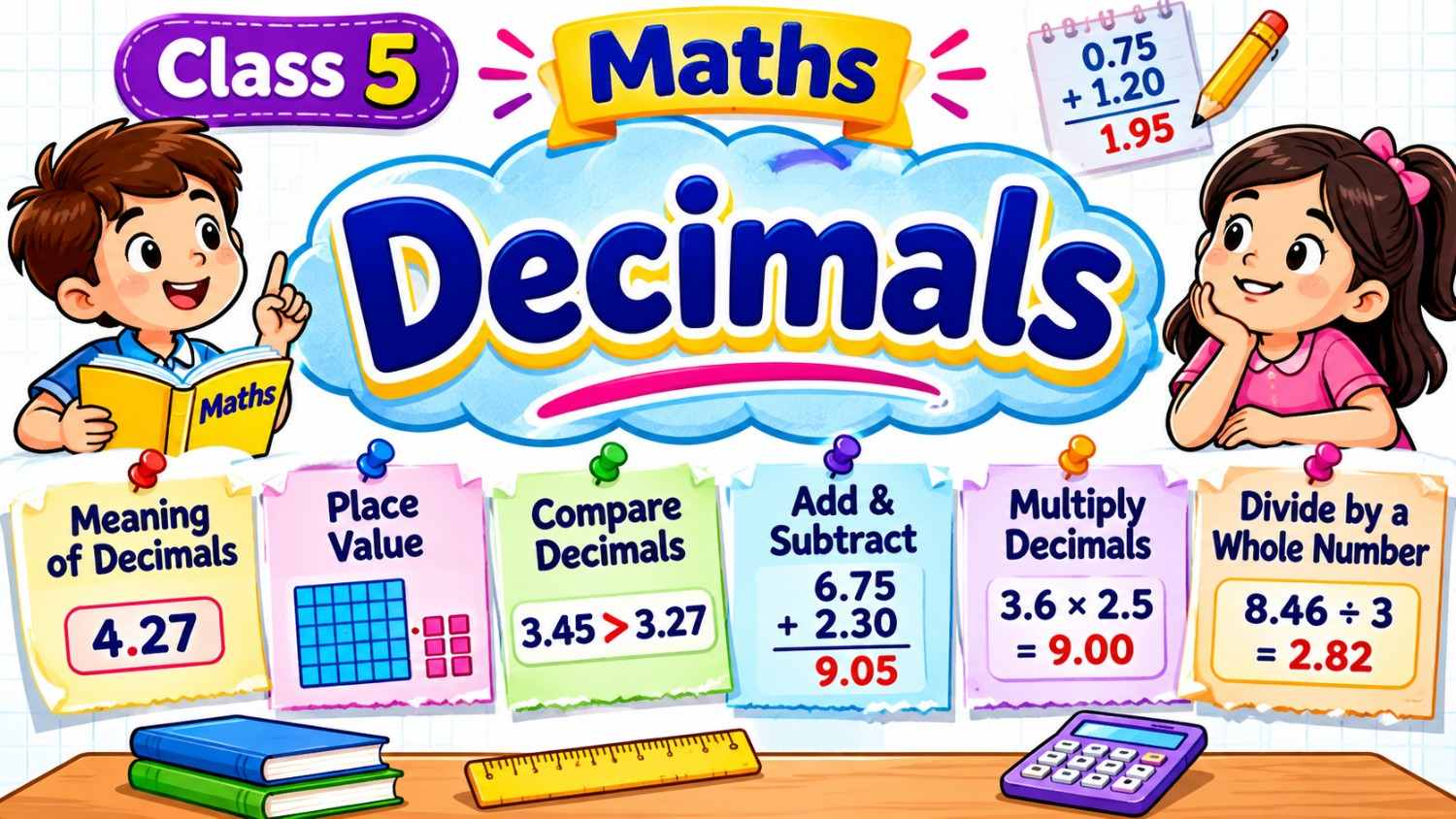
✨ What you will learn
- Decimal numbers and the decimal point
- Tenths, hundredths and thousandths
- Writing decimal fractions as decimal numbers, and back again
- Expanded form and comparing decimals
- Adding and subtracting decimals
🎯 Learning Objectives
- Identify the tenths, hundredths and thousandths places in a decimal number.
- Write decimal fractions such as 710 and 75100 as decimal numbers.
- Convert decimal numbers such as 2.5 into decimal fractions.
- Compare and arrange decimal numbers in ascending and descending order.
- Add and subtract decimal numbers correctly, with the decimal points in a line.
🗺️ Chapter Road Map
| Step | What to do |
| B · Notes | Learn the four big ideas about decimals |
| C · Pictures | See decimals as pictures and charts |
| D · Mind map | See the whole chapter on one page |
| E · Flash cards | Test yourself with 20 quick cards |
| F · Q&A | Write short and long answers |
| G · Case studies | Use decimals in real Indian stories |
| H · Quiz | Take the 25-question chapter quiz |
| I · Exercises | Practise 108 questions with answers |
📘 Section B: Concept Notes
Topic 1: Tenths, Hundredths and Thousandths
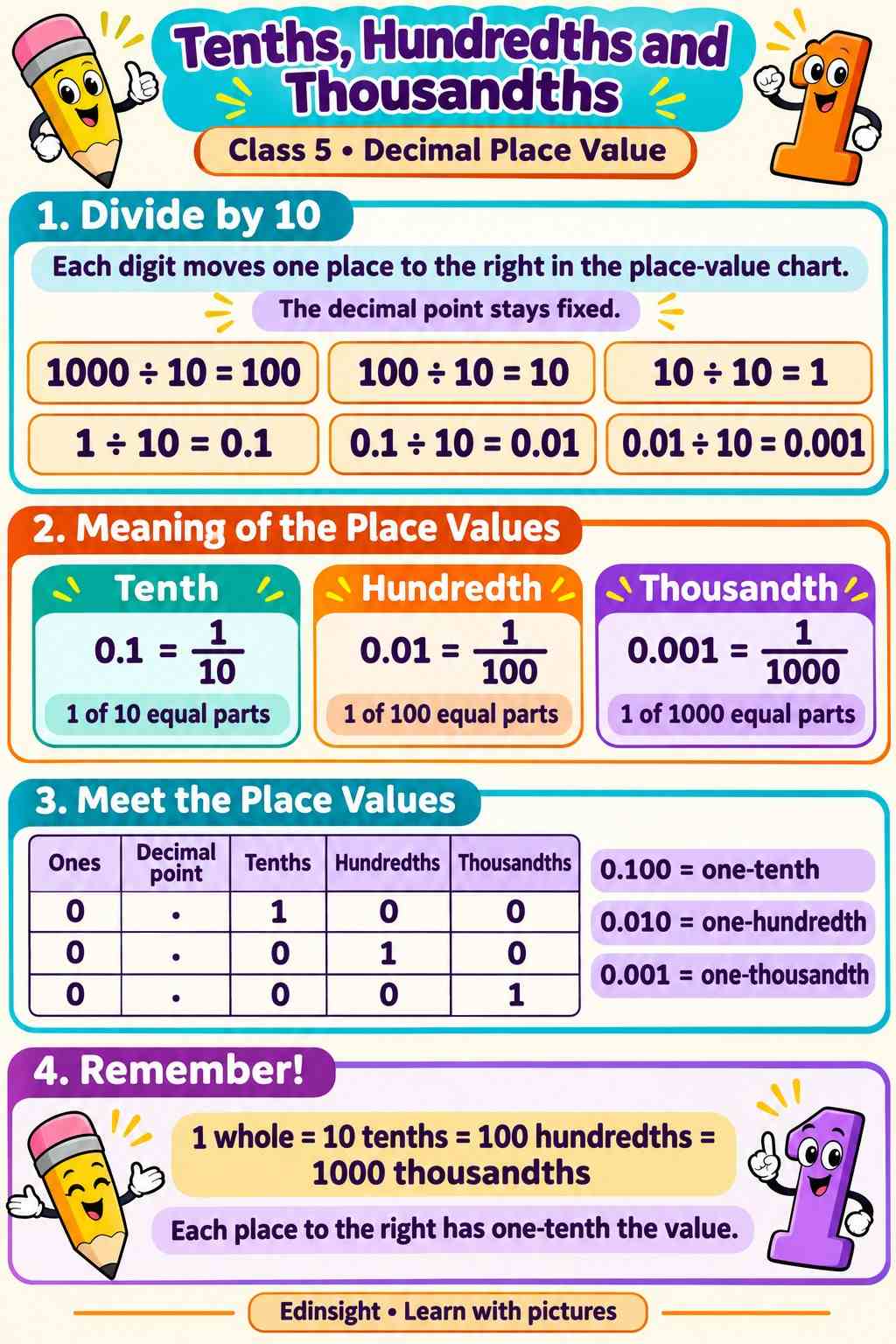
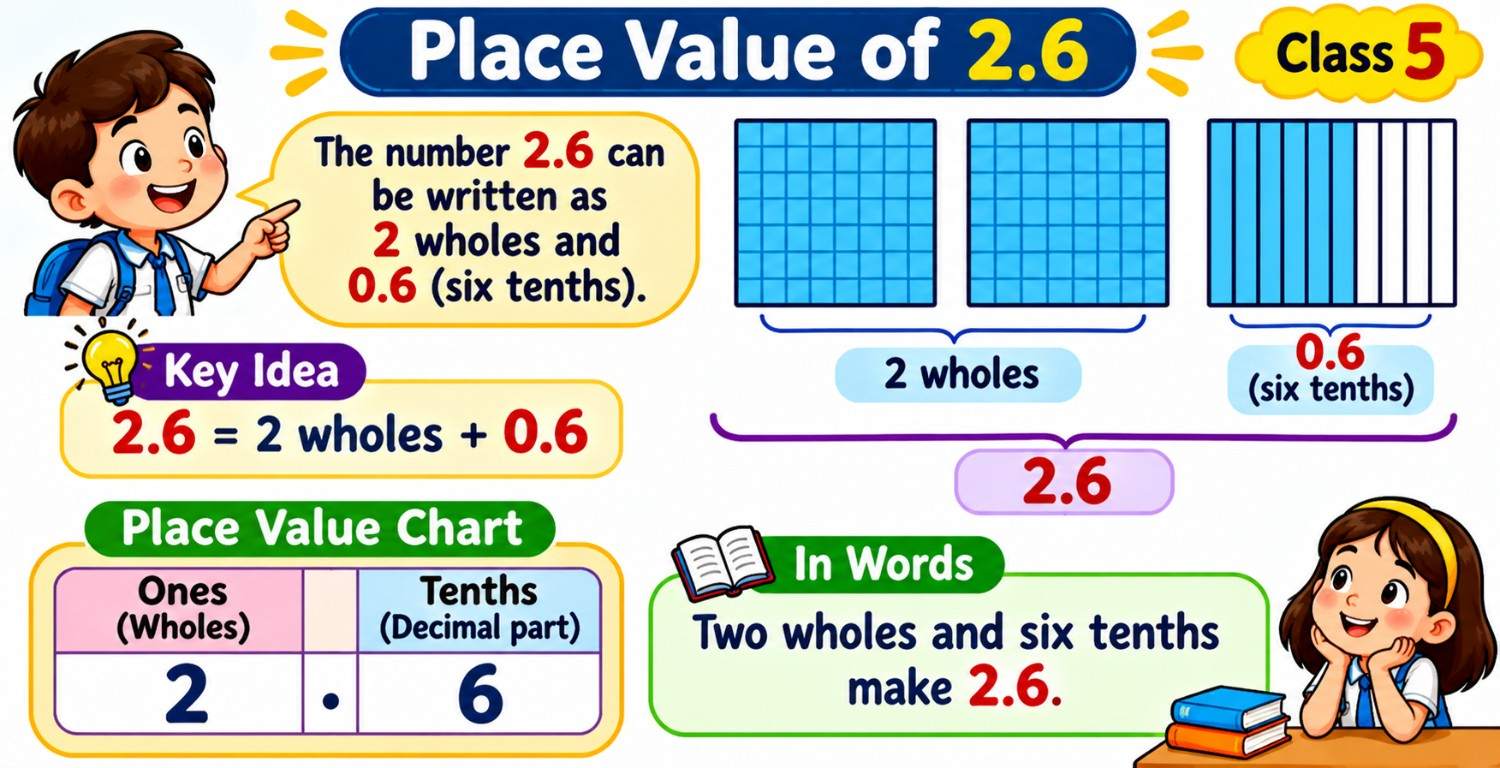
Decimal point: the dot that separates the whole part from the decimal part.
Tenths: one of ten equal parts.
Hundredths: one of hundred equal parts.
Thousandths: one of thousand equal parts.
Topic 2: Decimal Fractions and Decimal Numbers
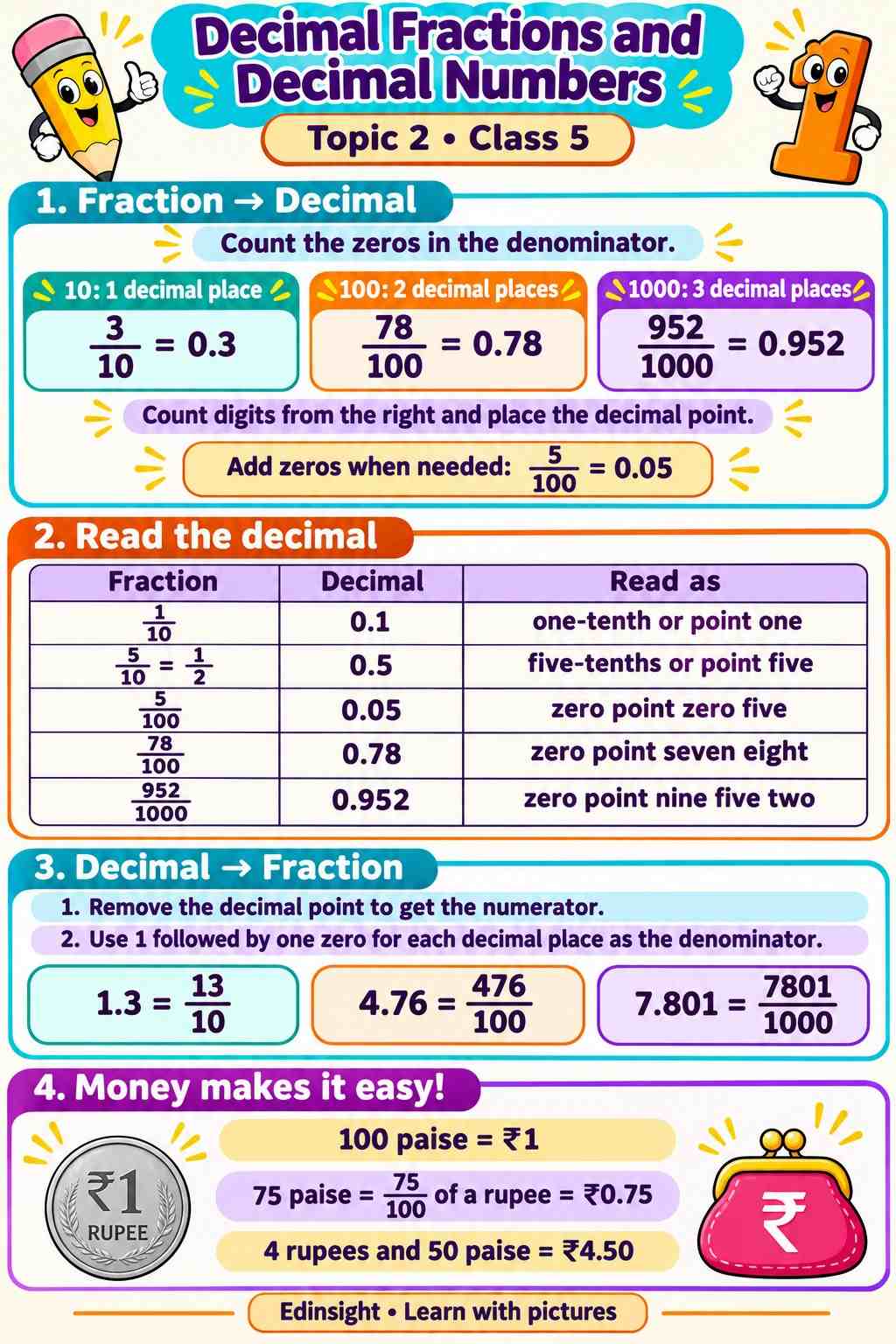
Equivalent decimals: decimals with the same value, such as 0.5 = 0.50 = 0.500.
Decimal number: a number with a whole part and a decimal part, such as 2.6.
Topic 3: Expanded Form and Comparing Decimals
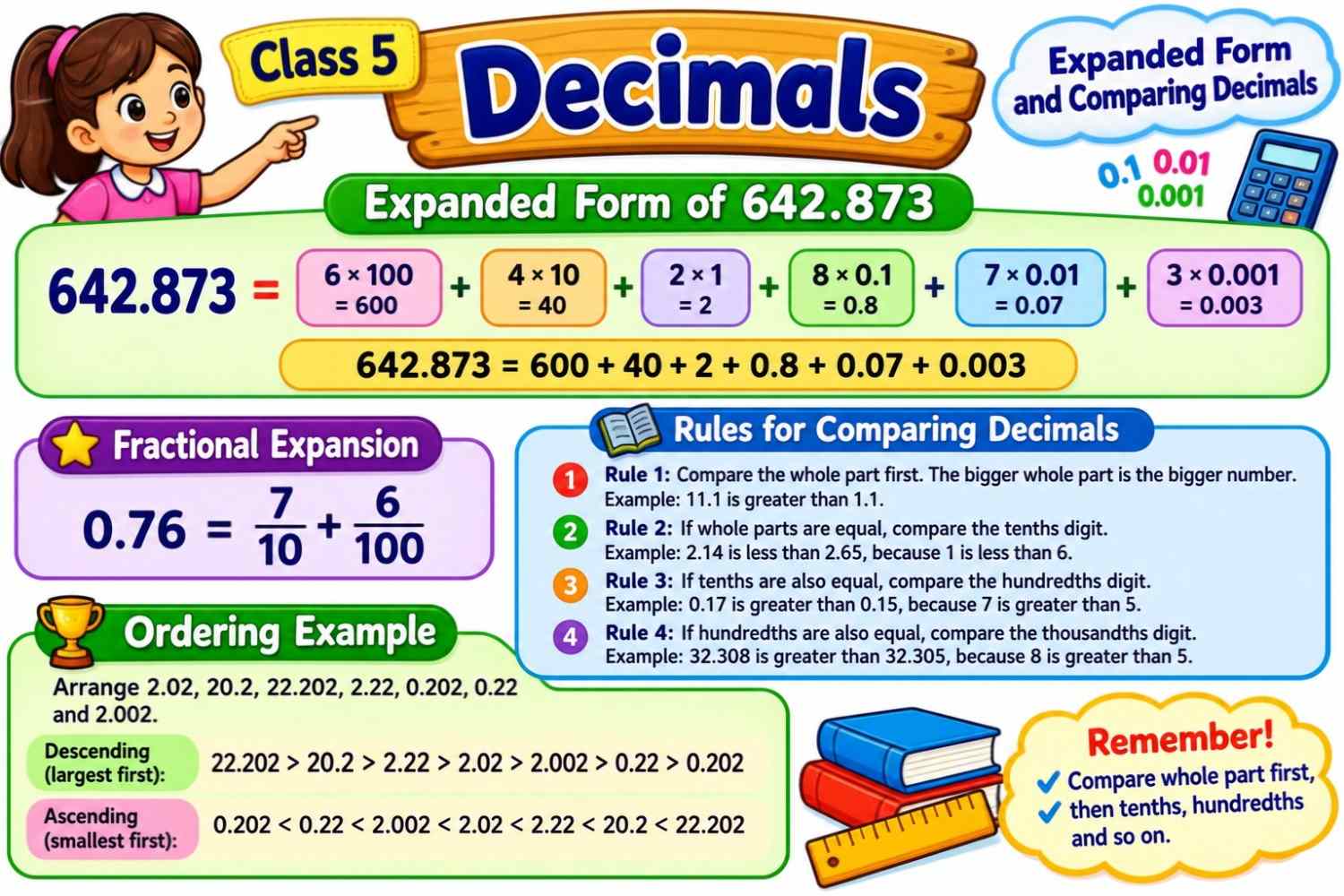
Integral part: the whole-number part of a decimal, such as 793 in 793.56.
Expanded form: writing a number as the sum of the value of each digit.
Topic 4: Adding and Subtracting Decimals
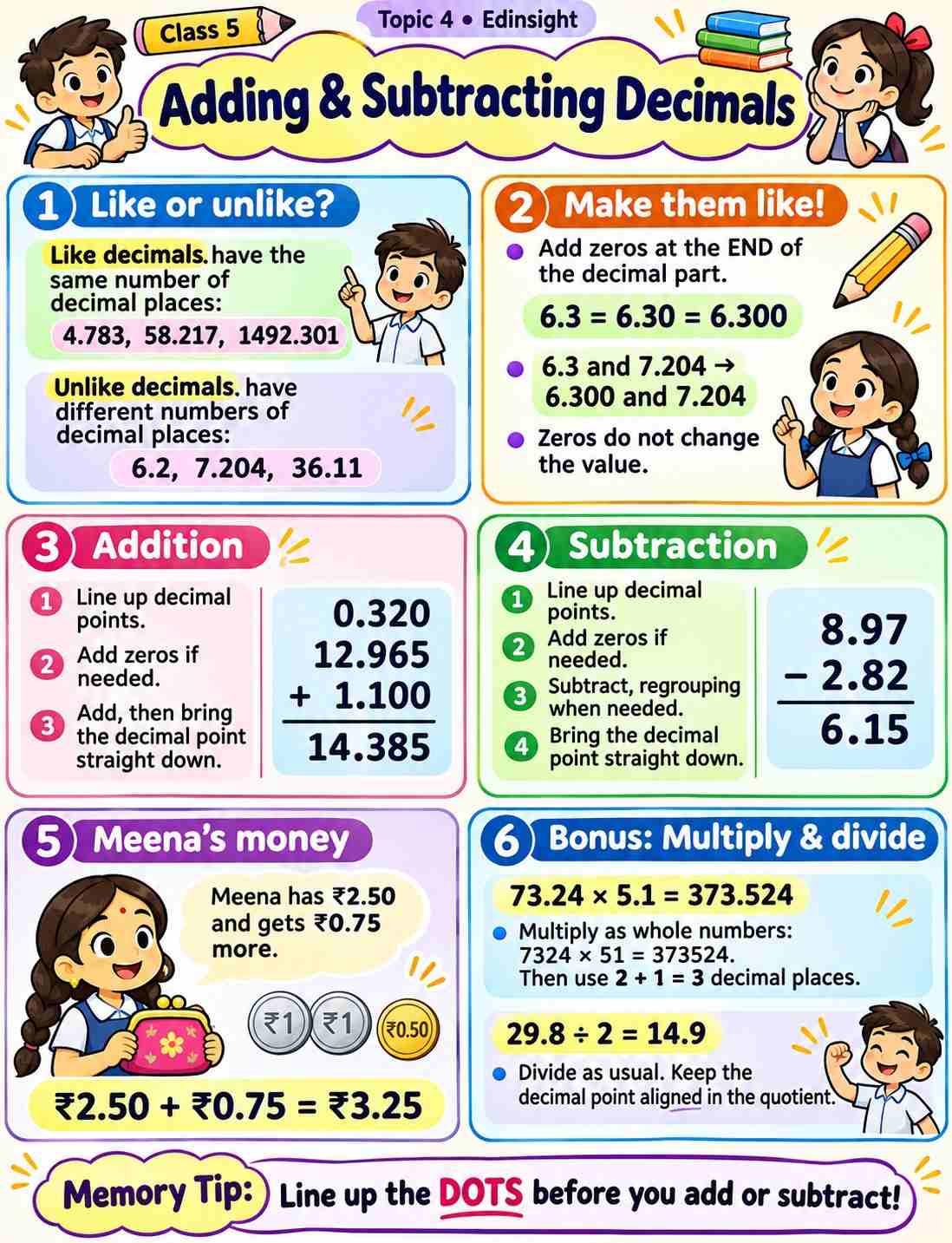
Like decimals: decimals with the same number of digits after the point.
Unlike decimals: decimals with different numbers of digits after the point.
🖼️ Section C: Picture Cards
Learn with decimal pictures. Each card shows one idea and its key idea.
Card 1: One-tenth 🟪
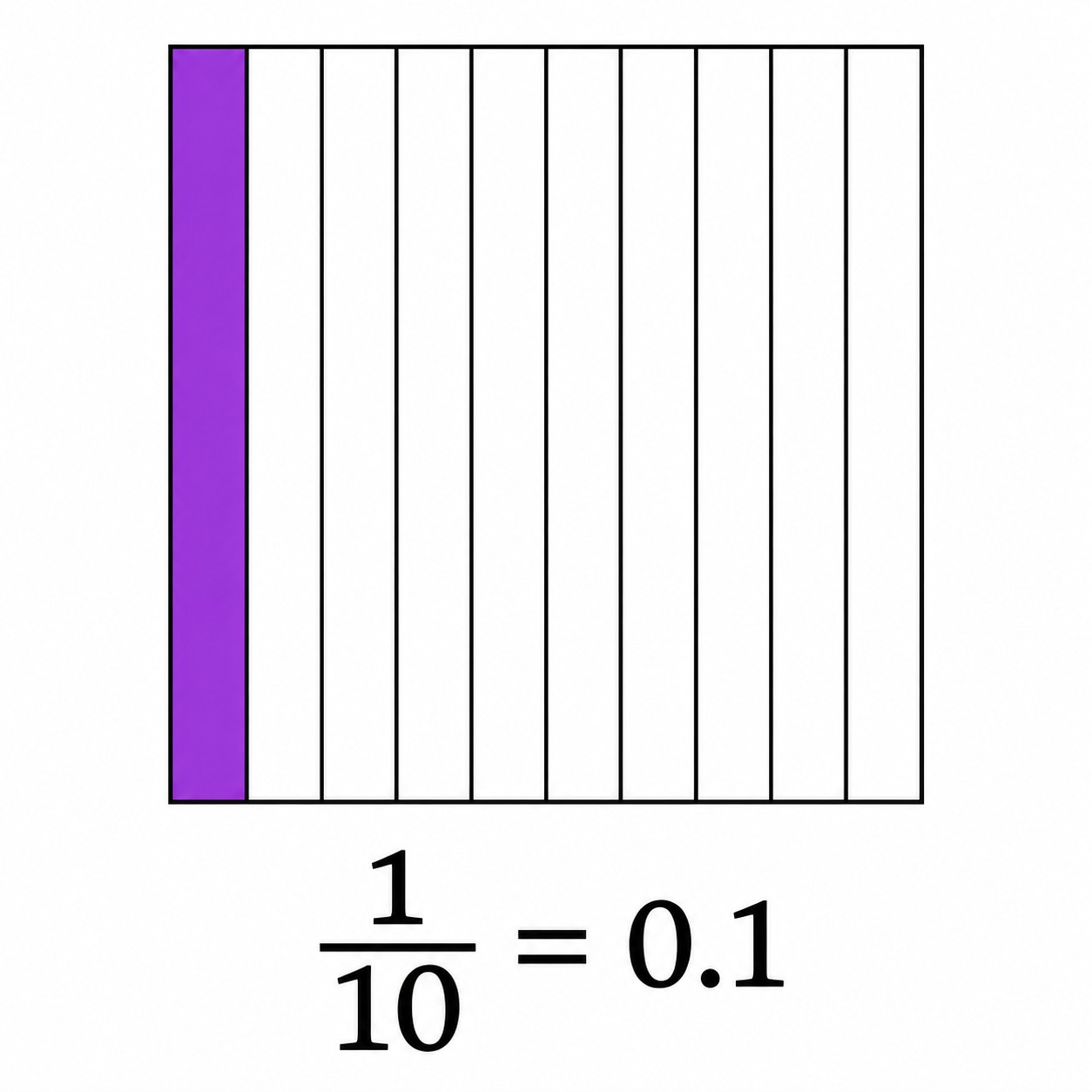
Key idea: One part out of ten equal parts is 0.1.
Card 2: One-hundredth 🟩
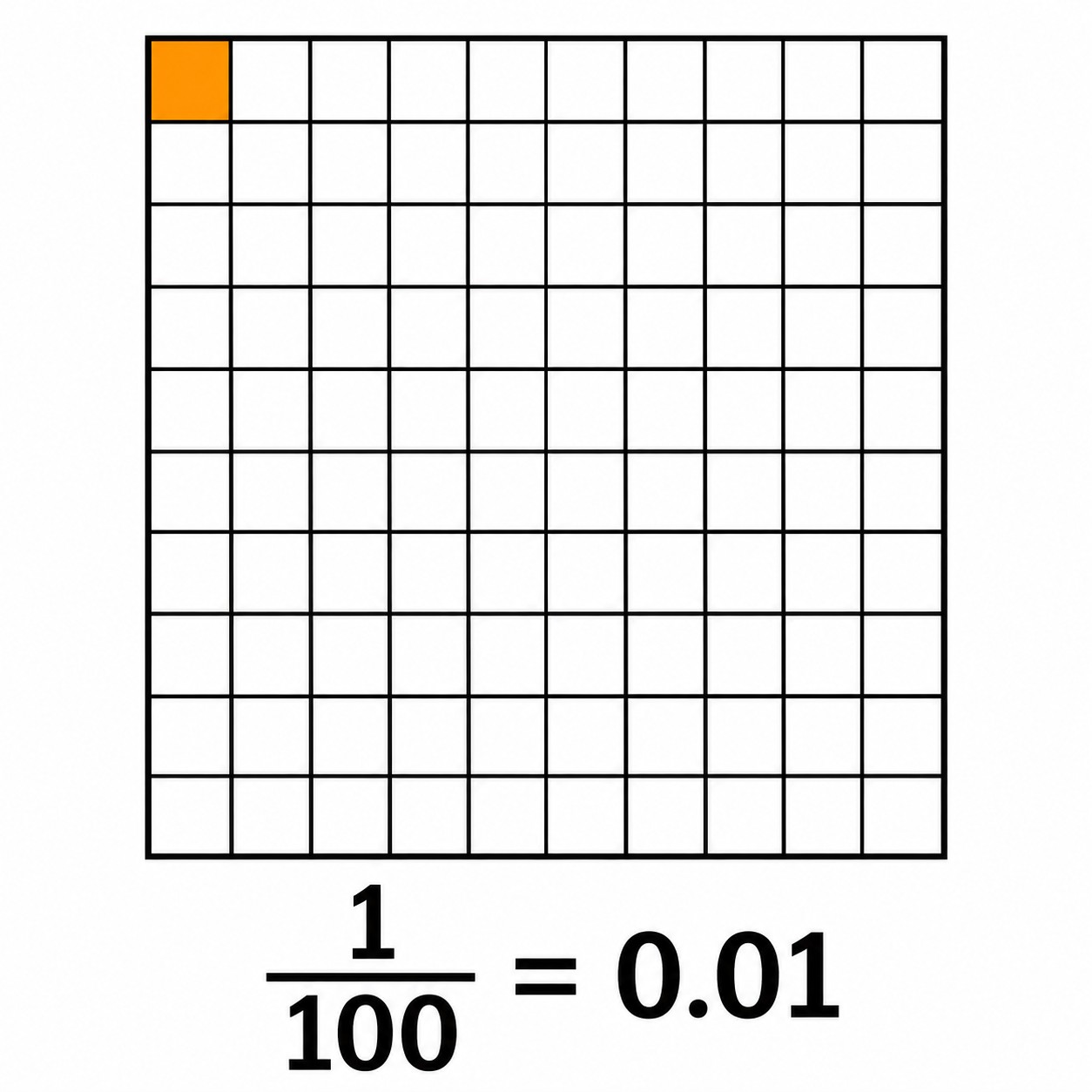
Key idea: One part out of one hundred equal parts is 0.01.
Card 3: One-thousandth 🧊
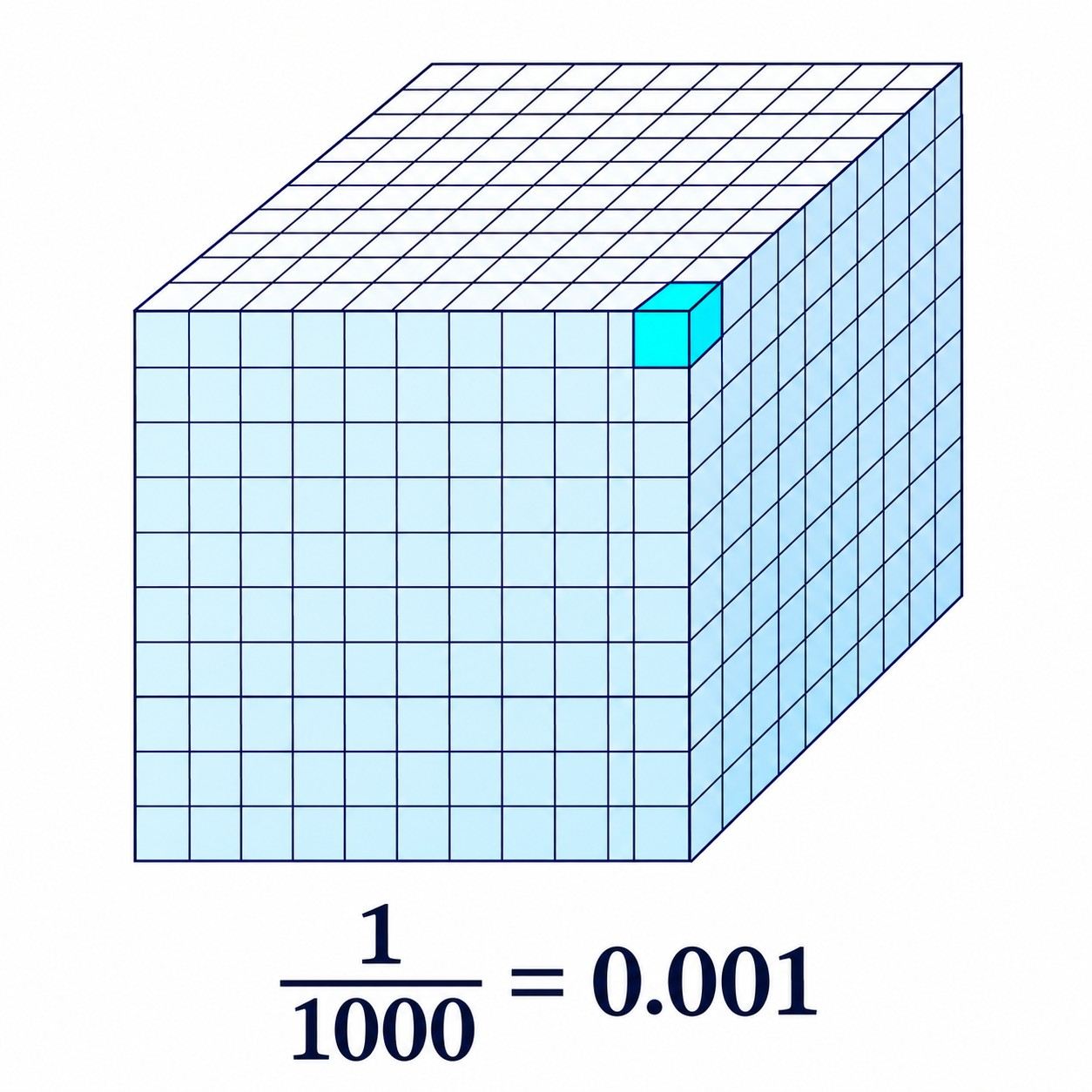
Key idea: One part out of one thousand equal parts is 0.001.
Card 4: Place value chart 📊
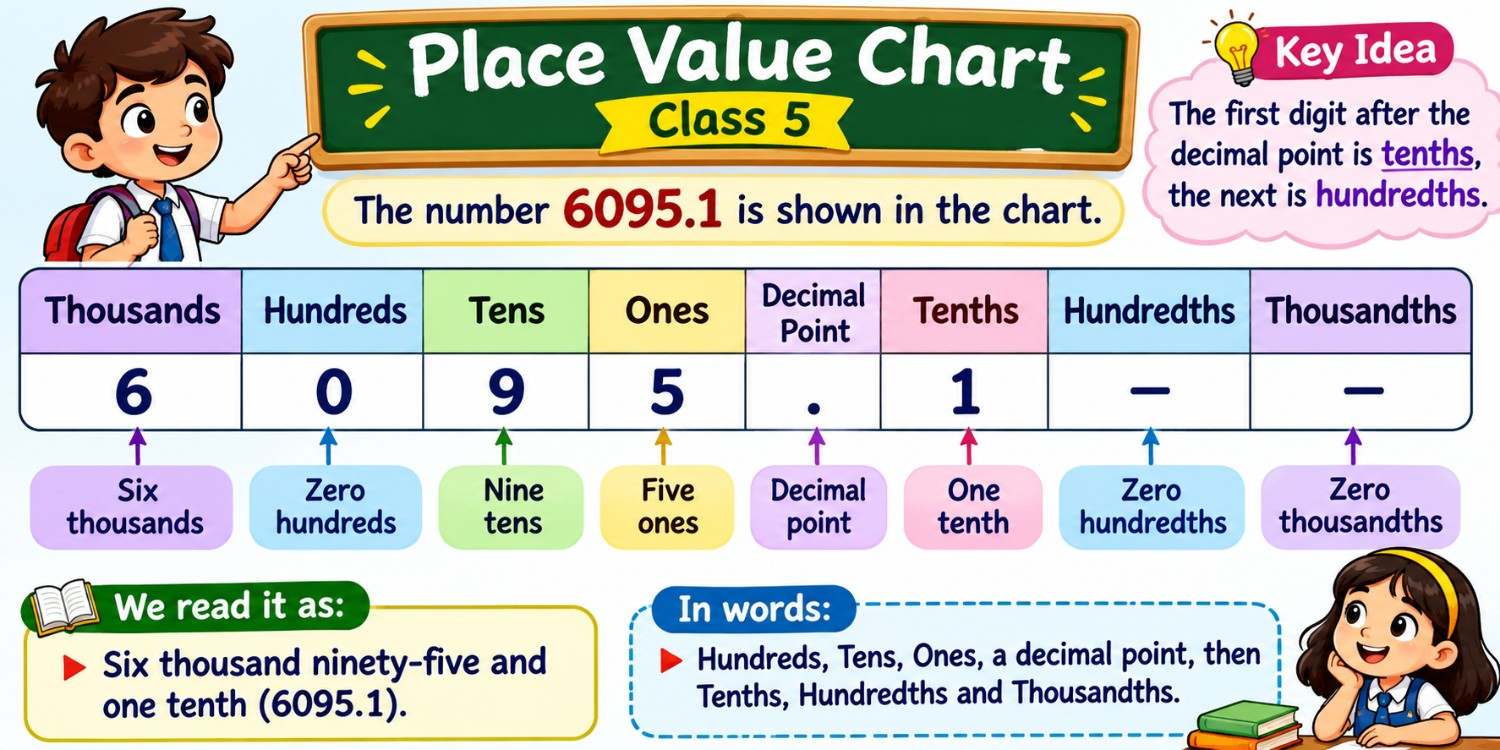
Key idea: The first digit after the point is tenths, the next is hundredths.
Card 5: Equivalent decimals ⚖️
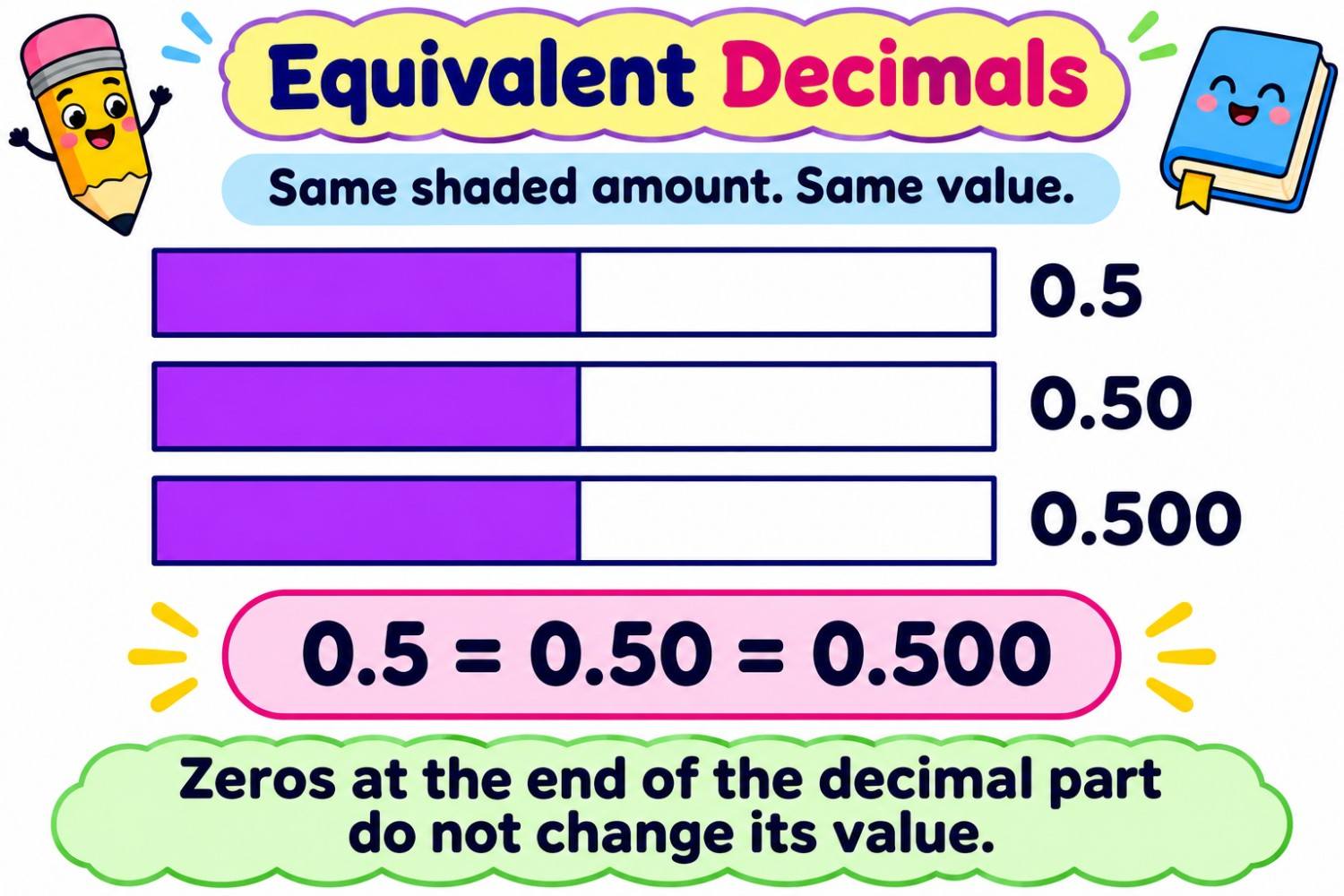
Key idea: Zeros at the end do not change the value.
Card 6: Whole and decimal parts 🧱
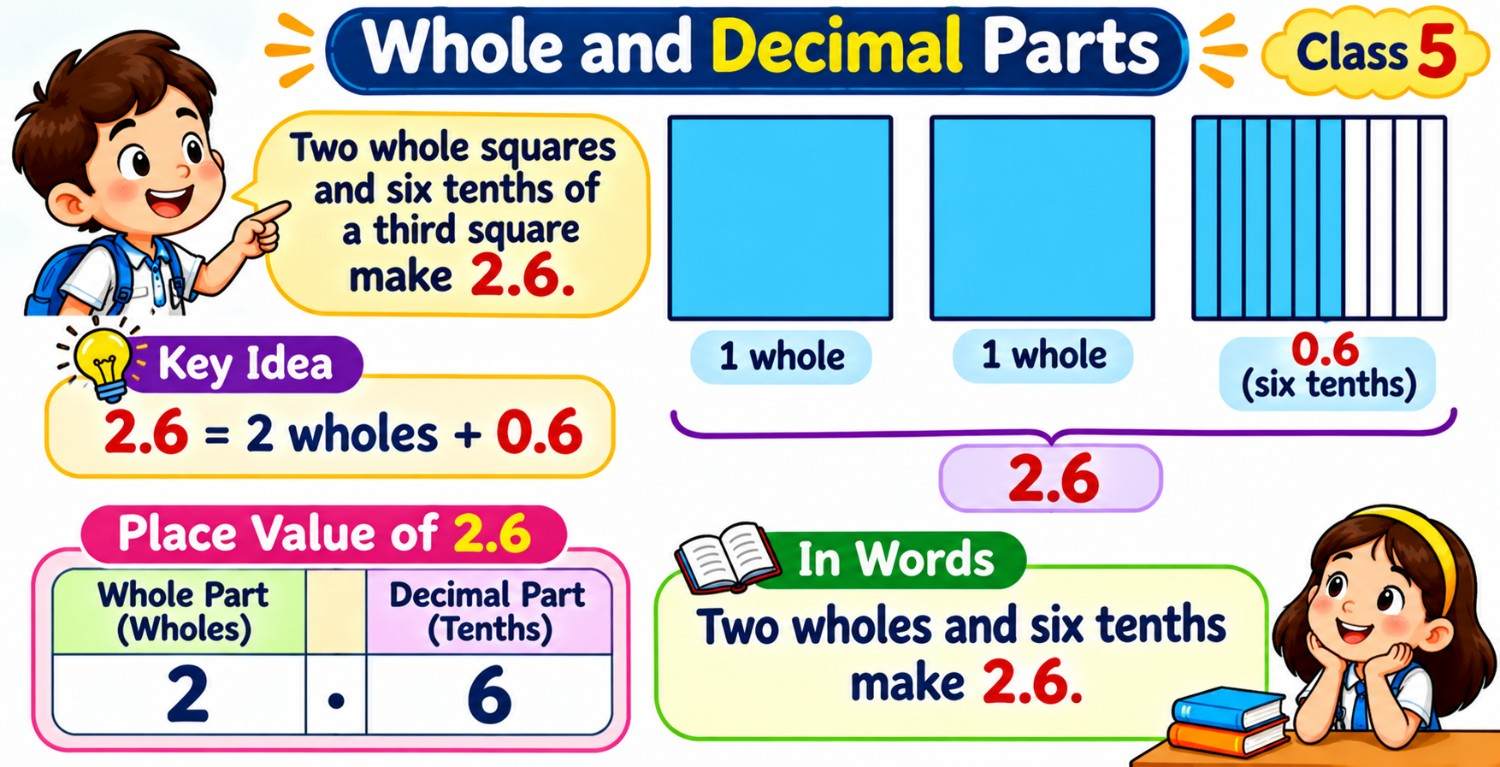
Key idea: 2.6 = 2 wholes + 0.6.
Card 7: Comparing decimals 🔍
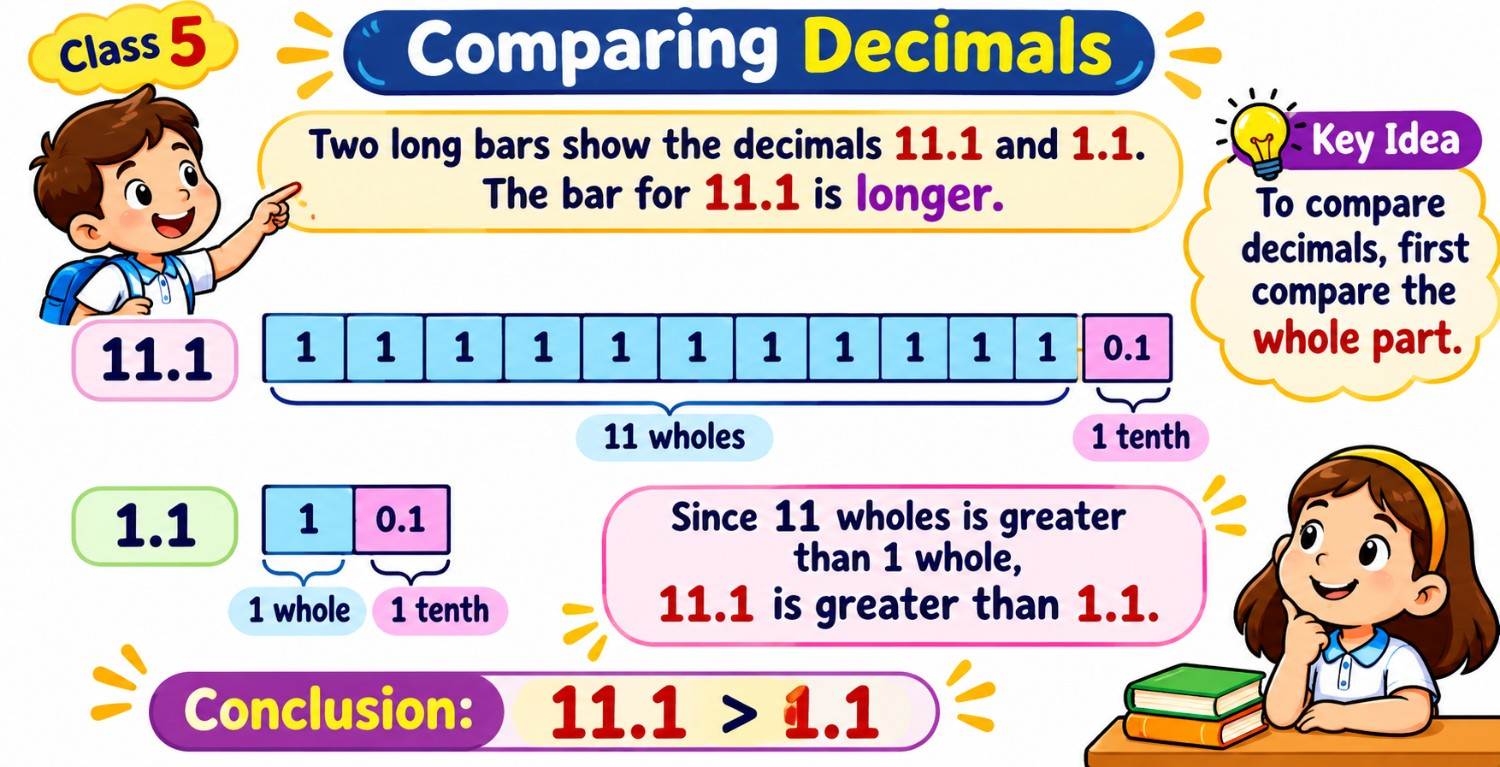
Key idea: Compare the whole part first.
Card 8: Adding decimals ➕
Key idea: Line up the decimal points before adding.
🌳 Section D: Mind Map
The Decimal Tree
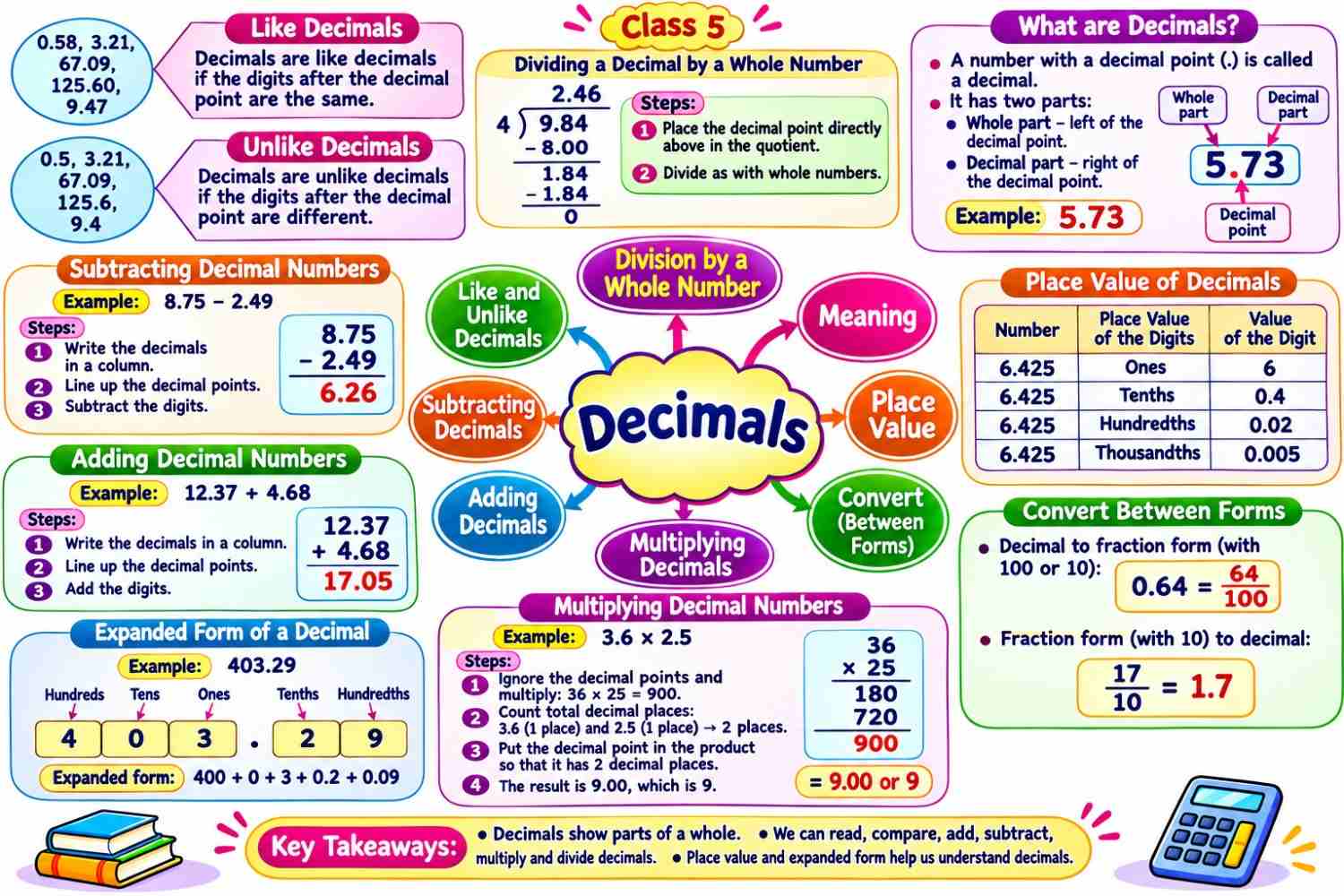
🌱 Roots (what is a decimal?)
A decimal number has a whole part, a decimal point and a decimal part. Example: 2.6.
🪵 Trunk (place values)
Tenths (110), hundredths (1100), thousandths (11000).
🌿 Branch 1: Convert
Fraction to decimal: 78100 = 0.78. Decimal to fraction: 1.3 = 1310.
🌿 Branch 2: Compare
Whole part first, then tenths, hundredths, thousandths.
🌿 Branch 3: Calculate
Line up the decimal points, add zeros, then add or subtract.
🍎 Fruits (real life)
Money (₹12.50), length (1.75 m), weight (2.5 kg) and time (1.5 hours).
📝 The same mind map in words (outline)
- Decimals
- Meaning: whole part + decimal point + decimal part
- Place values: tenths, hundredths, thousandths
- Conversions: fraction to decimal and back
- Expanded form: 642.873 = 600 + 40 + 2 + 0.8 + 0.07 + 0.003
- Comparing: whole part, tenths, hundredths, thousandths
- Adding and subtracting: line up the decimal points
1. Dividing by 10 moves the digit one place right.
2. Zeros at the end do not change a decimal.
3. Line up decimal points before adding or subtracting.
🃏 Section E: Flash Cards
Tap a card to see the answer.
1. What is 110 as a decimal?
0.1, read as one-tenth or point one.
2. What is 1100 as a decimal?
0.01, read as one-hundredth or zero point zero one.
3. What is 11000 as a decimal?
0.001, read as one-thousandth.
4. What is the decimal point?
The dot that separates the whole part from the decimal part.
5. What is 510 as a decimal?
0.5, the same as one-half.
6. Write 78100 as a decimal.
0.78, read as zero point seven eight.
7. Write 1.3 as a decimal fraction.
1310.
8. Write 4.76 as a decimal fraction.
476100.
9. Are 0.5 and 0.500 equal?
Yes. Zeros at the end do not change the value.
10. How do you read 0.05?
Zero point zero five, which is five hundredths.
11. What is the expanded form of 3.42?
3 + 0.4 + 0.02.
12. Which digit is in the hundredths place of 6.289?
8.
13. Which is bigger, 2.7 or 2.65?
2.7, because 7 tenths is more than 6 tenths.
14. Which is bigger, 0.17 or 0.15?
0.17, because 7 hundredths is more than 5 hundredths.
15. What are like decimals?
Decimals with the same number of digits after the decimal point.
16. Make 6.3 and 7.204 like decimals.
6.300 and 7.204.
17. What is 0.32 + 12.965?
13.285. Line up the decimal points first.
18. What is 8.97 minus 2.82?
6.15.
19. What happens to digits when you divide by 10?
Each digit moves one place to the right.
20. Why is 0.3 greater than 0.25?
0.30 is greater than 0.25, because 3 tenths is more than 2 tenths.
✍️ Section F: Q&A (Short and Long Answers)
Short Answer Questions (10)
Tap to see the model answer.
S1. What is a decimal number? Give one example.
A decimal number has a whole part and a decimal part, separated by a decimal point. For example, 275.35 has whole part 275 and decimal part 35. The decimal point separates the two parts.
S2. What is the value of the digit 7 in 3.765?
The digit 7 is in the tenths place, so its value is 7 tenths, which is 0.7. Each digit after the decimal point has a smaller place value than the one before it.
S3. Write 310 as a decimal number.
When the denominator is 10, put the decimal point before the first digit from the right of the numerator. So 310 is written as 0.3, read as zero point three or three-tenths.
S4. Write 5100 as a decimal number.
When the denominator is 100, put the decimal point before the second digit from the right. Since 5 has only one digit, add a zero in front. So 5100 is written as 0.05.
S5. Write 1.3 as a decimal fraction.
Remove the decimal point to get 13. There is one digit after the point, so the denominator is 10. Write the number as the numerator over the denominator. So 1.3 = 1310, read as thirteen tenths.
S6. Expand 642.873 in decimal form.
642.873 = 600 + 40 + 2 + 0.8 + 0.07 + 0.003. Each digit is multiplied by its place value. The 6 is in hundreds, the 4 in tens, the 2 in ones, the 8 in tenths, the 7 in hundredths and the 3 in thousandths.
S7. Which is greater, 11.1 or 1.1? Why?
11.1 is greater. The whole part of 11.1 is 11, which is more than 1, the whole part of 1.1. The rule is to compare the whole parts first. If the whole parts are different, we do not need to look at the decimal parts at all.
S8. Compare 0.17 and 0.15. Which is greater?
0.17 is greater. The whole parts are both 0 and the tenths digits are both 1. The hundredths digits are 7 and 5, and 7 is greater than 5. So 0.17 is greater than 0.15, and we can check it with a 10 by 10 grid of small squares.
S9. Make 6.3 and 7.204 like decimals.
Like decimals have the same number of digits after the point. Add zeros to 6.3 to get 6.300. Now 6.300 and 7.204 both have three digits after the point, so they are like decimals.
S10. What is 8.97 minus 2.82?
Line up the decimal points and subtract. Write 8.97 above 2.82 with the decimal points in one column. Subtract hundredths, then tenths, then ones. 8.97 minus 2.82 is 6.15. Bring the decimal point straight down into the answer.
Long Answer Questions (5)
Tap to see the model answer.
L1. Explain place value of digits after the decimal point, with an example.
Introduction: A decimal number has digits after the decimal point. Each of these digits has a place value.
Main points: The first digit after the point is in the tenths place, and its value is 110. The second digit is in the hundredths place, value 1100. The third digit is in the thousandths place, value 11000. Each place is ten times smaller than the place before it.
Example: In 127.536, the digit 5 is in the tenths place, 3 is in the hundredths place and 6 is in the thousandths place.
Conclusion: Knowing place value helps us read, write and compare decimal numbers correctly.
L2. How do we write a decimal fraction as a decimal number?
Introduction: A decimal fraction has a denominator of 10, 100 or 1000. We can write it as a decimal number.
Main points: If the denominator is 10, put the point before the first digit from the right. If it is 100, put the point before the second digit. If it is 1000, put it before the third digit. Add zeros in front when needed.
Example: 5100 becomes 0.05, and 9521000 becomes 0.952.
Conclusion: Count the zeros in the denominator. That number tells you how many digits go after the decimal point.
L3. Explain the rules for comparing two decimal numbers.
Introduction: When we compare decimal numbers, we follow a set order of steps.
Main points: First compare the whole parts. The bigger whole part is the bigger number. If the whole parts are equal, compare the tenths digits. If these are also equal, compare the hundredths, and then the thousandths digits.
Example: Compare 2.14 and 2.65. Both whole parts are 2. The tenths digits are 1 and 6, and 6 is bigger, so 2.14 is less than 2.65.
Conclusion: Always compare place by place, starting from the left, and never judge by the number of digits.
L4. Explain how to add decimal numbers correctly.
Introduction: Adding decimals is like adding whole numbers, but we must be careful with the decimal point.
Main points: Write the numbers one below the other so the decimal points are in one column. Add zeros at the end of numbers so each has the same number of digits after the point. Add as whole numbers, then place the decimal point in the answer in the same column.
Example: 0.32 + 12.965 + 1.1 is written as 0.320 + 12.965 + 1.100, which equals 14.385.
Conclusion: Lining up the decimal points gives a correct answer every time.
L5. Why is it useful to know decimals in daily life? Give examples from India.
Introduction: We use decimals every day, often without noticing.
Main points: Money is written with decimals: 1 rupee is 100 paise, so 50 paise is ₹0.50. Length is measured in metres and centimetres, so 1.25 m is 1 metre and 25 centimetres. Weight is written in kilograms, so 2.5 kg is 2 kg and 500 grams.
Example: At a Mumbai vegetable shop, if you buy 1.5 kg of onions at ₹40 per kg, you pay for the decimal part as well.
Conclusion: Decimals help us shop, measure and count accurately, so every student must learn them well.
🏫 Section G: Case Studies
Apply Decimals in Real Life
Read each story, then answer the five questions. Tap the answer block to check.
Story 1: Sharma Kirana Store in Dadar
Mr. Sharma keeps a small shop in Dadar. On Monday he sold 2.5 kg of rice and 0.75 kg of dal. On Tuesday he sold 1.25 kg of rice. A customer bought 0.5 kg of sugar. Mr. Sharma writes each weight with a decimal point in his notebook. He wants to know how much he sold in total.
- How much rice did Mr. Sharma sell in total on Monday and Tuesday?
- What is the total weight of rice and dal sold on Monday?
- Which is greater: 0.75 kg of dal or 0.5 kg of sugar?
- Write 0.5 kg as a decimal fraction.
- How many kilograms did he sell on Monday in all, including sugar?
Tap to see the answers
1. 2.5 + 1.25 = 3.75 kg of rice. Line up the decimal points and add.
2. 2.5 + 0.75 = 3.25 kg.
3. 0.75 is greater than 0.5 (which is 0.50), because 7 tenths is more than 5 tenths.
4. 0.5 = 510.
5. 2.5 + 0.75 + 0.5 = 3.75 kg in all, including the sugar.
Story 2: The Sports Day Race
Riya and Tanvi ran the 50 metre race on Sports Day at their school in Pune. Riya finished in 8.45 seconds. Tanvi finished in 8.54 seconds. The teacher wrote both times on the board. Later, the teacher asked the class to put the four top times in order from fastest to slowest. The other two times were 8.5 seconds and 8.405 seconds.
- Which girl finished first, Riya or Tanvi?
- Compare 8.45 and 8.54. Which is smaller?
- Write 8.5 with two decimal places.
- Arrange 8.45, 8.54, 8.5 and 8.405 from fastest (smallest) to slowest (largest).
- How much faster was Riya than Tanvi? Give the answer as a decimal.
Tap to see the answers
1. Riya, because 8.45 is less than 8.54.
2. 8.45 is smaller, because the tenths digits are 4 and 5, and 4 is smaller.
3. 8.50.
4. 8.405, 8.45, 8.5, 8.54. Compare the tenths, then the hundredths, then the thousandths.
5. 8.54 − 8.45 = 0.09 seconds.
Story 3: Ananya’s Rangoli for Diwali
Ananya is making a rangoli for Diwali in her building in Borivali. She needs red powder, green powder and yellow powder. She uses 0.3 kg of red powder, 0.25 kg of green powder and 0.7 kg of yellow powder. She has a bag with 1.5 kg of powder before she starts, and she uses only what she needs for the design.
- Which colour powder did Ananya use the most?
- Which is smaller, 0.3 kg or 0.25 kg?
- Write 0.7 kg as a decimal fraction.
- What is the total weight of red and green powder together?
- How much powder is left in the bag after she uses all three colours? (Use 1.5 kg as the starting amount.)
Tap to see the answers
1. Yellow powder, 0.7 kg, because 0.7 is greater than 0.3 and 0.25.
2. 0.25 kg is smaller. Write 0.3 as 0.30; 0.25 is smaller than 0.30.
3. 0.7 = 710.
4. 0.30 + 0.25 = 0.55 kg.
5. Total used is 0.3 + 0.25 + 0.7 = 1.25 kg. Left is 1.5 − 1.25 = 0.25 kg.
Story 4: Rohan’s Savings Jar
Rohan keeps his pocket money in a jar in his home in Kalyan. In the first week he saved ₹25.50. In the second week he added ₹10.75. He then gave ₹5.25 to his grandmother for her puja items. Rohan wants to know how much money he has now. He also wants to check if he has more than ₹30 saved.
- How much money did Rohan save in two weeks?
- Is ₹25.5 the same amount as ₹25.50? Why?
- How much money is left after he gives ₹5.25 to his grandmother?
- Is ₹25.50 greater than ₹25.05?
- Does Rohan have more than ₹30 now? Show your work.
Tap to see the answers
1. ₹25.50 + ₹10.75 = ₹36.25.
2. Yes, it is the same amount. 25.5 = 25.50, because adding a zero at the end does not change the value.
3. 36.25 − 5.25 = ₹31.00.
4. Yes. 25.50 is greater than 25.05, because 5 tenths is more than 0 tenths.
5. Yes, he has ₹31.00, which is more than ₹30.
Story 5: Kavya’s Rakhi Ribbon
Kavya is making rakhis for her cousins in Thane. She bought a ribbon of length 3.6 m from the market. She used 1.85 m for the first rakhi. Then she cut the rest into two equal pieces to make two more rakhis. Her friend asked her how long each piece is, and how much ribbon is left at the end of the work.
- Write 3.6 m as a decimal fraction.
- How much ribbon is left after the first rakhi? Use 3.60 − 1.85.
- Divide the remaining ribbon into two equal pieces. How long is each piece?
- Compare 1.85 m and 1.8 m. Which is greater?
- If she had 3.6 m and used it all for 4 rakhis of the same length, how long is each rakhi?
Tap to see the answers
1. 3.6 = 3610.
2. 3.60 − 1.85 = 1.75 m.
3. 1.75 ÷ 2 = 0.875 m each. Check: 0.875 + 0.875 = 1.75.
4. 1.85 is greater than 1.8, because 1.80 is less than 1.85.
5. 3.6 ÷ 4 = 0.9 m each.
🏆 Section H: Quiz
✅ Section H: Quiz
25 multiple choice questions: 10 easy, 10 medium and 5 application. Only one option is correct. After each answer you will see the correct answer and why.
Start the quiz ➜You now know how to read, write, compare and add decimals. Keep practising with your parents and teachers.
✏️ Section I: Practice Exercises
Topic-Wise Practice: 108 Questions
I.1 · Place Value of Decimal Digits
- In 45.267, which digit is in the tenths place?
- In 45.267, which digit is in the hundredths place?
- In 3.084, what is the value of the digit 8?
- In 92.605, what is the value of the digit 6 after the point?
- In 7.419, what is the value of the digit 9?
- In 0.357, what is the value of the digit 5?
- In 110.11, what is the value of the first 1 after the point?
- How many digits are there after the decimal point in 6.0045?
Tap to see the answers
- 2
- 6
- 0.08 (8 hundredths)
- 0.6 (6 tenths)
- 0.009 (9 thousandths)
- 0.05 (5 hundredths)
- 0.1 (1 tenth). The second 1 is 0.01 (1 hundredth).
- 4
I.2 · Reading and Writing Decimals in Words
- Write 4.5 in words.
- Write 0.08 in words.
- Write 12.345 in words.
- Write 100.1 in words.
- Write 0.004 in words.
- Write 56.07 in words.
- Write ‘Forty-two point five’ in numerals.
- Write ‘Zero point zero nine’ in numerals.
Tap to see the answers
- Four point five
- Zero point zero eight
- Twelve point three four five
- One hundred point one
- Zero point zero zero four
- Fifty-six point zero seven
- 42.5
- 0.09
I.3 · Decimal Fractions to Decimal Numbers
- Write 310 as a decimal number.
- Write 910 as a decimal number.
- Write 27100 as a decimal number.
- Write 6100 as a decimal number.
- Write 3511000 as a decimal number.
- Write 81000 as a decimal number.
- Write 4510 as a decimal number.
- Write 125100 as a decimal number.
- Write 1234100 as a decimal number.
- Write 51000 as a decimal number.
Tap to see the answers
- 0.3
- 0.9
- 0.27
- 0.06
- 0.351
- 0.008
- 4.5
- 1.25
- 12.34
- 0.005
I.4 · Decimal Numbers to Decimal Fractions
- Write 0.4 as a decimal fraction.
- Write 0.7 as a decimal fraction.
- Write 2.3 as a decimal fraction.
- Write 0.19 as a decimal fraction.
- Write 5.06 as a decimal fraction.
- Write 0.125 as a decimal fraction.
- Write 12.5 as a decimal fraction.
- Write 3.45 as a decimal fraction.
- Write 0.009 as a decimal fraction.
- Write 8.007 as a decimal fraction.
Tap to see the answers
- 410
- 710
- 2310
- 19100
- 506100
- 1251000
- 12510
- 345100
- 91000
- 80071000
I.5 · Equivalent and Like Decimals
- Write 0.6 with two zeros added at the end.
- Are 0.40 and 0.4 equal? Yes or no?
- Which decimal is equal to 2.5: 2.050, 2.500 or 2.005?
- Make 1.2 and 3.456 like decimals.
- Are 4.75 and 4.750 like decimals?
- Are 0.91 and 6.45 like decimals?
- Which decimal is like 2.345 and 7.123? Choose 9.12 or 9.123.
- Write 0.7 with four digits after the point.
Tap to see the answers
- 0.600
- Yes. Adding zeros at the end does not change the value.
- 2.500
- 1.200 and 3.456
- No. They have different numbers of digits after the point, but they are equal in value (equivalent decimals).
- Yes. Both have two digits after the point.
- 9.123 has three digits after the point, like 2.345 and 7.123. (9.12 is unlike them.)
- 0.7000
I.6 · Expanded Form of Decimals
- Write 3.5 in expanded form.
- Write 0.46 in expanded form.
- Write 27.84 in expanded form.
- Write 105.307 in expanded form.
- Write 6.009 in expanded form.
- Write 40 + 3 + 0.2 + 0.09 as a decimal number.
- Write 300 + 2 + 0.06 + 0.005 as a decimal number.
- Write 8 + 0.7 + 0.02 as a decimal number.
Tap to see the answers
- 3 + 0.5
- 0.4 + 0.06
- 20 + 7 + 0.8 + 0.04
- 100 + 5 + 0.3 + 0.007
- 6 + 0.009
- 43.29
- 302.065
- 8.72
I.7 · Comparing Decimals
- Fill the box with > or <: 4.5 ? 4.8
- Fill the box with > or <: 9.31 ? 9.13
- Fill the box with > or <: 6.07 ? 6.7
- Fill the box with >, < or =: 0.3 ? 0.30
- Fill the box with > or <: 12.4 ? 12.04
- Fill the box with > or <: 5.012 ? 5.021
- Fill the box with > or <: 0.6 ? 0.59
- Fill the box with > or <: 17.5 ? 7.15
- Fill the box with > or <: 0.08 ? 0.8
- Fill the box with > or <: 3.333 ? 3.33
Tap to see the answers
- 4.5 < 4.8
- 9.31 > 9.13
- 6.07 < 6.7
- 0.3 = 0.30
- 12.4 > 12.04
- 5.012 < 5.021
- 0.6 > 0.59
- 17.5 > 7.15
- 0.08 < 0.8
- 3.333 > 3.33
I.8 · Ordering Decimals
- Arrange in ascending order: 2.5, 0.25, 2.05, 0.52
- Arrange in descending order: 7.3, 7.03, 7.33, 7.333
- Arrange in ascending order: 10.1, 1.01, 11.01, 1.1
- Arrange in descending order: 0.6, 0.06, 0.066, 0.606
- Arrange in ascending order: 45.6, 4.56, 45.06, 4.506
- Arrange in descending order: 3.142, 3.14, 3.124, 3.2
- Arrange in ascending order: 0.9, 0.099, 0.909, 0.99
- Arrange in descending order: 22.22, 2.222, 22.2, 2.22
Tap to see the answers
- 0.25, 0.52, 2.05, 2.5
- 7.333, 7.33, 7.3, 7.03
- 1.01, 1.1, 10.1, 11.01
- 0.606, 0.6, 0.066, 0.06
- 4.506, 4.56, 45.06, 45.6
- 3.2, 3.142, 3.14, 3.124
- 0.099, 0.9, 0.909, 0.99
- 22.22, 22.2, 2.222, 2.22
I.9 · Addition of Decimals
- 2.5 + 1.3 = ?
- 4.25 + 3.5 = ?
- 0.6 + 0.75 = ?
- 12.09 + 7.4 = ?
- 5.125 + 2.75 = ?
- 9 + 0.45 = ?
- 3.07 + 6.93 = ?
- 0.8 + 0.08 + 0.008 = ?
- 14.6 + 3.25 + 0.5 = ?
- 22.04 + 7.6 = ?
Tap to see the answers
- 3.8
- 7.75
- 1.35
- 19.49
- 7.875
- 9.45
- 10
- 0.888
- 18.35
- 29.64
I.10 · Subtraction of Decimals
- 5.6 − 2.3 = ?
- 8.75 − 3.25 = ?
- 10 − 4.6 = ?
- 7.05 − 0.5 = ?
- 12.4 − 5.87 = ?
- 3.6 − 1.824 = ?
- 20 − 0.01 = ?
- 15.3 − 7.35 = ?
- 6.5 − 2.75 = ?
- 100 − 36.4 = ?
Tap to see the answers
- 3.3
- 5.5
- 5.4
- 6.55
- 6.53
- 1.776
- 19.99
- 7.95
- 3.75
- 63.6
I.11 · Multiplying and Dividing Decimals
- 4.36 × 10 = ?
- 0.57 × 100 = ?
- 3.9 ÷ 10 = ?
- 46.8 ÷ 100 = ?
- 0.4 × 1000 = ?
- 2.5 × 4 = ?
- 29.8 ÷ 2 = ?
- 7.35 ÷ 5 = ?
Tap to see the answers
- 43.6
- 57
- 0.39
- 0.468
- 400
- 10
- 14.9
- 1.47
I.12 · Word Problems and Challenge Questions
- Ravi bought 1.75 kg of potatoes and 0.5 kg of onions. What is the total weight?
- Meera had ₹50. She spent ₹12.75 on a pencil box and ₹18.5 on a notebook. How much is left?
- A 6.4 m ribbon is cut into 4 equal parts. How long is each part?
- Ajay runs 2.5 km in the morning and 1.75 km in the evening. How far does he run in all?
- A bottle has 1.5 litres of water. Sana drinks 0.75 litre in the morning and 0.5 litre in the afternoon. How much is left?
- Apples cost ₹120.50 per kg. What is the cost of 2 kg?
- Anita has 3.5 m of cloth and sews 2.75 m. How much cloth is left?
- Ram is 1.45 m tall and his sister is 1.3 m tall. How much taller is Ram?
- Challenge 1: What is 0.5 + 0.05 + 0.005?
- Challenge 2: Which digit can replace the box in 4.□7 to make it greater than 4.73? Choose 8 or 9.
Tap to see the answers
- 2.25 kg (1.75 + 0.50)
- ₹18.75 (12.75 + 18.50 = 31.25, and 50 − 31.25 = 18.75)
- 1.6 m
- 4.25 km
- 0.25 litre
- ₹241.00
- 0.75 m
- 0.15 m
- 0.555
- 8 or 9 (4.87 and 4.97 are both greater than 4.73)
✅ Practice Completion Checklist
- ☐ I can name the tenths, hundredths and thousandths places.
- ☐ I can write decimal fractions as decimal numbers, and back again.
- ☐ I can write decimals in words and expanded form.
- ☐ I can compare and arrange decimals correctly.
- ☐ I can add and subtract decimals with the decimal points in a line.
- ☐ I can multiply and divide decimals by 10, 100, 1000 and whole numbers.