👆 Tap a button to jump to that section, then tap the heading to open it. The blue H · Quiz button opens the chapter quiz.
🎯 Section A: Learning Objectives
💻 Chapter 1: The Amazing Journey of Computers
Class 5 · Computer & AI
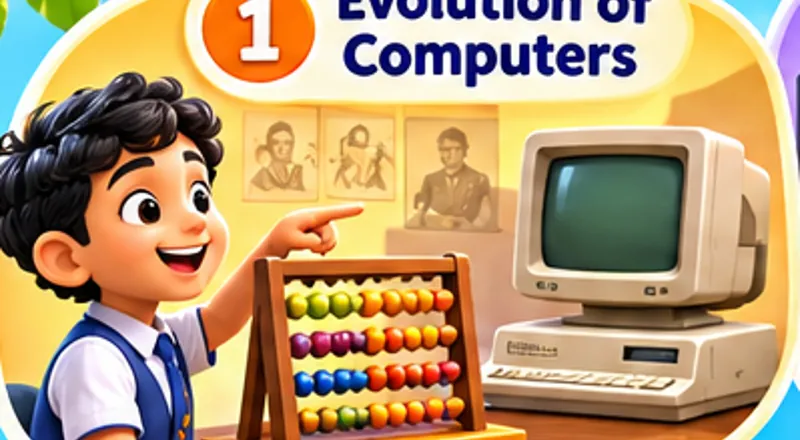
What you will learn
- Explain how people counted and calculated before computers were invented.
- Name the inventors and machines that led step by step to the modern computer.
- List the five generations of computers and what changed in each one.
- Describe the main characteristics of a computer, such as speed and accuracy.
- Explain the limitations of a computer, such as its lack of feelings and decision-making.
🧭 Before you start
You have already learnt that a computer is a powerful device. But have you ever thought, who invented the computer? This machine is the result of the work of many minds over thousands of years. Can you name one old calculating tool people used before computers?
Chapter Road Map
| Step | What we do | Where |
| 1 | Read the four topics on how computers were invented | Section B |
| 2 | Look at picture cards of famous machines and people | Section C |
| 3 | See the chapter as a mind map | Section D |
| 4 | Revise with 20 flash cards | Section E |
| 5 | Practise short and long answers | Section F |
| 6 | Read case studies and answer questions | Section G |
| 7 | Take the 25-question chapter quiz | Section H |
📘 Section B: Concept Notes
1. Early Calculating Devices
Story: Dev finds an old wooden frame with coloured beads in his grandfather’s cupboard. ‘This is an Abacus,’ says Dadaji. ‘Long before computers, people used tools like this one to count and calculate. Would you like to know how we went from beads on a wire to the laptop on your desk?’ Dev nods, and Dadaji begins the story of the amazing journey of computers.
Since ancient times, people have invented tools for calculation. Early humans tied knots in ropes and carved marks on clay to keep records. They also used fingers, toes, pebbles, stones, sticks, knotted strings and bones to count.
The first real step towards computing was the invention of the Abacus, around 3000 years ago in China. It is a wooden frame with beads on parallel wires, used to do simple calculations like addition and subtraction at a fast speed. The Abacus is still used in some schools today as an aid in teaching the numeral system.
In 1642, a mathematician named Blaise Pascal invented a calculating machine called the Pascaline Adding Machine, when he was only 19 years old. Numbers were fed into the machine by dialling them on wheels. The Pascaline is believed to be the first mechanical calculator in the world, but it could perform only addition and subtraction.
Earlier, in 1617, John Napier had invented a calculating device called Napier’s Bones. It was able to perform addition, subtraction, multiplication and division.
In 1672, a mathematician named Gottfried Wilhelm Leibniz expanded Blaise Pascal’s ideas and invented the digital mechanical calculator called the ‘Step Reckoner’. It was the first calculator that could perform all four arithmetic operations: addition, subtraction, multiplication and division.
- Abacus: a wooden frame with beads on wires, used for simple calculations
- Pascaline: Blaise Pascal’s mechanical adding machine of 1642
- Napier’s Bones: John Napier’s 1617 device for all four operations
- Step Reckoner: Leibniz’s 1672 calculator, the first for all four operations
The Abacus (3000 years ago) only added and subtracted. The Pascaline (1642) also only added and subtracted. It was Napier’s Bones (1617) and then the Leibniz Step Reckoner (1672) that could do all four operations.
The Abacus is still manufactured and sold today, and many countries hold Abacus competitions where children calculate huge sums faster than a calculator, purely with beads and mental maths.
Ask an elder at home if they know how to use an Abacus. If you can find one (or a picture of one), try to show how you would add 24 and 13 on it.
| Wrong idea | Correct idea |
| The Abacus could do all four operations. | The Abacus could only do simple addition and subtraction. |
| Blaise Pascal invented the Abacus. | Blaise Pascal invented the Pascaline. The Abacus was invented in China about 3000 years ago. |
| The Pascaline was the first calculator for all four operations. | The Pascaline could only add and subtract. The Leibniz Step Reckoner was the first for all four operations. |
2. Babbage’s Engines and the First Programmer
In 1822, a mathematician named Charles Babbage developed a steam-driven calculating machine the size of a room, which he called the Difference Engine. It consisted of a series of gears and levers that could be programmed to perform one specific calculation. But even after working on it for 10 years, this machine never became a reality.
In 1833, Babbage invented a machine called the Analytical Engine, the first-ever working model of a mechanical computer: a fully program-controlled machine. It also included integrated memory, program flow control and an ALU (Arithmetic Logic Unit). This is why Charles Babbage is known as the ‘Father of Computers’.
The instructions given to Babbage’s Analytical Engine were in the form of binary numbers, 0s and 1s, and the first person to introduce this concept was Lady Ada Lovelace. Since she was the first to introduce the concept of programming, she is known as the ‘First Computer Programmer’.
Herman Hollerith, an army engineer, built an electromechanical device called the Tabulating Machine in 1890. The machine read and stored data from punched cards. After its success, Hollerith formed a Computing Tabulating Recording Company to sell his machine. Later, in 1924, his company became part of the International Business Machines Corporation, today popularly known as IBM.
- Difference Engine: Babbage’s 1822 steam-driven machine for one calculation
- Analytical Engine: Babbage’s 1833 program-controlled mechanical computer
- ALU: Arithmetic Logic Unit, the part that does calculations
- Binary numbers: instructions written using only 0s and 1s
- Tabulating Machine: Hollerith’s 1890 machine that read punched cards
Charles Babbage is the ‘Father of Computers’ because of the Analytical Engine (1833). Lady Ada Lovelace is the ‘First Computer Programmer’ because she wrote instructions for it in binary.
Herman Hollerith’s small Tabulating Machine company of 1890 grew, through mergers, into IBM, one of the biggest computer companies in the world today. A clever invention for counting punched cards eventually became a global technology giant!
Write the numbers 0 to 5 using only 0s and 1s (binary numbers: 0, 1, 10, 11, 100, 101). This is the same idea Lady Ada Lovelace used for her instructions.
| Wrong idea | Correct idea |
| Charles Babbage’s Difference Engine was a working computer. | The Difference Engine never became a reality. The Analytical Engine (1833) was the first working model. |
| Herman Hollerith invented IBM. | Hollerith invented the Tabulating Machine. His company later became part of IBM in 1924, it was not invented by him. |
3. The Five Computer Generations
After these early calculating machines, the present computer took its shape over five generations.
First Generation (1940s): In 1944, Prof. Howard Aikens built Mark-I, the first electro-mechanical computer. It used punched cards and a typewriter for input and output, was 50 feet long, 8 feet high, weighed 5 tons, and could add, subtract, multiply, divide and refer to previous results. In 1945, ENIAC (Electronic Numerical Integrator and Computer), built by John Mauchly and Presper Eckert, became the first electronic general-purpose digital computer. It had over 18,000 vacuum tubes, was 1000 times faster than Mark-I, consumed almost 200 kW of power, and had no internal storage. In 1951, the same two inventors built UNIVAC (Universal Automatic Computer), with 5200 vacuum tubes, which could handle both numeric and textual information. First generation computers were huge, very expensive, and made of vacuum tubes.
Second Generation (1950s): After 1955, transistors and magnetic tapes changed the image of the electronic computer. Manufacturers began offering page printers, cathode ray-tube displays and card feeders. These computers were smaller, faster, more reliable and more energy-efficient, and used magnetic tapes to store data.
Third Generation (1960s): The invention of Integrated Circuits (IC) led to smaller computers with better functioning and more storage. They were sometimes called minicomputers: smaller, cheaper, more affordable and more dependable than before.
Fourth Generation (1970s): Very Large Scale Integration (VLSI) placed thousands of transistors on a single chip called a microprocessor, so these were sometimes called microcomputers. IBM released its first desktop PC, using the Intel 8088 chip as CPU; in 1983 it introduced the PC-XT with more memory and hard drive space; and in 1985, Microsoft released the first version of Microsoft Windows. Fourth generation computers were small enough for an office table, used a hard disk to store data, and introduced the GUI (Graphical User Interface) operating system.
Fifth Generation (present, after 1986): This generation is based on Artificial Intelligence (AI) and is still developing. In 1997, Intel introduced the MMX microprocessor, designed to improve game and multimedia performance. The goal of fifth-generation computing is to develop devices that respond to natural language input, like chatbots, autocomplete, autocorrect, spellcheck and search engines.
- Vacuum tube: a large glass device used in first-generation computers
- Transistor: a small device that replaced the vacuum tube in the second generation
- Integrated Circuit (IC): many tiny electronic parts combined on one chip
- Microprocessor: a chip with thousands of transistors, used from the fourth generation
- GUI: Graphical User Interface, a screen with pictures and windows instead of only text
Each generation got smaller, faster, cheaper and more powerful: Vacuum tubes (1st) → Transistors (2nd) → Integrated Circuits (3rd) → Microprocessors/VLSI (4th) → Artificial Intelligence (5th).
ENIAC weighed more than 27 tons and took up 1800 square feet of floor space, yet a modern smartphone, which fits in your pocket, is many times more powerful than ENIAC ever was. The original name of Microsoft Windows was ‘Interface Manager’.
Make a simple timeline on a sheet of paper. Draw one box for each generation (1st to 5th) and write one machine or invention in each box, in the correct order.
| Wrong idea | Correct idea |
| GUI operating systems were introduced in the third generation. | GUI operating systems were introduced in the fourth generation, along with microprocessors. |
| ENIAC was the first generation computer that used transistors. | ENIAC used vacuum tubes, not transistors. Transistors were introduced in the second generation. |
4. Characteristics and Limitations of a Computer
A computer has several useful characteristics. Speed: a computer can process millions of instructions within a few seconds; its speed is measured in MIPS (Millions of Instructions Per Second). Accuracy: a computer gives a high degree of accuracy, and every calculation is performed with the same accuracy. Diligence: a computer can work for hours without any breaks or boredom; it does not get tired.
Storage capacity: a computer can store a very large amount of data in its hard disk, and devices like CDs, DVDs and flash drives store even more. Versatility: computers can perform many different kinds of tasks; at one time, you can type a document while also listening to a song. Compactness: with regular advances in technology, computer size keeps decreasing.
Reliability: a computer does not make mistakes on its own; if the input is correct, it always gives the relevant answer. Power of remembering: the data stored in a computer can be recalled at any time.
A computer is a versatile machine, but it also has limitations. Lack of decision-making ability: a computer does not have a brain like human beings, and cannot take a decision on its own; it can only perform the tasks it is instructed to do. Lack of intelligence: a computer has zero intelligence of its own; it can only work as per the instructions given by human beings.
Lack of feelings and emotions: computers do not possess feelings or emotions like human beings, and cannot do anything on their own. Time taken in planning and programming: we must first choose the jobs to be computerised, and then proper planning and development of programs can take days, months and sometimes even years. Human Dependency: a computer is fully automated once switched on, but it cannot switch itself on; it cannot work completely on its own without human assistance.
- MIPS: Millions of Instructions Per Second, used to measure a computer’s speed
- Versatility: the ability to do many different kinds of tasks
- Diligence: the ability to work for long hours without getting tired
- Human Dependency: a computer needs a human to switch it on and guide it
A computer has 8 characteristics (Speed, Accuracy, Diligence, Storage capacity, Versatility, Compactness, Reliability, Power of remembering) and 5 limitations (Lack of decision-making ability, Lack of intelligence, Lack of feelings and emotions, Time taken in planning and programming, Human Dependency).
Even the most advanced computers with artificial intelligence still cannot feel happy, sad or proud. They can only process the instructions and data that humans give them.
Ask a grown-up at home to name one task they trust a computer for (like a calculation) and one task they do not trust a computer for (like deciding what to wear). Discuss why.
| Wrong idea | Correct idea |
| A computer can decide things on its own, like a human brain. | A computer cannot take any decision on its own. It only follows the instructions it is given. |
| A fast computer (high speed) is automatically accurate too. | Speed and accuracy are different characteristics. A computer is accurate only when the input and instructions given to it are correct. |
🖼️ Section C: Picture Cards
Look at each picture idea and explain the key idea in your own words.
Picture 1: The Abacus
Image prompt: Flat illustration of an Indian child sliding coloured beads on a wooden abacus frame, bright colours, no text.
The Abacus uses beads on wires to do simple addition and subtraction.
Key idea: It was invented in China about 3000 years ago.
Picture 2: The Pascaline
Image prompt: Flat illustration of a young Blaise Pascal in 17th-century clothing dialling numbers on a small brass box machine with wheels.
Blaise Pascal built this mechanical adding machine in 1642, at the age of 19.
Key idea: It could only add and subtract.
Picture 3: Babbage’s Analytical Engine
Image prompt: Flat illustration of a large room-sized Victorian machine made of brass gears and levers, with Charles Babbage standing beside it.
Charles Babbage designed this fully program-controlled mechanical computer in 1833.
Key idea: It is why Babbage is called the ‘Father of Computers’.
Picture 4: Lady Ada Lovelace
Image prompt: Flat illustration of Lady Ada Lovelace in Victorian dress, writing a list of 0s and 1s on paper beside a gear-driven machine.
Ada Lovelace wrote the first set of instructions, in binary numbers, for the Analytical Engine.
Key idea: She is called the ‘First Computer Programmer’.
Picture 5: Hollerith’s Tabulating Machine
Image prompt: Flat illustration of an old punched-card machine with a card reader and a dial panel, Herman Hollerith standing beside it.
Herman Hollerith’s 1890 machine read and stored data from punched cards.
Key idea: His company later became part of IBM in 1924.
Picture 6: ENIAC: a First Generation Computer
Image prompt: Flat illustration of a huge room filled with cabinets of blinking vacuum tubes and wires, two operators adjusting switches.
ENIAC (1945) was the first electronic general-purpose computer, with over 18,000 vacuum tubes.
Key idea: First generation computers were huge, costly and used vacuum tubes.
Picture 7: A Microprocessor Chip
Image prompt: Flat illustration of a tiny silicon microprocessor chip held between two fingers, with a giant old computer faded in the background.
A microprocessor places thousands of transistors on a single small chip.
Key idea: Fourth generation computers became small enough for an office table.
Picture 8: A Modern AI-powered Laptop
Image prompt: Flat illustration of an Indian student using a laptop that shows a friendly chatbot face on its screen, speech bubbles with question marks.
Fifth generation computers use Artificial Intelligence to understand natural language, like chatbots and search engines.
Key idea: A computer still has no feelings of its own; it only follows instructions.
🧠 Section D: Mind Map
Image prompt: Colourful mind map poster with the centre ‘The Amazing Journey of Computers’ and five branches: early calculating devices, Babbage and Lovelace, five generations, characteristics, limitations. Simple icons, Indian children.
The same mind map in words
Knots and tally marks • Abacus • Napier’s Bones • Pascaline • Leibniz Step Reckoner
Difference Engine (1822) • Analytical Engine (1833) • Lady Ada Lovelace, first programmer • Hollerith’s Tabulating Machine → IBM
1st: vacuum tubes (Mark-I, ENIAC, UNIVAC) • 2nd: transistors • 3rd: Integrated Circuits • 4th: microprocessors (VLSI) • 5th: Artificial Intelligence
Speed • Accuracy • Diligence • Storage capacity • Versatility • Compactness • Reliability • Power of remembering
Lack of decision-making • Lack of intelligence • Lack of feelings and emotions • Time in planning and programming • Human Dependency
Outline
- Early calculating devices
- Babbage and Lovelace
- Five generations
- Characteristics
- Limitations
🃏 Section E: Flash Cards
Read the question, think of the answer, then tap the card to check.
1. What is an Abacus?
A wooden frame with beads on wires, used to do simple addition and subtraction. It was invented in China about 3000 years ago.
2. Who invented the Pascaline, and when?
Blaise Pascal invented it in 1642, at the age of 19. It is believed to be the first mechanical calculator.
3. What could the Pascaline do?
It could only perform addition and subtraction.
4. Who invented Napier’s Bones?
John Napier invented it in 1617. It could add, subtract, multiply and divide.
5. What was special about the Leibniz Step Reckoner?
Invented in 1672 by Gottfried Wilhelm Leibniz, it was the first calculator that could perform all four arithmetic operations.
6. What was the Difference Engine?
A steam-driven calculating machine designed by Charles Babbage in 1822. It never became a reality.
7. What was the Analytical Engine?
Charles Babbage’s 1833 machine: the first-ever working model of a program-controlled mechanical computer.
8. Why is Charles Babbage called the ‘Father of Computers’?
Because his Analytical Engine (1833) was the first fully program-controlled machine, with memory, program flow control and an ALU.
9. Why is Lady Ada Lovelace called the ‘First Computer Programmer’?
She was the first person to write instructions, in binary numbers (0s and 1s), for Babbage’s Analytical Engine.
10. What did Herman Hollerith’s Tabulating Machine do?
Built in 1890, it read and stored data from punched cards.
11. What company did Hollerith’s company later become?
It became part of the International Business Machines Corporation (IBM) in 1924.
12. Name the three famous first-generation computers.
Mark-I (1944), ENIAC (1945) and UNIVAC (1951).
13. What were first-generation computers made of?
Vacuum tubes. They were huge in size and very expensive.
14. What changed in the second generation?
Transistors and magnetic tapes replaced vacuum tubes after 1955, making computers smaller, faster and more reliable.
15. What invention marked the third generation?
Integrated Circuits (IC), which led to smaller, cheaper ‘minicomputers’.
16. What technology defined the fourth generation?
Very Large Scale Integration (VLSI), which placed thousands of transistors on one microprocessor chip.
17. What is the goal of fifth-generation computing?
To use Artificial Intelligence to build devices that respond to natural language, like chatbots and search engines.
18. In which unit is a computer’s speed measured?
MIPS, or Millions of Instructions Per Second.
19. Name three characteristics of a computer.
Any three of: Speed, Accuracy, Diligence, Storage capacity, Versatility, Compactness, Reliability, Power of remembering.
20. Name two limitations of a computer.
Any two of: Lack of decision-making ability, Lack of intelligence, Lack of feelings and emotions, Time taken in planning and programming, Human Dependency.
✏️ Section F: Q&A
Try to answer each question yourself first. Then tap to see the model answer.
10 Short Questions
Short 1. How did people count and calculate before machines were invented?
Early humans tied knots in ropes and carved marks on clay to keep records. They also used fingers, toes, pebbles, stones, sticks and bones to count. These simple tools were the first step towards the calculating devices and computers we use today.
Short 2. What is an Abacus, and what can it do?
An Abacus is a wooden frame with beads on parallel wires. It was invented in China about 3000 years ago. By moving the beads, people can do simple calculations like addition and subtraction at a fast speed. It is still used in some schools today.
Short 3. Who invented the Pascaline, and what could it do?
Blaise Pascal invented the Pascaline in 1642, when he was only 19 years old. Numbers were fed into it by dialling wheels. It is believed to be the first mechanical calculator in the world, but it could only perform addition and subtraction.
Short 4. What makes Napier’s Bones and the Leibniz Step Reckoner important?
Napier’s Bones (1617) and the Leibniz Step Reckoner (1672) could perform all four operations: addition, subtraction, multiplication and division. This made them more powerful than the Abacus and the Pascaline, which could only add and subtract.
Short 5. Why is Charles Babbage called the ‘Father of Computers’?
In 1833, Charles Babbage invented the Analytical Engine, the first-ever working model of a mechanical computer. It was fully program-controlled and included memory, program flow control and an ALU. This earned him the title ‘Father of Computers’.
Short 6. Why is Lady Ada Lovelace called the ‘First Computer Programmer’?
The instructions for Babbage’s Analytical Engine were given in binary numbers, 0s and 1s. Lady Ada Lovelace was the first person to introduce this concept of programming. For this reason, she is known as the first computer programmer in history.
Short 7. What did Herman Hollerith invent, and what did his company become?
Herman Hollerith, an army engineer, built the Tabulating Machine in 1890. It read and stored data from punched cards. His Computing Tabulating Recording Company later became part of IBM in 1924, a company that still exists today.
Short 8. Name the computers of the first generation and what they were made of.
The first-generation computers were Mark-I (1944), ENIAC (1945) and UNIVAC (1951). They were made of vacuum tubes, which made them huge in size, very expensive, and in need of frequent maintenance.
Short 9. What changed between the second and third generations of computers?
Second-generation computers (1950s) used transistors and magnetic tapes, making them smaller and more reliable than before. Third-generation computers (1960s) used Integrated Circuits, which made them even smaller, cheaper and more dependable, and were sometimes called minicomputers.
Short 10. Give two characteristics and one limitation of a computer.
Two characteristics of a computer are speed, since it can process millions of instructions in seconds, and accuracy, since it gives correct results when the input is correct. One limitation is that it lacks decision-making ability and cannot think for itself.
5 Long Questions
Long 1. Describe the journey of calculating devices from the Abacus to the Analytical Engine.
Long before computers, people needed tools to calculate faster and accurately. The Abacus, invented in China about 3000 years ago, used beads on wires for addition and subtraction. In 1617, Napier’s Bones could perform all four operations. In 1642, Blaise Pascal built the Pascaline, the first mechanical calculator, though it could still only add and subtract. In 1672, Leibniz improved this with the Step Reckoner, the first calculator for all four operations. Finally, in 1822 and 1833, Charles Babbage designed the Difference Engine and then the Analytical Engine, the first program-controlled mechanical computer, with memory and an ALU. Each inventor built on the ideas before, slowly turning counting tools into the first true computer design.
Long 2. Explain why Charles Babbage and Lady Ada Lovelace are both important in the history of computers.
Charles Babbage and Lady Ada Lovelace worked on the same machine but made different contributions. Babbage designed the hardware: the Analytical Engine of 1833, a program-controlled mechanical computer with memory, program flow control and an ALU. For this, he is called the ‘Father of Computers’. Lovelace focused on instructing the machine. She was the first to write instructions for it, using binary numbers made only of 0s and 1s. This idea of step-by-step instructions is exactly what programming means today. She is remembered as the ‘First Computer Programmer’. Together, their work shows a computer needs both a working machine and clear instructions to be useful, a lesson still true today.
Long 3. Describe the five generations of computers and one important change in each.
Computers have developed through five generations since the 1940s. In the First Generation (1940s), computers like Mark-I, ENIAC and UNIVAC used vacuum tubes and were huge and expensive. In the Second Generation (1950s), transistors and magnetic tapes made computers smaller, faster and more reliable. In the Third Generation (1960s), Integrated Circuits reduced size further, creating ‘minicomputers’. In the Fourth Generation (1970s), VLSI placed thousands of transistors on one microprocessor chip, with hard disks and GUI operating systems. In the Fifth Generation (present), computers use Artificial Intelligence for natural language tools like chatbots and search engines. Each generation became smaller, faster, cheaper and more powerful.
Long 4. Write a short note on the Mark-I, ENIAC and UNIVAC computers.
Mark-I, ENIAC and UNIVAC were the three famous computers of the First Generation. Mark-I was built in 1944 by Prof. Howard Aikens: an electro-mechanical computer, 50 feet long, that used punched cards and a typewriter for input and output. ENIAC, built in 1945 by John Mauchly and Presper Eckert, was the first electronic general-purpose digital computer. It had over 18,000 vacuum tubes, was 1000 times faster than Mark-I, but had no internal storage. UNIVAC, built by the same inventors in 1951, had 5200 vacuum tubes and could handle both numeric and textual information. These three machines show how fast computer technology improved.
Long 5. Explain the characteristics and limitations of a computer, with examples.
A computer has many useful characteristics. Its speed, in MIPS, lets it process millions of instructions in seconds. Its accuracy gives correct results whenever the input is correct, and its diligence lets it work for hours without tiring. It also has large storage capacity, is versatile, compact, reliable, and can remember stored data. But it also has limitations: it lacks decision-making ability and intelligence, and has no feelings, so it cannot decide what to wear on its own. Building a program can take months to plan, and a computer always depends on a human to switch it on. In short, a computer is powerful, but only does what it is instructed to do.
🔍 Section G: Case Studies
Case Study 1: Dev’s Abacus
Dev finds his grandfather’s old wooden abacus in a cupboard in their Mumbai flat. He slides the colourful beads along the wires, trying to make the number 37. His grandfather explains that before computers, this simple tool, invented in China about 3000 years ago, was used for addition and subtraction. Dev is amazed that something so simple was once so important.
Questions
- What is the name of the old counting tool Dev finds?
- About how long ago was the Abacus invented, and where?
- What two operations can an Abacus perform?
- Name one other early counting tool used before the Abacus.
- Why might Dev’s grandfather still remember how to use an Abacus?
👇 Tap to see the answers
- A wooden Abacus with beads on wires.
- About 3000 years ago, in China.
- Addition and subtraction.
- Any one of: knots in ropes, marks on clay, fingers, pebbles, stones, sticks or bones.
- Abacuses were commonly used and taught in schools before calculators and computers became common, so older generations often learnt to use them.
Case Study 2: The School Project on Inventors
Priya’s teacher in Pune gives the class a project: find out who is called the ‘Father of Computers’ and who is called the ‘First Computer Programmer’. Priya reads that both people worked on the same machine, the Analytical Engine, but did very different jobs. She makes two posters, one for each inventor, to present to her class.
Questions
- Who is called the ‘Father of Computers’, and why?
- Who is called the ‘First Computer Programmer’, and why?
- In which year was the Analytical Engine invented?
- What number system did Lovelace use to write her instructions?
- Why did Priya make two separate posters instead of one?
👇 Tap to see the answers
- Charles Babbage, because he designed the Analytical Engine, the first program-controlled mechanical computer.
- Lady Ada Lovelace, because she was the first to write instructions, in binary numbers, for the Analytical Engine.
- 1833.
- Binary numbers, made only of 0s and 1s.
- Because Babbage and Lovelace made two different kinds of contributions: one built the machine, and the other wrote the instructions for it.
Case Study 3: A Visit to a Computer Museum
On a school trip to a technology museum in Mumbai, Arjun sees a huge old machine behind glass, covered in blinking lights and switches, with a sign that reads ‘ENIAC, 1945’. The guide explains it had over 18,000 vacuum tubes and filled an entire room, yet it was 1000 times faster than the computer before it. Arjun compares it to his father’s slim laptop and cannot believe how much computers have changed.
Questions
- What is the name of the machine Arjun sees, and in which year was it built?
- What were ENIAC’s circuits made of?
- Which earlier machine was ENIAC 1000 times faster than?
- Name one feature of first-generation computers that made them hard to use.
- Why is Arjun amazed when he compares ENIAC with his father’s laptop?
👇 Tap to see the answers
- ENIAC, built in 1945.
- Vacuum tubes, more than 18,000 of them.
- Mark-I.
- Any one of: they were huge in size, very expensive, used a lot of power, or had no internal storage and needed frequent maintenance.
- Because a room-sized, extremely expensive 1945 machine is far weaker than a small, affordable modern laptop, showing how much computers have improved over the generations.
Case Study 4: Neha’s Difficult Decision
Neha asks her family’s smart computer assistant to help her decide what to wear to her cousin’s wedding. The assistant can tell her the weather and show her pictures of outfits, but it cannot tell her how she will feel in each one, or which colour will make her grandmother smile the most. Neha realises she must make this decision herself.
Questions
- What task did Neha ask the computer to do?
- Why could the computer not make this decision for her?
- Name one thing the computer could still help Neha with.
- Which limitation of a computer does this story mainly show?
- Why is it important for Neha to understand this limitation?
👇 Tap to see the answers
- To help her decide what to wear to the wedding.
- Because a computer lacks decision-making ability and cannot think or feel like a human being.
- Any one of: telling her the weather, or showing her pictures of outfits.
- Lack of decision-making ability (and lack of feelings and emotions).
- So that she relies on computers for the tasks they are good at, like information and calculations, but still uses her own judgement for personal choices.
Case Study 5: Building a New School App
The principal of Riya’s school wants a new computer program that will mark attendance automatically using a tablet. The computer teacher explains that this cannot be done overnight: the team must first plan exactly what the program should do, then write and test the program carefully. The principal is surprised to learn that this process may take several months.
Questions
- What new program does the principal want for the school?
- According to the computer teacher, can this program be built instantly?
- Which limitation of a computer does this story describe?
- Name the two main steps the teacher describes before the program is ready.
- Why do you think careful planning is important before building a computer program?
👇 Tap to see the answers
- A program to mark attendance automatically using a tablet.
- No, it cannot be built instantly.
- Time taken in planning and programming.
- Planning what the program should do, and then writing and testing the program.
- Careful planning helps make sure the finished program works correctly and does exactly what the school needs, avoiding costly mistakes later.
✅ Section H: Quiz
Test yourself with the 25-question chapter quiz. Only one option is correct, and you will see the right answer after each question.
Start the quiz ➜🎉 Well done!
You now know the amazing journey from the Abacus to Artificial Intelligence, and what a computer can and cannot do!