CLASS 5 · SOCIAL STUDIES · CHAPTER 17
🌾 Agriculture in India and Human Resources
Learn · Look · Recall · Practise · Apply
👆 Tap a button to jump to that section, then tap the heading to open it. The blue H · Quiz button opens the chapter quiz.
🎯 A · Learning Objectives

What you will learn
After this chapter, you will be able to:
- Trace how farming in India changed from traditional methods to modern methods.
- Identify food crops and cash crops, and name examples of each.
- Explain animal husbandry: livestock, poultry farming and aquaculture.
- Describe the main problems faced by farmers.
- Suggest ways to help farmers and protect the soil.
Before you start
You already know that people need food, clothes and shelter. Farmers grow the food we eat. Keep this in mind as you read.
Road map
| Section | What is inside |
| B · Notes | Farming then and now, food crops, cash crops, animal husbandry and farm challenges |
| C · Pictures | 8 picture cards to see each big idea |
| D · Mind map | The whole chapter on one page |
| E · Flash cards | 20 words to learn, with tap-to-see meanings |
| F · Q&A | 10 short and 5 long answer questions with model answers |
| G · Case studies | 5 real-life stories from India with questions |
| H · Quiz | 25 multiple-choice questions with instant feedback |
📚 B · Concept Notes
Short points based on the textbook, pages 149 to 154.
Topic 1: Farming then and now
Agriculture means growing crops and rearing animals for use by human beings. It is also called farming. A very large number of Indians work in agriculture.
Traditional farming: For many centuries, farmers ploughed fields with animals. They used natural fertilizers, such as animal manure or compost, to help plants grow. They mostly depended on rain to water their crops.
When crops are ripe, farmers harvest them. After harvesting, the whole cycle starts again for the next crop.
The Green Revolution: In the mid-20th century, food grains were not always enough for a growing population. Important changes were then made, which came to be called the Green Revolution. Main changes:
- New seeds that give more food per crop.
- Chemical fertilizers and pesticides.
- Machines to plough and sow seeds.
- Canals to carry water to areas where rainfall is poor.
- Information on soil, seeds and crop prices through television and the internet.
Organic farming: Some farmers return to traditional methods without chemicals and pesticides. This is called organic farming. It is popular, but its yield is low, so it cannot yet meet India’s huge demand for food.
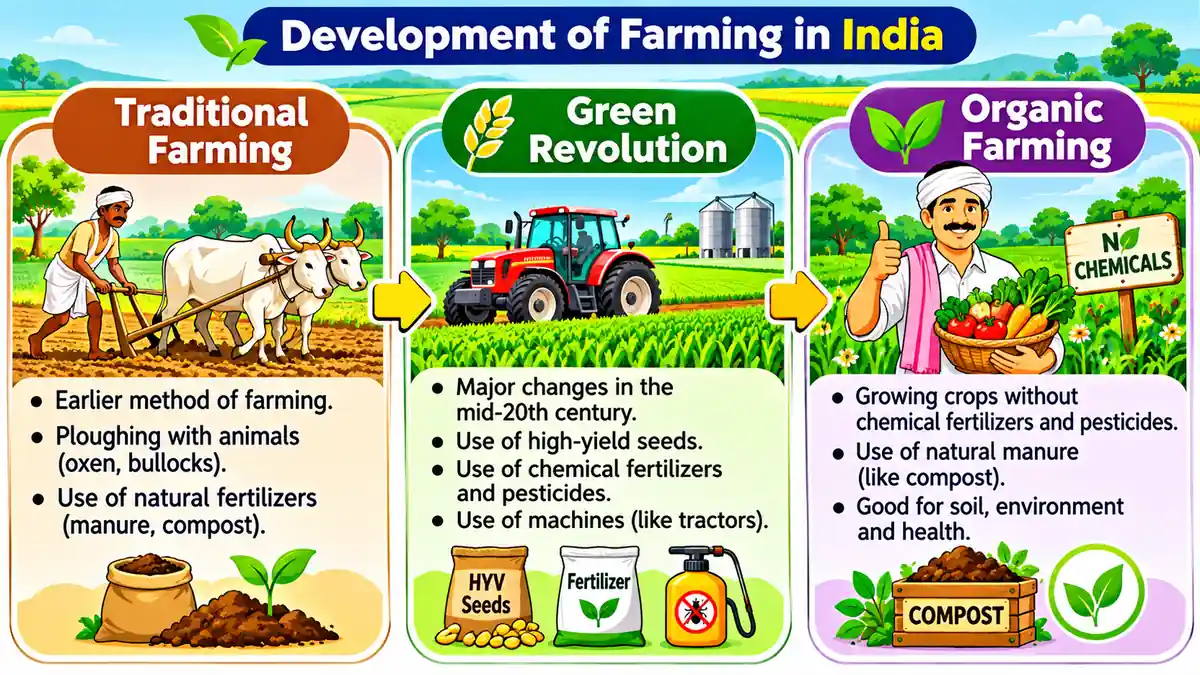
| Part of farming | Earlier | Now |
| Ploughing | Animals pulled the plough | Machines and tractors are used |
| Fertilizer | Animal manure and compost | Chemical fertilizers, along with natural manure |
| Water | Mostly rain | Canals and irrigation |
Topic 2: Food crops
Food crops are grown to meet the food needs of people and animals. Any extra can be sold. Rice and wheat are the staple foods for most Indians. A staple food is the main food eaten every day.
| Crop | What it needs | Where in India |
| Rice | Plenty of water. Two to three crops a year where water is enough. | Northern plains, Assam valley, coastal plains and parts of the plateau |
| Wheat | A winter crop. Needs a cool, dry climate. | Uttar Pradesh, Madhya Pradesh, Punjab and Haryana |
| Millets (bajra, jowar, ragi) | Small grains. Grow in drier regions. | Drier parts of the country |
Other food crops are potatoes, pulses (dals), fruits and vegetables.
Topic 3: Cash crops
Cash crops are grown by the farmer mainly for sale and profit, not mainly as food.
| Crop | What it needs | What we get |
| Oilseeds (groundnut, mustard, sunflower, sesame) | Grown in the Deccan Plateau and drier areas of the west | Oil for cooking and soap. The leftover matter feeds cattle. |
| Cotton | Black soil and a warm, dry climate | Fibres from the cotton boll, used to make cloth |
| Sugar cane | Warm climate and enough water | Sugar, made from its juice in factories |
| Jute | Hot, damp climate. Mostly grown in West Bengal. | Fibre for bags, carpets, fabric and ropes |
| Tea | Warm, humid climate. Grown on well-drained hill slopes, because tea cannot grow in standing water. | Tea leaves. Assam and West Bengal are the main tea-producing states. |
| Coconut | High temperature and plenty of rain all year | Every part of the tree is useful. Grown mostly along the coast of Karnataka, Kerala and Tamil Nadu. |
Topic 4: Animal husbandry and the challenges of farming
Animal husbandry is also a branch of agriculture. It has three parts:
- Livestock rearing: Livestock means animals kept on a farm for their meat or milk. In India, the main animals are cows, buffaloes, goats and sheep. Cows and buffaloes are kept for milk. India is the topmost milk producer in the world.
- Poultry farming: Raising domestic birds such as hens, chickens, ducks, geese and turkeys for meat, eggs and sometimes feathers. Feathers are used to line jackets and blankets to keep warm.
- Aquaculture: Farming water creatures such as fish, shrimps, prawns, crabs and oysters in a controlled environment. They are bred in suspended water cages or barricaded coastal waters.
Challenges faced by farmers:
- Too many chemicals reduce natural soil fertility and leave traces in food.
- Growing crops again and again, without rest, stops the soil from renewing itself.
- Cutting down trees causes soil erosion and climate change. Dumping waste pollutes soil and water.
- Traders may not pay farmers a good price.
Solutions: Improved seeds, new farming methods, technology, weather forecasting, education and government schemes help farmers.
🖼️ C · Picture Cards (8)
Each card shows one big idea. The second line is the key idea to remember.
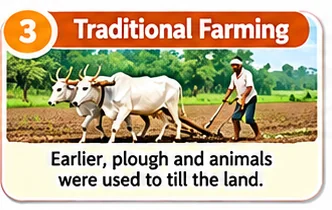
1 · Traditional farming
Animals plough the field; farmers use manure and depend on rain.
Key idea: Old methods used animals and natural manure.
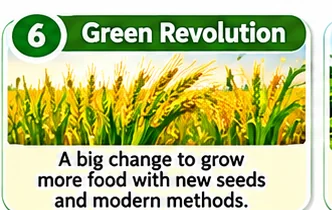
2 · Green Revolution
New seeds, machines, canals and fertilizers helped farmers grow more food.
Key idea: More food from new seeds and modern methods.
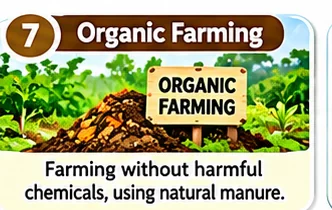
3 · Organic farming
Farming without artificial chemicals, using natural manure like compost.
Key idea: Natural manure, no harmful chemicals.
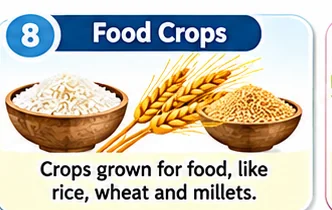
4 · Food crops
Rice, wheat and millets are grown to feed people and animals.
Key idea: Food crops are for eating.
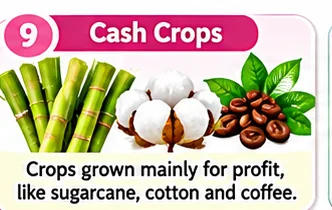
5 · Cash crops
Sugar cane, cotton, tea and jute are grown mainly for sale and profit.
Key idea: Cash crops are grown to sell.
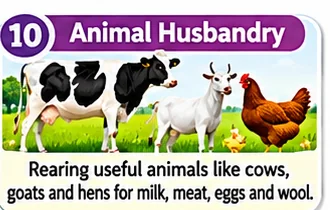
6 · Livestock
Cows and buffaloes are kept for milk. Goats and sheep are also common.
Key idea: Livestock give us milk and meat.
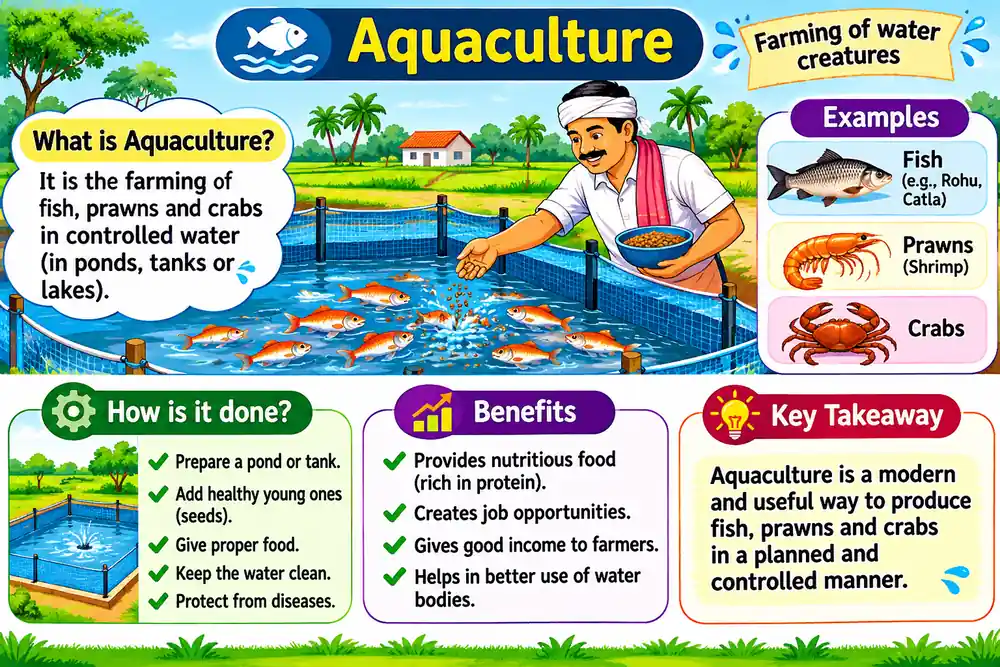
7 · Aquaculture
Fish, prawns and crabs are raised in controlled water.
Key idea: Farming of water creatures.
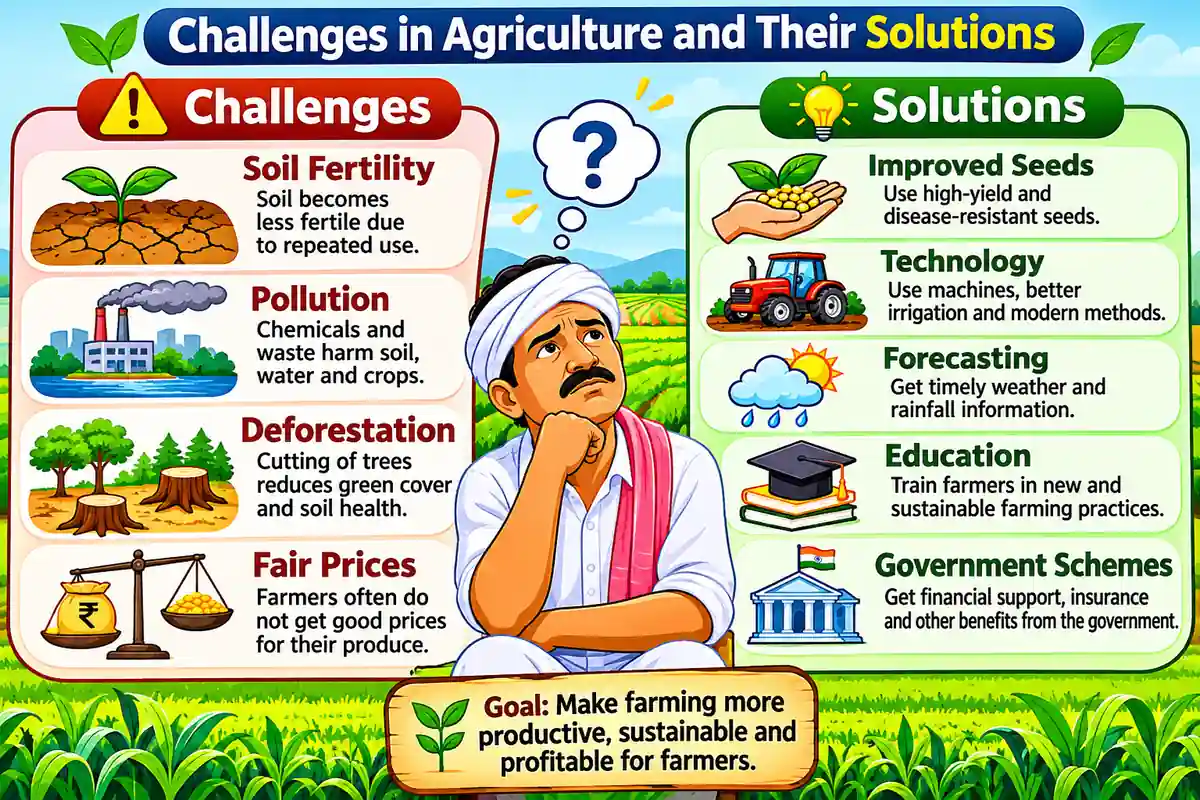
8 · Challenges
Chemicals, waste, deforestation and unfair prices make farming hard.
Key idea: Farmers need care, good seeds and fair prices.
🧠 D · Mind Map
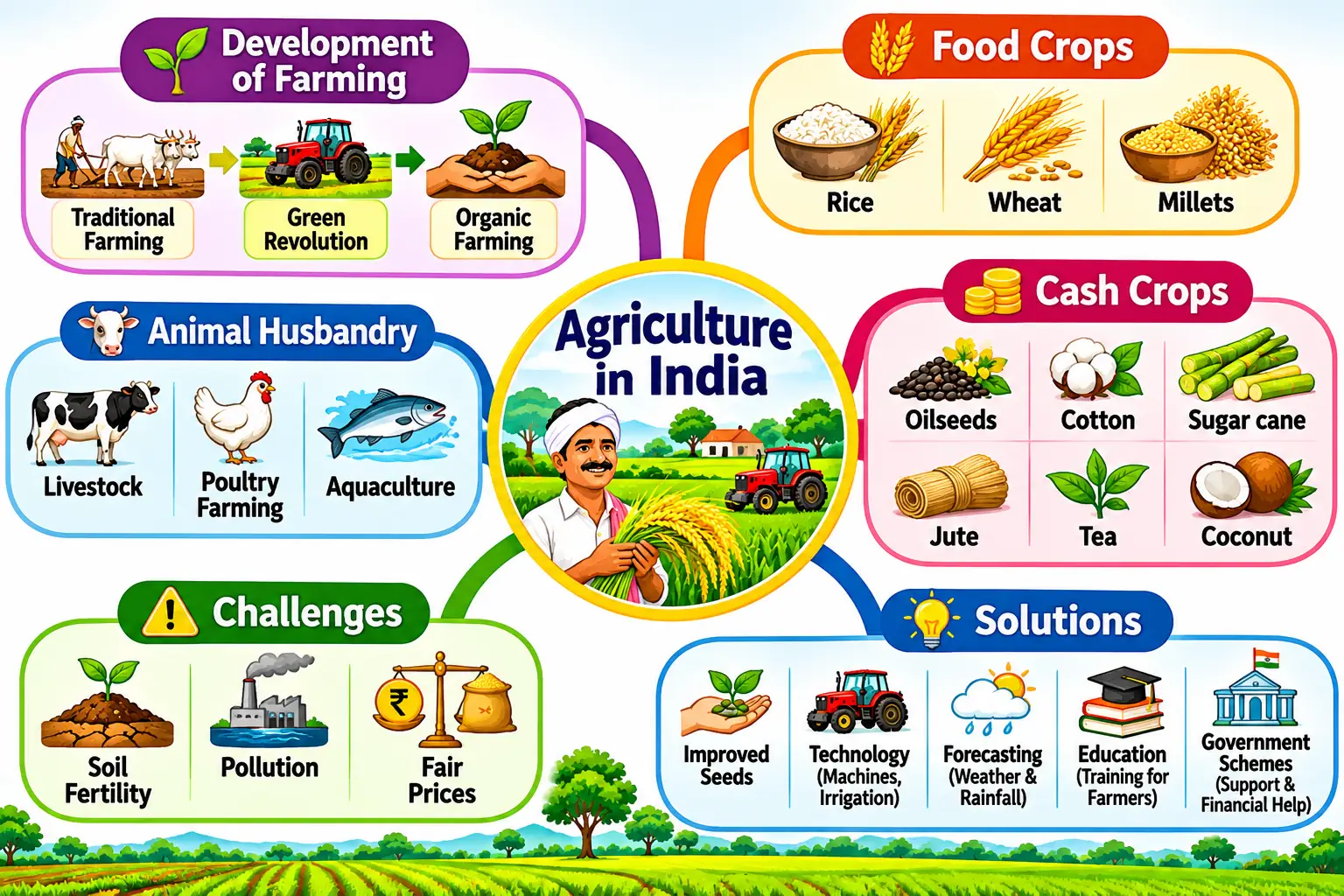
The same mind map in words:
Traditional → Green Revolution → Organic
Rice · Wheat · Millets
Oilseeds · Cotton · Sugar cane · Jute · Tea · Coconut
Livestock · Poultry · Aquaculture
Soil fertility · Pollution · Fair prices
Outline:
- Agriculture in India
- Development of farming: traditional, Green Revolution, organic
- Food crops: rice, wheat, millets
- Cash crops: oilseeds, cotton, sugar cane, jute, tea, coconut
- Animal husbandry: livestock, poultry farming, aquaculture
- Challenges: soil fertility, pollution, deforestation, fair prices
- Solutions: improved seeds, technology, forecasting, education, government schemes
🃏 E · Flash Cards (20)
Tap a card to see its meaning.
1 · Agriculture
Growing crops and rearing animals for use by human beings.
2 · Harvest
To gather crops when they are ripe.
3 · Plough
To dig and turn over the soil in a field.
4 · Fertilizer
A substance added to soil to make plants grow well.
5 · Manure
Waste matter from animals, spread over or mixed with soil to help plants grow.
6 · Compost
A mixture of decayed plants and food that is added to soil to help plants grow.
7 · Irrigate
To supply water to land so that crops will grow.
8 · Organic farming
Farming methods that do not use artificial chemicals.
9 · Green Revolution
Big changes in farming in the mid-20th century that helped farmers grow more food with new seeds and modern methods.
10 · Food crop
A crop grown to meet the food needs of people and animals, such as rice.
11 · Cash crop
A crop grown mainly for sale and profit, such as cotton or tea.
12 · Staple food
The main food that people eat every day, such as rice or wheat.
13 · Millets
Food crops with small grains, such as bajra, jowar and ragi.
14 · Oilseed
A seed from which oil is extracted, such as mustard or groundnut.
15 · Boll
The part of the cotton plant that contains the seeds.
16 · Livestock
Farm animals kept for their meat or milk, such as cows and goats.
17 · Poultry farming
Raising domestic birds such as hens and ducks for meat, eggs and feathers.
18 · Aquaculture
Farming water creatures such as fish and prawns in a controlled environment.
19 · Barricade
A line of objects placed across an area to stop people from getting past.
20 · Forecast
A statement about what will happen in the future, based on information available now.
🔍 G · Case Studies (5)
Read each story, think about the questions, then tap to see the answers.
Sunita’s dry land near Nashik
Sunita is a farmer in a village near Nashik. Her land gets very little rain, and she does not have a well nearby. Her neighbours grow rice in wet fields, but Sunita knows that rice needs much more water than she has. She wants to grow a grain that can survive in dry weather, so that her family has food every day. Her teacher suggested that she read about dry-land crops in her textbook and talk to the village agriculture officer.
Questions:
- Is rice a suitable crop for Sunita’s dry land? Why?
- Which group of grains could Sunita grow? Name three of them.
- Which type of crop is this: food crop or cash crop? Why?
- Name one step Sunita could take to get water for her crops.
- Why does a farmer in a dry area need to plan crops carefully?
Tap to see the answers
- No. Rice needs plenty of water, and Sunita’s land is dry.
- Millets such as bajra, jowar and ragi. The textbook says millets grow in drier regions.
- A food crop, because the grains are eaten by her family.
- Any one of: digging a well, building a small pond, or using canal water if it is nearby.
- Because water is limited, so the farmer must choose crops that need less water.
Gurpreet’s winter field in Punjab
Gurpreet farms in Punjab. In the cool, dry winter, he prepares his fields. He uses a tractor to plough the land and a canal to water it. He sows a crop that is the main food of many people in his state. When the golden ears are ripe, he harvests them with machines. His grandfather says that farming was much harder when they used only bullocks and rain. Gurpreet is happy, because his wheat will feed his family and sell well in the market.
Questions:
- Which winter crop is Gurpreet growing?
- Why is this crop suitable for a cool, dry winter?
- Name two modern methods Gurpreet uses on his farm.
- Which other states, besides Punjab, grow this crop in large amounts?
- What does the word “harvest” mean in this story?
Tap to see the answers
- Wheat.
- Wheat needs a cool, dry climate, as the textbook says it is a winter crop.
- Any two of: tractor for ploughing, canal water for irrigation, machines for harvesting.
- Uttar Pradesh, Madhya Pradesh and Haryana.
- To gather the crop when it is ripe.
Ravi’s cotton and groundnut farm in Gujarat
Ravi has a field of black soil in Gujarat. The weather is warm and dry, so he chooses cotton as his main crop. He also grows groundnut on a small part of the land. After the groundnut is pressed, the leftover matter is given to his cows. Ravi sells the cotton to a trader in the market. He keeps records of his sales, which help him plan next season’s crops. His friend in the village grows only rice, so Ravi is trying a different mix.
Questions:
- Which cash crop does Ravi grow on his black soil?
- What is the name of the part of the cotton plant that contains seeds?
- Groundnut is an oilseed. What product is taken from it?
- What does Ravi do with the leftover matter after pressing?
- Why is cotton called a cash crop?
Tap to see the answers
- Cotton.
- Boll.
- Oil, used for cooking and for making soap and other products.
- He feeds it to his cows.
- Because it is grown mainly to sell and earn profit, not as food.
Anjali’s coconut and tea garden in Kerala
Anjali’s family owns a coconut farm along the coast of Kerala. The weather there is hot and rainy all year. Her father says that every part of the coconut tree is useful. The trunk, leaves, shells, fibre and fruit can all be used. Higher up in the hills, her uncle grows tea on a slope where rainwater runs away quickly, so the plants do not stand in water. Anjali helps her family dry the coconut fibre every week. Her cousin plans to study agriculture when he grows up.
Questions:
- Name two cash crops in this story.
- Why does coconut grow well in Kerala?
- Name two useful parts of the coconut tree.
- Why does tea grow on a slope and not in a low, wet field?
- Name one other state where coconut is grown, besides Kerala.
Tap to see the answers
- Coconut and tea.
- Because coconut needs high temperature and plenty of rain all year.
- Any two of: trunk, leaves, shells, fibre, fruit.
- Tea cannot grow in standing water, so water must drain away from the plant.
- Karnataka or Tamil Nadu.
Mohan’s family farm near Ratnagiri
Mohan’s family lives near the coast of Ratnagiri in Maharashtra. They keep a cow and a buffalo for milk, and a few hens for eggs. Behind their house, they have a small pond where fish are bred in safe, enclosed water. Mohan’s mother sells the extra milk and eggs in the village. The family says they are happy with this mix of farm work. They also plan to learn about organic farming next year, so they can use natural manure in their garden.
Questions:
- Name the two animals kept for milk.
- Which part of animal husbandry do the hens belong to?
- What is the fish farming called?
- Why are the fish kept in enclosed water?
- Name the three parts of animal husbandry that are shown in this story.
Tap to see the answers
- A cow and a buffalo.
- Poultry farming.
- Aquaculture.
- So that the fish stay safe and live in suitable conditions.
- Livestock rearing, poultry farming and aquaculture.
✅ Section H: Quiz
25 multiple-choice questions. Choose one answer for each question. You get your score and an explanation for every question.
Start the quiz ➜🎉 Well done!
You have learnt how farms grow food and cash crops, and how animals and fish help people. Keep looking at the farms and food around you.